
Solar Industry's Bright Future
The solar industry has evolved into one of the key investment fields worldwide, and market forecasts continue to project double-digit growth for the coming years.
June/July 09
The production of solar photovoltaic (PV) modules and components is now an industry with an annual market volume of more than $20 billion (2008). Manufacturing is no longer dominated by small start-ups and university spin-offs. Instead industry leaders with global standing, such as Q-Cells, REC, or First Solar have emerged. Additionally, established large corporations like GE, Sharp, and Intel are increasingly active in the field or have recently entered into this highly attractive business.
Given the strong medium- and long-term fundamentals of the solar industry, companies will continue to expand their capacities, invest in new production sites, and establish a truly global footprint. This results in excellent prospects for individual regions to position themselves as manufacturing locations of choice.
Leading companies have started to establish manufacturing locations in each of the three current main regions - America, Asia-Pacific, and Europe - to fully cover the global market and optimize their cost structure as the industry becomes more and more competitive.
Challenges for PV Manufacturers
PV manufacturers are currently faced with an increasing geographical diversification of their industry: Dependency on a small number of (heavily subsidized) core markets is decreasing, and market growth is taking place on an ever-wider scale. This means companies will have to choose their locations in a geographically fragmented market, with many centers of growth in almost all parts of the world.
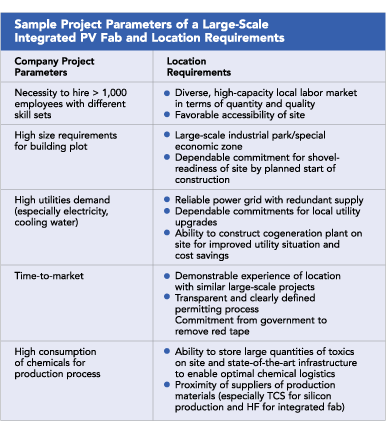
Like sales markets, companies themselves are also changing. Founder-managed companies are turning into medium-sized enterprises, and established market participants are going public. This naturally influences the decision-making process and the formulation of corporate strategy. In addition, the scale of investment projects in photovoltaics is also constantly increasing. Whereas, until recently, the manufacturing process was fragmented into the various steps in the value chain (silicon, wafers, cells, modules), and corresponding investment amounts for each individual project were relatively small, the industry is quickly turning to a more and more integrated production process, with larger volumes and projects now easily reaching several hundred millions of dollars in investment and the creation of at least a few hundred jobs.
Increasing Demands on Locations
As a result, the demands on respective locations, especially in terms of labor availability and infrastructural development, have also increased to such an extent that it is considerably harder for a potential site to meet all the criteria and, thus, for an investor to implement a project without incurring problems and risks. Alongside technical innovations in products and production processes, finding an optimal location for new production facilities represents a major strategic aid for PV companies to confront the increasing cost pressure in the industry.
For this reason, low-cost locations such as Malaysia and the Philippines have benefited from major PV investments in the last year or two. These two countries have become destinations for large-scale offshore solar manufacturing; this is particularly due to their existing background in semiconductors and electronics, where similar production processes are used and similar skills, suppliers, and infrastructure are needed.
But production is not always moved to the cheapest possible locations. Especially - but not only - in the thin-film sector, other factors often play a bigger role, such as the availability of skilled labor, the reliability of power supply and process materials sourcing, relative proximity to the target market, and logistical access because of the size of the products, as well as proximity to equipment suppliers. These are some of the reasons why thin-film investments continue to be made in locations such as Germany (Signet Solar, Sunfilm), Spain (T-Solar), and Switzerland (Pramac). Moreover, products are still far from commodization and production processes far from mature at almost all steps of the PV value chain. Innovative companies, therefore, continue to locate in established, lower-risk environments.
The choice of locations does not, however, need to be restricted to the regions that have so far been the top locations for the PV industry. The conditions and the investment environment of potential locations are in constant flux. Consequently, making a sustained investment decision involves not just backing the tried and tested, but also securing a competitive advantage from a location tailored as closely as possible to the company's own goals and requirements, as First Solar, for example, initially demonstrated in eastern Germany and then in Malaysia.
One of the main determinants of a location choice for a solar company is, of course, what it intends to produce at the new facility. The main location criteria differ considerably depending on the part of the value chain in which a company operates. This is also why sites in regions as different as Quebec, Morocco, France, Saudi Arabia, and Florida have been able to attract PV investments in recent months.
Industry Hot Spots
Although they have not yet attracted large PV investments and are still to a certain extent "insider tips," "budget options" in particular have the potential to become future hot spots for the photovoltaic industry. They offer an interesting mixture of proximity to the main markets (e.g., Mexico to the United States; the Czech Republic and Hungary to Germany; Turkey and Portugal to southern Europe), coupled with an inexpensive production environment, and yet stable and reliable general operating conditions.
Projects in the United States are profitable for foreign investors for the foreseeable future, especially in view of the low dollar exchange rate. However, the main location factor is without doubt the prospect of the United States becoming the world's largest PV market within the next few years. Growth centers for photovoltaics have already developed in California, Oregon, New Mexico, and Ohio, for example, although other states should not be overlooked as possible investment locations.
Countries and regions with cheap electricity prices - such as some Canadian provinces, Australia, and the Middle East - are principally of relevance where investments in the silicon, ingot, and wafer sectors are concerned, because of the high energy requirements involved. Although these areas are certainly of interest for individual projects, they are, however, no more likely to develop as principal locations for the industry in the next few years than pure low-cost locations with no local market at all.
Eastern Germany is likely to maintain its position as one of the most attractive investment locations for the PV industry. "Solar Valley," as it has come to be called, is the biggest of its kind in the world. Within a decade it has been established in the previously economically depressed region of eastern Germany. All stages of the value chain in production and all thin-film technologies as well as R&D institutes and equipment suppliers are represented. This acts as a powerful magnet, attracting further projects.
Out of the top four production locations throughout the world - China, Japan, Germany, and Taiwan - Germany has attracted by far the most foreign investments in the PV sector. However, partly because of the nature of the incentive programs, which grant large amounts of direct funding especially to small and medium-sized projects, the really large production volumes will, in the future, probably be realized mainly in Asia, where investors are attracted by the availability of substantial long-term tax breaks.
Ralf Segeth is senior manager of site selection, economic development, and investment promotion at Apricum. He has been instrumental in numerous projects, setting up new production facilities for worldwide clients in the clean-tech industry. Before joining Apricum, Segeth was an investment project manager for the German Industrial Investment Council and a manager at KPMG.
Recent Project Announcements
Green Fuels Operating Plans Stephens County, Oklahoma, Refinery Operations
06/09/2026
Integer Technologies Expands Baton Rouge, Louisiana, Research Operations
06/09/2026
USA Rare Earth Plans Blacksburg, South Carolina, Production Operations
06/08/2026
Kurt J. Lesker Company Expands Jefferson Hill, Pennsylvania, Operations
06/08/2026
Abastos Wholesale Expands Louisville, Kentucky, Operations
06/08/2026
Blue Origin Expands Merritt Island, Florida, Manufacturing Operations
06/06/2026
OPmobility Plans Rossford, Ohio, Manufacturing Operations
06/05/2026
General Tool Company Expands Cincinnati, Ohio, Manufacturing Operations
06/05/2026
Hyper Solutions Expands Henrico County, Virginia, Operations
06/04/2026
British-Based Abingdon Health USA Expands Madison, Wisconsin, Operations
06/04/2026
Merrell Bros Expands Kokomo, Indiana, Operations
06/04/2026
Unilever Plans New Haven, Connecticut, Innovation Operations
06/04/2026
Gelatys Establishes Fort Myers, Florida, Production Operations
06/04/2026
Jabil Plans Prince George County, Virginia, Manufacturing Operations
06/04/2026
Most Read
-
Where Workforce Capacity Is Being Built — and Where It’s Being Deployed
Q1 2026
-
40th Annual Corporate and 22nd Annual Consultant Site Selection Survey Results
Q1 2026
-
2025’s Top States for Business: How the Winners Are Outpacing the Rest
Q3 2025
-
The Workforce Bottleneck in America’s Manufacturing Revival
Q4 2025
-
What Does “Site Readiness” Really Mean?
Q1 2026
-
How AI Is Reshaping the Way Communities Compete for Investment
Q2 2026
-
Phillip Morris International Starting Building Before Plans
Q1 2026