
Regional Review: Southwest Region a Top-Ranked Global Destination for Business
The Southwest region does a stellar job of producing something that every state in the country wants desperately — job growth. Arizona, New Mexico, Oklahoma, and Texas have generated nearly 357,000 new jobs over the past 12 months. Texas is responsible for producing the lion's share of those new jobs. In fact, the state ranks number one in the country for its job creation. Texas alone added 260,800 new jobs between December 2011 and December 2012.
Location USA / April 2013
Recent FDI Announcements
Texas also is a top-ranked global destination for foreign direct investment. More than 1,300 major foreign companies have active operations in Texas. Between 2008 and 2012, more than 430 non-U.S. companies announced over 500 separate business expansions in Texas. Those projects created an estimated 46,000 jobs and $38 billion in capital investment, according to the Office of the Governor. For example, Luxembourg-based Tenaris announced in February that it would build a $1.3 billion steel pipe manufacturing facility in Matagorda County. The one-million-square-foot plant is expected to create 600 jobs. Texas certainly casts a long shadow. Neighboring states have had to work harder to capture business expansion that has been slow to rebound. Arizona has been working to cultivate key industries such as renewable energy, aerospace, and biosciences. The state also is being recognized for the growth potential in developing a vibrant technology community. The Milken Institute placed Arizona in the top 10 of technology-focused state economies.
Those accolades are helping the state attract international attention. Luxemburg-based STEALTH Software announced in February that it has selected Arizona as the site of its U.S. headquarters. The new location represents a $2 million capital investment and is expected to generate 200 high-wage jobs. STEALTH chose Arizona because of the favorable business environment and highly skilled and affordable labor pool.
Growth in the Traditional & Renewable Energy Sector
The powerful energy and renewable energy sectors are key engines for growth across the Southwest. Texas is once again at the forefront as a major center for oil and gas production and petroleum refining. Texas leads the nation in its petroleum refining and chemical products production. However, its broader energy sector, which also includes electric, coal, and nuclear power generation — as well as renewable and sustainable energy generation — contributes more than $172 billion to the Texas economy each year.
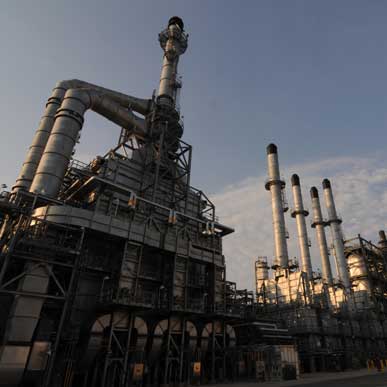
Since 2008, the largest single foreign direct investment project in Texas has been within the oil, gas and mining sector. Saudi Arabia’s Saudi Aramco and the Netherlands’ Royal Dutch Shell PLC conducted a multi-year expansion of the Motiva Enterprises refinery in Port Arthur. Completed in 2012, the refinery is now the largest in the nation.
The Southwest region is also expanding its presence in the renewable energy sector that includes solar, wind, and hydropower. "Even though activity within the sustainable energy market has cooled over the past two years, Arizona has positioned itself to attract solar energy firms," says Michael McDermott, director of Global Corporate Services at Newmark Grubb Knight Frank in Chicago. Arizona is an ideal location for manufacturing those solar components because of its close proximity to solar generation facilities, he adds.
In January, the U.S. Department of the Interior recently announced that more than 192,000 acres of land in Arizona is being dedicated to utility-scale renewable energy projects. In addition, the Interior Department also identified a third so-called solar energy zone in Arizona that is part of the Obama administration’s effort to develop large-scale projects on public lands across the West. The Agua Caliente zone in Yuma County could generate more than 20 megawatts of power.
Oklahoma has a long history in oil and gas production and currently ranks third in the country for natural gas production. In addition, Oklahoma is emerging as one of the country's top producers for wind energy. In fact, the U.S. Department of Energy predicts Oklahoma will be the second-largest generator of wind energy by 2030.
Incentives Close the Deal
Texas has a successful track record of deploying economic development programs such as the Texas Enterprise Fund (TEF) to land large corporate expansion projects. Since it was created in 2003, TEF has become one of the state's most competitive tools to recruit and bolster business. As of December 31, 2012, the TEF has invested more than $487.4 million and closed the deal on projects generating 66,094 new jobs and more than $17.4 billion in capital investment in the state, according to the Office of the Governor.
Texas and also Oklahoma have traditionally been the two most aggressive states in the region for pursuing new business with economic development incentives and programs. "Oklahoma has always been a steady-eddy where they don't see huge swings in growth," says John Lenio, a managing director in the Economic Incentives Group at CB Richard Ellis in Phoenix, Arizona. "Oklahoma has been attracting a good array of aerospace and defense manufacturing, and financial and professional services."
Aerospace is a key industry for Oklahoma. According to the Oklahoma Department of Commerce, the state employs nearly 150,000 workers with a total annual output for aerospace that exceeds $12.5 billion annually — including exports of $4.4 billion to 170 countries. The state also relies on mainstays such as manufacturing.
Swedish-based SWEP, the world’s leading supplier of brazed plate heat exchangers for use in the heat transfer industry, announced in January that it would begin operations in the Tulsa, Oklahoma, area in 2013 to support its growing customer demand. The company will initially hire 25 employees to staff the operation, with an additional 30 to 50 hires by 2015. SWEP cited Tulsa’s strong manufacturing and transportation and low energy rates as two of the key factors in the company’s decision to locate in the city.
Arizona, in particular, is pouring more resources into its economic development efforts. The state has completely overhauled its incentives over the last year. "Arizona has gone from one of the least aggressive in the region to one of the most aggressive in the region over a few months," says McDermott.
Arizona has introduced a variety of new programs and tax credits through its recently enacted Arizona Competitiveness Package. For example, its Renewable Energy Tax Incentive Program provides tax incentives to companies in the solar, wind, geothermal, and other renewable energy industries that are expanding or locating in Arizona. "They have not been very competitive over the last few years, and I think they lost enough projects that it changed minds at the state level on the role incentives play in securing a deal," adds McDermott.
New Mexico has struggled to compete for business expansion against its larger neighbors. However, the state continues to position itself as a place for aerospace and high-tech innovation. The state is even attracting global attention as the site of the first spaceport in the world that is being built from the ground-up with the intent to host the global commercial spaceflight industry. The $209 million project is nearing completion of its first phase of construction, which includes basic operational infrastructure such as an airfield, launch pads, and terminal. Spaceport America has already landed the world’s first commercial passenger "spaceline" company with Sir Richard Branson’s Virgin Galactic.
Another potential game-changer in New Mexico is a major announcement from Pegasus Global Holdings. The group plans to begin construction on a 30-square-mile mock city called the Center for Innovation, Testing, and Evaluation in Lea County, New Mexico. The project will generate some 3,350 direct and indirect jobs. Such projects align with New Mexico's strategy to draw on resources — such as its three federal laboratories, four military facilities, and a research university — as the state endeavors to become a leader in R&D and tech commercialization.
Recent Project Announcements
British-Based Abingdon Health USA Expands Madison, Wisconsin, Operations
06/04/2026
Korea-Based DUCK IL USA Expands Auburn, Alabama, Manufacturing Operations
05/30/2026
British-Based SubSea Craft Plans Virginia Beach, Virginia, Operations
05/27/2026
Italy-Based CEP USA Plans Little Rock, Arkansas, Manufacturing Operations
05/21/2026
Sandvik-Alpha Metallurgical Resources Plan Putnam County, West Virginia, Manufacturing Operations
05/19/2026
Australia-Based Trigg Minerals Plans Iron County, Utah, Refinery Operations
05/18/2026
Poland-Based Displate Manufacturing Plans Louisville, Kentucky, Operations
05/11/2026
Czech Republic-Based GHH-BONATRANS Plans Wayland, New York, Production Operations
05/05/2026
Australia-Based Syenta Establishes Tempe, Arizona, Semiconductor Development Operations
04/23/2026
Japan-Based JST Plans Guntersville, Alabama, Manufacturing Operations
04/22/2026
France-Based One Biosciences Plans Albany, New York, Laboratory Operations
04/22/2026
Taiwan-Based Apogee Power Plans Liberal, Kansas, Lithium Battery Manufacturing Operations
04/21/2026
Japan-Based SMBC Group Plans Charlotte, North Carolina, Headquarters Operations
04/20/2026
Netherlands-Based Signature Foods USA Plans Easley, South Carolina, Manufacturing Operations
04/16/2026
Most Read
-
Where Workforce Capacity Is Being Built — and Where It’s Being Deployed
Q1 2026
-
40th Annual Corporate and 22nd Annual Consultant Site Selection Survey Results
Q1 2026
-
2025’s Top States for Business: How the Winners Are Outpacing the Rest
Q3 2025
-
The Workforce Bottleneck in America’s Manufacturing Revival
Q4 2025
-
What Does “Site Readiness” Really Mean?
Q1 2026
-
How AI Is Reshaping the Way Communities Compete for Investment
Q2 2026
-
Phillip Morris International Starting Building Before Plans
Q1 2026