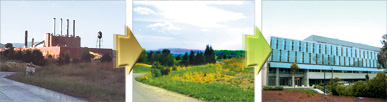
Brownfield Risks Brownfield
properties do present a significant amount of risk for the purchaser.
It is important to be aware of these risks and what actions purchasers
can take to manage them. There are three primary risk factors of which
to be aware: regulatory risks, financial risks, and human exposure.
When looking at the risks associated with brownfields, everything is
driven by the risk of human exposure.
These risks can be
measured in comparison with the type of brownfield property that is
being considered. Superfund sites pose the greatest threat for all
three of these risks, as these properties exhibit the largest amount of
contamination and are often the most costly to remediate. Petroleum
sites present the lowest exposure to these risks, as they are typically
the easiest to remediate, have a common contaminate with a proven
process for cleanup, and are the most cost-effective. Industrial
brownfield sites and FUDS tend to fall on middle ground when looking at
these risk factors.
The financial risk associated with
brownfields is driven primarily by the process needed to remediate the
site. Different remediation technologies are available for various
types of contamination. If a brownfield has contaminated soil and the
purchaser chooses to implement an excavation and removal or soil vapor
extraction of the soil, this process is available with less financial
risk than a more complicated Superfund site with greater contamination
that requires more involved technologies, engineered or institutional
controls, and long-term operation and maintenance (O&M).
Though
the risks associated with brownfields are significant, purchasers do
have key tools available to help manage these risk factors. There are a
variety of insurance products available for brownfield buyers that can
help protect them from the risks involved in remediation and
redevelopment of a contaminated property. Any brownfield buyer should
purchase pollution legal liability (PLL) insurance. This relatively
inexpensive coverage protects Brownfield purchasers from third-party
lawsuits and regulatory reopeners. This is an important shield of
protection from third-party lawsuits claiming bodily injury or property
damages from neighbors claiming harm from the pollution already
existing at the property.
Regulatory reopeners can also halt or
greatly delay brownfield redevelopment when changes in regulations,
technological advances, or the discovery of previously unknown
pollution at the site results in unexpected regulatory involvement.
Insurance protecting buyers from this is extremely important, as
unanticipated delays of this nature can mean great financial burdens
and other complications for the redevelopment of a brownfield property.
Cost
cap insurance is another policy that can protect brownfield purchasers
from the financial risks associated with remediation of a contaminated
site. Cost cap insurance manages the economic risk when the actual cost
of remediating a brownfield site exceeds the estimated cost presented
at the beginning of the project. Cost cap insurance helps brownfield
buyers handle the innate uncertainty of liability and remediation costs
associated with a brownfield project by covering the difference.
As
the process of remediation and redevelopment of brownfield sites
continues to evolve and the shortage of available land for development
forces executives to consider Brownfield sites for their projects, the
industry will continue to discover new risks and trends that will need
to be considered. Soil vapor intrusion is one relatively recent
discovery of which potential brownfield purchasers must be aware.
Contaminated
soil vapor is the air within the soil that has the capability of coming
through the floors of a building and exposing people to the
contamination. This represents a new medium that must be treated when
remediating a brownfield property. In many cases, development can begin
on a brownfield site while the remediation of contaminated groundwater
and soil is still happening. However, with vapor intrusion, the
remediation typically must be completed before development can begin,
causing a significant delay. California is one state leading the charge
to deal with the regulation of soil vapor, which has gone largely
unregulated until now. It is likely many other states will follow
California's lead to regulate this new medium of concern.
Another
risk involves lack of available sites. In many of the industrialized
regions with the greatest land shortage, a majority of the
petroleum-contaminated brownfield sites have already been redeveloped.
This leaves buyers with fewer options that tend to fall into the
larger, more complicated categories for purchase. These sites require
greater cooperation between the developer, regulators, and legal
instruments to help acquire and successfully remediate and redevelop
these sites back to productive use.
Brownfield Advantages Brownfield
projects do have advantages as well as risks. Due to the risks involved
and the challenges faced by firms looking to remediate a site, the land
is often available for purchase at a significant discount. Brownfield
properties are well-suited for industrial developments or straight
retail, as opposed to residential or institutional. When the intended
use for the property does not involve tenants living at the property 24
hours a day, the extent of the cleanup is limited and can mean a faster
turnaround time to remediate and redevelop the property.
Today,
the potential buyer of a brownfield property has many tools available
to help navigate the complicated landscape of remediation and
redevelopment. Arming themselves with a thorough understanding of the
legal advancements, nature of the properties on the market, and
potential risks and management of those risks can ensure that the
investment in a brownfield project will yield a good land basis that
improves the bottom line.
Curtis
Slocum is a development specialist and brownfield expert with Voit
Development Company, a commercial real estate development firm
headquartered in Newport Beach, California. Voit Development Company
has developed and acquired projects comprising of more than 24 million
square feet of space with aggregate values in excess of $2 billion.
Visit the company's website at (949) 644-8648 or online at www.voitco.com.
|