A "High-Tech, High-Touch" Approach to Construction Management
Contractors who engage in open communication and rigorous problem-solving and owners who view their contractors as trusted advisors are much more likely to achieve successful projects.
August 2012
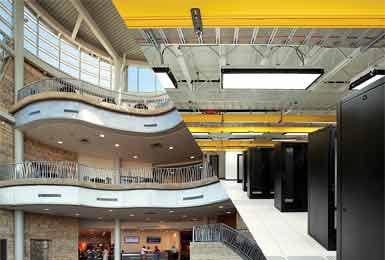
With that in mind, owners like the City of Manhattan, Kansas, and the General Services Administration (GSA) were seeking contractors who focus on areas of project management that seem obvious, but are often rare: trustworthiness, problem-solving, communication, and total satisfaction.
The regional contractor selected as construction manager by both owners, McCownGordon, had long ago recognized a severe limitation - project managers and executives of construction companies are primarily focused only on the technical details of getting a project built, a one dimensional approach. Instead, McCownGordon identified a palette of human skills for construction managers that places the client's objective as primary, as well as including a masterful grasp of the requisite technical knowledge. This blend of human and technical might be thought of as a "high-tech, high-touch" approach. Communication
The establishment of clear channels of communication has proven to be one of the biggest challenges faced by contractors in their working relationship with owners. It is only when communication is complete, accurate, and transparent that an owner/contractor relationship based on trust, rather than on narrow self-interest, can develop.
The stage was set for this type of relationship from the beginning of the Flint Hills Discovery Center (City of Manhattan) and the USDA Data Center (GSA) projects. By organizing and mandating full project team meetings with the owner, architect/engineer, contractor, and subcontractors at the onset, and encouraging a problem-solving approach, an atmosphere of frank communication was created early - in stark contrast to the adversarial relationship that can often develop on many projects. This ability to explore, discuss, and ultimately resolve issues extended to every aspect of the project: cost, schedule, design, and technical questions. With time, a bond of solid trust was established; each member of the team, from owner to lowest tier subcontractor, was committed to the overall success of the project as defined by the owner. The contrast between this approach and the more common "profit at any cost" attitude could not have been greater.
Solutions
Every construction project is faced with challenges; it is how they are tackled and resolved that makes the difference between a successful job and one that leaves an owner dissatisfied. The all-too-human temptation to paper over a problem, shift blame elsewhere, or sacrifice quality for short-term profitability is deadly to a building project's success. In both the Flint Hills and USDA projects, the contractor, McCownGordon, clearly identified that open, collaborative, non-judgmental problem-solving would be the only method permitted on the project. That expectation was conveyed to every member of the project team at every team meeting.
Due to the unique design of the Flint Hills Discovery Center, structural steel and glazing proved to be the major technical challenge. Comprised of many curved structural members and intricate glass shapes, the lobby of the building was complex and had the greatest potential to negatively impact the schedule. Alone, this portion of the building was so technically difficult that the entire project could have been derailed.
Recognizing that the glass cylinder was central to the architectural concept and highly desirable to the city, the contractor proposed a solution that included subcontractor and vendor cooperation. Instead of ordering all structural steel at once, as is customary, standard steel members, which comprised 90 percent of the building, were ordered initially, while the shop drawings of the cylinder lobby's steel was refined and finalized and then ordered separately. The overall construction schedule was not impacted, while the more complex curved steel received the additional attention needed.
The USDA Data Center was originally planned in three construction phases: mechanical/electrical, the new data center, and renovations to the then-existing data center. However, as the preconstruction work on the center began, the contractor came to a startling conclusion: many aspects of the three phases could be performed simultaneously and thereby create significant cost savings. Presenting this alternative phasing approach to the GSA, McCownGordon demonstrated where the overlap could occur. The GSA was sold on this approach when McCownGordon committed to returning the savings realized to the GSA budget.
These simple solutions could not have been reached without the thorough communication channels developed on the project. Had the contractor not identified why the museum's steel was complex or how the data center phasing could be overlapped, schedules and cost would have certainly been impacted. Furthermore, an enlightened and engaged owner was necessary to bring about this kind of collaborative approach. It sounds obvious, but the more open the owner/contractor relationship is, the greater the facility exists to resolve potential challenges. With both the city and the GSA, the contractor did this by bringing every party to the table and over-communicating. Like anything else, the more problem-solving and communication that occur, the better the team gets at the "high-tech, high-touch" approach.
Cost, Schedule, and Quality
The three variables of every project - time, cost, and quality - are on every builder's mind on every project. Today's "high-tech, high-touch" contractors are challenged to consider those variables outside of the traditional "owner versus contractor" posture. The contractor who adopts the long-term, client-driven view and the owner that seeks a contractor as a trusted advisor will realign the project delivery team into a cohesive whole that shares the same time, cost, and quality objectives. The old formula with owner and contractor fixed in a zero-sum equation - one party must sacrifice in order for the other's success - becomes obsolete.
The contractor recognized that the city's cost, schedule, and quality needs had to be met; in return, the City of Manhattan understood McCown-Gordon's need for a profitable project. Getting to that understanding required openness, communication, and trust that formed the core of the relationship from the project's inception. The GSA recognized McCownGordon's ability to compress construction phasing, and the contractor understood the sensitiveness of federal budgets. Owners, like everyone else, want to minimize their risk, and contractors who are attuned to this become poised to maximize their own success.
Preconstruction
The "high-tech, high-touch" contractor is aware its services are not limited to just the construction of the project. The contractor can be a trusted advisor, and as such an advisor, it can perform the highly detailed preconstruction services that are necessary for a complex building. While these services do not supplant the owner's in-house staff, the architect/engineer team, or subcontractors, they augment and mesh with the entire team, creating a finely tuned approach to design and construction. Fortunately, the owners of both projects cited herein had realized that alternative project delivery models such as design/build, construction management, and integrated project delivery could take advantage of the contractor as a trusted advisor.
A New Breed
Contractors who adopt a "high-tech, high-touch" approach, who advocate for open communication, rigorous problem-solving, and a true focus on owner needs, are in an excellent position to survive and excel in a difficult economy. Owners who view their contractors as trusted advisors and not adversaries are much more likely to achieve successful projects. This new breed of owner/contractor teams - built on communication, trust, and problem-solving - will build solid relationships and ultimately ensure on-time, on-budget projects of lasting quality.
Project Announcements
Apex Plastics Opens Expanded Production Plant In Brookfield, Missouri
09/22/2014
Japan-Based Bridgestone Rubber-BSA Opens Biorubber Process Research Center In Mesa, Arizona
09/22/2014
SpencerARL Expands Its Plattsburgh, New York, Manufacturing Facility
09/22/2014
Hill International, Inc. Relocates Corporate Headquarters To Philadelphia, Pennsylvania
09/22/2014
Prysmian Group Plans $8.2 Million Expansion At Abbeville County, South Carolina, Manufacturing Center
09/22/2014
Japan-Based Kowa Kentucky Plans $8.3 Million Manufacturing Facility In Corbin, Kentucky
09/22/2014
Most Read
-
2023's Leading Metro Locations: Hotspots of Economic Growth
Q4 2023
-
2023 Top States for Doing Business Meet the Needs of Site Selectors
Q3 2023
-
38th Annual Corporate Survey: Are Unrealized Predictions of an Economic Slump Leading Small to Mid-Size Companies to Put Off Expansion Plans?
Q1 2024
-
Making Hybrid More Human in 2024
Q1 2024
-
Manufacturing Momentum Is Building
Q1 2024
-
20th Annual Consultants Survey: Clients Prioritize Access to Skilled Labor, Responsive State & Local Government
Q1 2024
-
Public-Private Partnerships Incentivize Industrial Development
Q1 2024