Which Talent Sourcing Strategy Is Right for Your Company - and Its Location?
Carefully aligning your company’s talent sourcing strategy with its choice for a new facility location will result in a successful investment decision.
Q2 2019
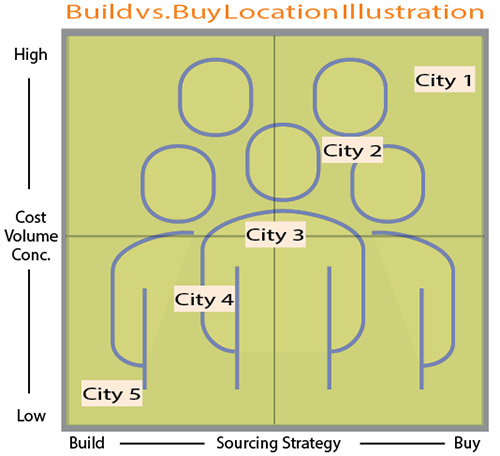
When considering a new location, knowing how markets may enable recruiting goals will help increase chances for success. Talent sourcing strategies include “build” and “buy” scenarios: “Build” strategies include locations where a company can hire trainable workers in the labor force, recruit from local and regional schools, and attract people from outside the region. “Buy” scenarios are supported when new hires have applicable industry experience. Combinations of both approaches are common.
Differences in Location Decisions
Every organization is unique, even ones in the same industry. Each company chooses to compete for talent in different ways, resulting in different operating locations. As an illustration of location choices in this context, three sample cases are summarized below:
Pharmaceutical Research & Development — A drug company’s workforce needs were evolving in response to business model changes. The company historically relied on a smaller employee base heavily weighted to research and discovery, with a smaller number of people focused on clinical trials and product commercialization. As business strategies evolved the company anticipated (1) continued innovation, (2) rapid workforce growth to support clinical trials, and (3) greater need for commercialization skills.
The status quo of operating in a smaller market that had limited relevant industry activity, but with a respected university that supplied talent when rare turnover occurred, was no longer tenable. The company weighed benefits and risks between locations and opted to expand in a location that boasted both respected universities with applicable programs as well as a mature clinical trial industry, and also an active startup life science community that was generating new ideas. A “buy” strategy was key and the location choice was a metropolitan area in the mid-Atlantic region.
Information Technology Services — An information technology services company’s existing situation of operating in high-cost locations risked the ability to win future contracts, and their distributed operation created inefficiencies while servicing accounts. The company’s objective was to consolidate applications development and network operations to improve efficiency and gain a competitive pricing advantage in a new location.
The company clearly defined unique workforce skills of the future, evaluated locations throughout the United States, and settled on a location with market attributes that aligned with the chosen “build” strategy. The solution consisted of slow and steady workforce growth in a low-cost, smaller talent market with local and regional colleges engaged to create a long-term talent pipeline. Recruiting efforts were buoyed by the university system’s commitment to increase graduate output from computer science related disciplines. Additionally, state government contributed significant dollars to incentivize the implementation. The location choice for this “build” strategy was a small metropolitan area in the U.S. South-Central region.
When considering a new location, knowing how markets may enable recruiting goals will help increase chances for success. Loan Servicing — A financial services organization needed to choose one or more locations to enable growth for servicing routine loans (general inquiries and counseling) and complex loans (work-outs and modifications).
The company’s existing situation consisted of a distributed operation across three locations, one of which had well above average talents costs and cost of living. The primary goal for the business was to reduce cost without sacrificing talent knowledge and expertise.
For the routine processes, the company could train new hires up with a minimal amount of customer service or retail experience. For the complex function, the business preferred hiring people with knowledge of the loan servicing industry, often with experience with a specialty (default, foreclosure, etc.). Indicators for locations considered illustrated clear tradeoffs associated with talent market cost and the presence of a mature loan servicing industry. Locations that performed well for one function did not always perform well for the other. After much deliberation, a “buy” strategy was pursued and a consolidation of the two functions ended up in a metropolitan area with moderate costs and a mature industry in the U.S. Southwest region.
These three cases illustrate the influence of talent sourcing and how different business location decisions can be. What is common among each was a robust decision process.
The variability of “build” and “buy” talent sourcing strategies is high because all companies are unique in some way. Location Considerations for Executives
Risk of a poor location decision — For many companies, the workforce typically represents 70 percent to 80 percent of an organization’s structural cost. This fact alone draws significant focus to talent-related decisions, but there are significant risks beyond base wage costs that organizations face with poor location decisions.
For example, insufficient location evaluation can place companies in areas that are too competitive creating high levels of turnover and wage pressure. And decisions based solely on general population metrics or wage rates can result in shallow depth of talent pool or misaligned skillsets to ramp up or sustain workforce demands, which can have a direct impact on business growth and revenue.
To avoid these risks, it is critical to understand an organization’s talent sourcing strategy and its alignment with different talent markets by asking the right questions.
Decision framework — There is an overall framework that supports location decision-making. There are many questions and considerations to be addressed in the decision process and ones related to talent access, talent pipeline development, cost, and timing associated with a workforce buildup are consistent across organizations. The answers help solidify a talent sourcing strategy and identify locations that best enable it.
The variability of “build” and “buy” talent sourcing strategies is high because all companies are unique in some way. Thus, planning to compete for talent in a new location requires thoughtful, often creative, solutions. As organizations face these decisions, their chosen recruiting approach can influence their choices. Since there is no “one best place” for all businesses, careful consideration of talent sourcing and location alignment will result in successful location investment decisions. The question is, which strategy is right for your business?
Recent Project Announcements
TurbineOne Establishes Old Town, Maine, Innovation Operations
09/18/2026
Tampa Brass & Aluminum Expands Tampa, Florida, Headquarters Operations
09/18/2026
Toyotetsu Mid America Expands Owensboro, Kentucky, Operations
09/17/2026
Mayo Clinic Laboratories Plans Southaven, Mississippi, Operations
09/16/2026
V&S Schuler Tubular Products Expands Muskogee, Oklahoma, Manufacturing Operations
09/15/2026
Germany-Based Stöbich Fire Protection Systems Expands Dorchester County, South Carolina, Manufacturing Operations
09/14/2026
Black Bayou Energy Hub Expands-Plans Lafayette-Cameron Parish, Louisiana, Natural Gas Operations
09/14/2026
General Atomics Expands Shannon, Mississippi, Manufacturing Operations
09/14/2026
AirPro Expands Rhinelander, Wisconsin, Operations
09/13/2026
Moog Expands West Valley, Utah, Production Operations
09/13/2026
KIHOMAC Expands Davis County, Utah, Operations
09/13/2026
Spot & Tango Expands Upper Macungie Township, Pennsylvania, Production Operations
09/13/2026
Arvaya AI Automations Consulting Plans North Charleston, South Carolina, Operations
09/13/2026
SHEIN Establishes Lebanon, Indiana, Fulfillment Operations
09/13/2026
Most Read
-
The Shifting Landscape of Location Strategy
Q2 2026
-
Power Is the New Gatekeeper in Manufacturing Site Selection
Q2 2026
-
Avoid These Red Flags, Deal Killers, and Blunders in Site Selection
Q2 2026
-
Site Readiness Is Broken: What Manufacturers Should Demand From Their Locations
Q3 2025
-
What Site Selectors Discuss After the Site Visit Ends
Q3 2026
-
Why Relationships Still Win Projects in Site Selection
Q3 2026
-
21st Annual Shovel Awards: The American Industrial Economy Remade in Real Time
Q2 2026