
The Department of Energy's Role in Promoting Green Projects
Which kinds of projects are benefiting, and how many permanent jobs are they expected to create?
September 2010
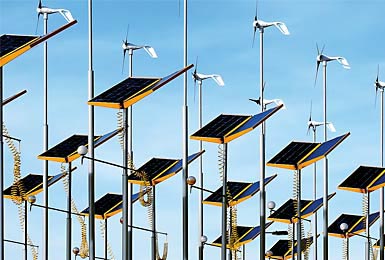
The Department of Energy (DOE) has recently completed an aggressive round of loans and grants to companies producing emerging technology for the clean-energy sector. From producers of solar panels to manufacturers of lithium ion batteries, companies are expanding plants and creating jobs at an accelerated pace across the country as a result of the DOE's targeted investments. And while communities celebrate the expansions - holding ribbon-cuttings and, in some cases, even hosting President Obama for the festivities - it remains to be seen if the companies expanding their operations will find sustainable markets for their products.
Projects in Motion
Financial support for projects comes in the form of outright grants or loan guarantees. The DOE is currently offering loan guarantees worth a total of $750 million in each of the following categories:
• Geothermal Energy
• Wave/Tidal
• Hydropower
• Wind
• Solar
In total, the DOE has made more than 70 awards, totaling $2.5 billion. Some of the biggest projects put in motion by DOE funds have included:
• A massive new concentrated solar power facility, covering 1,900 acres of the Arizona desert, where Abengoa Solar will use 900,000 mirrors to supply electricity to the Arizona Public Service Company. The project got financing with the help of a $1.45 billion grant from the DOE, and will create 5,100 construction jobs.
• An expansion of facilities in Loveland, Colorado for Abound Solar, which plans to add 1,200 new high-tech jobs in the manufacture of low-cost, cadmium telluride, thin-film photovoltaic solar modules. Abound received a DOE loan guarantee of $400 million on top of $200 million in venture capital that it was able to raise on its own.
• A new facility in Brownstown Township, Michigan, where General Motors will produce lithium ion batteries for use in supplying the electric GM vehicle known as the Chevy Volt. GM got a DOE grant of $105 million for the project.
• A new facility in Holland, Michigan, where Compact Power, Inc. will build battery cells to supply to GM in Brownstown. A DOE grant of $115 million helped pay for workers as well as battery components and supplies.
• A new facility in Kokomo, Indiana, where Delphi will manufacture power electronic components. The facility was funded in part by an $89.3 million grant from the DOE.
• A major expansion for Celgard LLC in Charlotte, North Carolina, where the company will expand its capacity for the production of separators, a key component in lithium ion batteries. The Charlotte expansion is the first of two phases. The second phase will include the construction of a new facility in Concord, North Carolina. The total cost of the two phases is projected to be $100 million, of which the DOE is contributing $49 million. A Robust Supply Chain
Mitch Pulwer, general manager of Celgard LLC, said the company sought to participate in the DOE program for two reasons.
"First, Celgard is the only significant battery separator supplier developing, manufacturing, and selling products here in the United States," Pulwer said. "And second, we believe that the DOE recognizes that if the United States is to have a vibrant domestic electric-drive-vehicle (EDV) industry, there needs to be a focus on a robust supply chain that includes critical component suppliers such as Celgard."
Celgard expects to supply all major producers of electric drive vehicles with the products it develops in North Carolina. "While we don't identify specific customers, most of the significant lithium battery manufacturers are working with Celgard products, either for production of lithium batteries used in existing electric-drive vehicles or in experimental trials for future vehicles," Pulwer said. "Celgard is certainly committed to supplying lithium battery separators to the U.S. and global EDV industry today and as it grows in the future."
Particularly in the area of batteries, a DOE report asserts that its funding is bringing components to the market for the first time that are capable of working with consumer-viable products - replacing older road-enabled batteries that cost as much as $33,000 each. The lack of affordable, highly functional batteries has been a particularly high barrier to the widespread adoption of electric vehicles. When the Recovery Act passed, batteries were too costly, too heavy, too bulky, and would wear out too quickly. Recovery Act investments are literally reshaping electric batteries and reshaping the economics of battery production and distribution.
Some Criticism
The initiative has come under some criticism, however, on two fronts. One criticism involves the amount of money being invested on a per-job basis. Although the Abengoa facility will supply massive amounts of solar-generated energy to Arizona, and will even be able to store energy in order to keep the supplies running after sundown, the total cost of the loan guarantee comes out to nearly $400,000 per job, with many of these being temporary construction jobs.
And even in Michigan, which needs all the jobs it can get, some state lawmakers question the intervention of government on behalf of certain industries. In spite of the enthusiasm surrounding the Chevy Volt, for example, the car is expected to retail at a starting price of $40,000 - which makes it unlikely that it will be a big seller, at least initially.
Can all the companies gearing up their operations to supply GM for the Volt remain viable over the long term if a way isn't found to make the product more affordable to consumers? Michigan State Representative Chuck Moss (R-Birmingham) is skeptical.
"Any time the government puts its thumb on the scale for one choice or another it distorts the market," Moss said. "People make choices based on cost and perceived wants and needs. If the state passes laws that take wealth from some people and give it to others - say `green' products - it's interfered with the market. Subsidizing anything masks the true costs of a product and changes the cost calculations of consumers, diverting demand away from its natural course to the artificial market for government-preferred choices."
This is just one perspective, but perhaps it needs to be taken into account.
-
Dan Calabrese
Dan Calabrese has worked as a journalist for 25 years, with extensive experience covering business, including a tenure on staff at the Grand Rapids Business Journal and ongoing contributions to trade journals such as Transport Topics, Pet Age, DBusiness, Specialty Coffee Retailer, and Area Development. He is editor in chief of the online news and commentary site The North Star National (www.northstarnational.com) and a regular contributor to The Michigan View (www.themichiganview.com).

Location USA
Regional Review: The Plains States Enjoying Renewed Economic Health
-
Location USA
Regional Review: Pacific States Show Their Prowess in Advanced Technologies
-
Location USA
Regional Review: FDI Adds to Vitality of the Mountain States
-
Location Notebook
Location Notebook: Data Centers Betting on Nevada


Recent Project Announcements
Toyotetsu Mid America Expands Owensboro, Kentucky, Operations
09/17/2026
Mayo Clinic Laboratories Plans Southaven, Mississippi, Operations
09/16/2026
V&S Schuler Tubular Products Expands Muskogee, Oklahoma, Manufacturing Operations
09/15/2026
Germany-Based Stöbich Fire Protection Systems Expands Dorchester County, South Carolina, Manufacturing Operations
09/14/2026
Black Bayou Energy Hub Expands-Plans Lafayette-Cameron Parish, Louisiana, Natural Gas Operations
09/14/2026
General Atomics Expands Shannon, Mississippi, Manufacturing Operations
09/14/2026
AirPro Expands Rhinelander, Wisconsin, Operations
09/13/2026
Moog Expands West Valley, Utah, Production Operations
09/13/2026
KIHOMAC Expands Davis County, Utah, Operations
09/13/2026
Spot & Tango Expands Upper Macungie Township, Pennsylvania, Production Operations
09/13/2026
Arvaya AI Automations Consulting Plans North Charleston, South Carolina, Operations
09/13/2026
SHEIN Establishes Lebanon, Indiana, Fulfillment Operations
09/13/2026
Saval Foods Expands Howard County, Maryland, Headquarters Operations
09/12/2026
SteelFab Expands Fayetteville, North Carolina, Manufacturing Operations
09/12/2026
Most Read
-
The Shifting Landscape of Location Strategy
Q2 2026
-
Power Is the New Gatekeeper in Manufacturing Site Selection
Q2 2026
-
Avoid These Red Flags, Deal Killers, and Blunders in Site Selection
Q2 2026
-
Site Readiness Is Broken: What Manufacturers Should Demand From Their Locations
Q3 2025
-
What Site Selectors Discuss After the Site Visit Ends
Q3 2026
-
Why Relationships Still Win Projects in Site Selection
Q3 2026
-
21st Annual Shovel Awards: The American Industrial Economy Remade in Real Time
Q2 2026