
Advantages of Natural Light in Manufacturing Facilities
Already popular in offices and retail, natural lighting is now gaining recognition for its benefits in manufacturing settings.
Apr/May 09
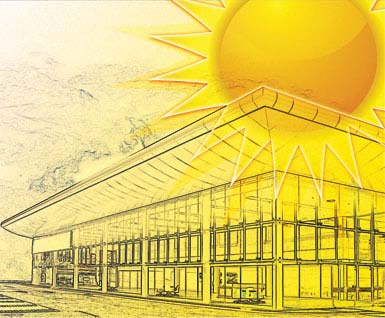
The high energy costs of manufacturing create a natural interest on the part of companies to find ways to counterbalance those costs. But the rugged structure required for a facility housing heavy manufacturing has typically led to the use of brick, steel, or concrete - usually from foundation to roof. Several factors are now changing that, though, and are starting to steer some designers and users of manufacturing facilities to the inclusion of natural light.
Bright Benefits
At East Lansing, Michigan-based Peckham Inc., a new 109,000-square-foot facility set to open this spring is replete with natural light, as much for the human resources benefits as for those of energy savings, although both are clearly factors. "Natural light was a huge component of the design on a number of levels," says Scott Vyn, the architect who led the job for Integrated Architecture of Grand Rapids, Michigan. "One of the most obvious is that natural light is healthy for you and ties you into sequences that are natural to your body. You're aware of the cycles to the day."
In the Peckham facility, Integrated designed a large light well in the middle of the building, which company officials believe does more than just provide light. (Article photos are from the facility.) They believe it helps break down the traditional corporate hierarchy. "We put a lot of emphasis on blurring the line between blue-collar jobs and white-collar jobs," says Mitch Tomlinson, CEO of Peckham. "We didn't want that division. We wanted one facility that we all kind of shared. There are very few offices and a lot of open space and natural light."
Natural light is only one of a variety of features that help make buildings more energy-efficient. The Environmental Protection Agency reports that when combined with other features - such as on-site renewable energy systems, better ventilation, downsized equipment, and light-reflective materials - natural light can contribute to energy savings of 20 percent to 50 percent. Tomlinson says he is unsure how much Peckham will save on energy costs, but believes it doesn't need to be much to pay a dividend because the overall cost of the building - about $85 per square foot - is competitive with more traditional approaches.
Tomlinson expects the natural light atmosphere to be a boon to employee morale at Peckham, which is especially important because the company embraces a primary mission of hiring people with a variety of disabilities. "We think, in order for folks to be successful, they need to have an environment that's built around their need for natural support, if you will," he says. "I think our data proves it - that if that environment exists where they can learn and adjust to have the support they need to be successful, they can be as competitive in the labor market as anybody else."
The defense contractor Lockheed Martin reports that a design modification at its Sunnyvale, California, facility that increased daylight and fresh air resulted in a 15 percent drop in absenteeism, a result consistent with the U.S. Green Building Council's (USGBC) assertion that even a 1 percent increase in employee productivity can generate a positive economic impact equal to four times the company's entire energy bill. In a summary of Lockheed Martin's findings in a 2008 LEED newsletter, the USGBC said, "On average, annualized costs for personnel amount to $200 per square foot - compared with $20 per square foot for bricks and mortar and $2 per square foot for energy. A modest investment in soft features, such as access to pleasant views, increased daylight, fresh air, and personal environment controls, can quickly translate into significant bottom-line savings."
Natural light also provides manufacturers with points toward certification under the USGBC's Leadership in Energy and Environmental Design (LEED) program - a coveted designation in today's design and construction world, and one that commonly identifies those who earn it with cutting-edge environmental leadership. But you won't earn LEED points for natural light unless you have a lot of it. The program requires natural light in 75 percent of all spaces, and daylight views from 90 percent of all spaces within the building. "With or without LEED, we were trying to hit 100 percent," says Vyn. "It was a big challenge, because it's a big square building."
Maximizing Materials
One way to get natural light to the entire building is to use a building material that inherently lets light through. That was the strategy of Hamilton, Montana-based Rocky Mountain Log Homes when it was forced to build a new manufacturing facility following the loss of its old one to fire six years ago. Company president Jim Schueler says the company wanted the energy savings and the improved environment after its old building - constructed from steel - basically functioned like an oven once the fire started.
The solution was a building Schueler describes as a tent, constructed from duraweave fabric by a company known as Cover-All. "It's an aluminum frame that that goes up quite fast, and it's pretty close in cost [to a traditional building]," he says. "But if you don't need an insulated building, you can put in floor heat. It just runs heat through the floor so an operator's feet are warm, and he stays warm just about up to his head. It's basically the same energy consumption as it was with a metal building."
William Abney, a representative for Cover-All, says such buildings were originally designed to house livestock, but he is seeing growing interest for commercial and industrial uses. "They're not really designed to be an efficient building, although from an air-loss standpoint, they're pretty air-tight, which is a good thing," he says. "The light is going to give you the best natural light if you want light in the building, and the colors minimize the light a little."
Cost Concerns
While natural light is clean, plentiful, and free, there are places where too much of it will actually drive your energy bills up - like Florida. Nestle Waters earned LEED points for the recent construction of its new 640,000-square-foot plant in Madison, Florida, but the LEED points didn't come from natural light. "In Florida, where you have a balance issue between the light and the heat, you have to figure out how much light you can let in before you start using too much power to cool the building down," says company spokesperson Jim McClellan. "Even though we used some natural light, we didn't meet the LEED criteria. The cost/benefit analysis didn't support the use of that much."
The expense involved with installing natural light may be slowing the manufacturing sector's embrace of it. "I have not seen an increase in the use of natural light in manufacturing facilities," says Brenden McEneaney, green building program advisor in the Office of Sustainability and the Environment for the City of Santa Monica, California. Although McEneaney said that owes partly to the rather light volume of manufacturing in Santa Monica, it also has to do with limits to what natural light - especially from skylighting - can achieve when used in currently popular ways. "The indoor environmental quality, while improved by daylighting, would be far more improved by access to views, which skylights typically can't provide," he says. "If the skylights did look out over landscape, and were clear, they would increase the cooling loads dramatically for the structure."
Of course, skylights are not the only method by which to achieve natural light. Rod Kivioja, director of sales for Wisconsin-based SuperSky - a skylight installation company that worked on Toyota's Georgetown, Kentucky, facility - says manufacturers wanting natural light these days might go for clerestory windows, which are sometimes referred to as "light scoops" and consist of rows of windows above eye level that allow light into a space. "Those are a lot less expensive than skylights, and a vertical clerestory does let in natural light," he says.
It's far from the perfect solution, but in an age when everyone is looking for ways to cut costs, a source of light that is clean, free, and widely available will receive growing attention; which is why the combination of manufacturing facilities and natural light is likely to become more common in the months and years ahead.
Recent Project Announcements
Prysmian Expands Jackson, Tennessee, Manufacturing Operations
08/14/2026
Defense Maritime Solutions Expanda Chesapeake, Virginia, Production Operations
08/14/2026
Prysmian Expands Catawba County, North Carolina, Production Operations
08/14/2026
ACCO Engineered Systems Plans Monument, Colorado, Fabrication Operations
08/14/2026
Aternium Plans Dover, Delaware, Hydrogen Production Operations
08/14/2026
Apollo Global Management Plans Austin, Texas, Operations
08/14/2026
Boston Scientific Plans Plainfield, Indiana, Medical Device Distribution Operations
08/14/2026
Willoughby Industries Plans Zionsville, Indiana, Headquarters-Manufacturing Operations
08/14/2026
Capital Group Expands New York City Operations
08/14/2026
Shoulder Innovations Expands Kent County, Michigan, Headquarters Operations
08/14/2026
R.W. LaPine Expands Kalamazoo County-Berrien County, Michigan, Production Operations
08/14/2026
Vertical Autonomy Expands Jackson County, Michigan, Operations
08/12/2026
Coca-Cola Bottling Company United Expands Alexandria, Louisiana, Operations
08/12/2026
Germany-Based IEB Americas Plans North Charleston, South Carolina, Production Operations
08/12/2026
Most Read
-
Rethinking Environmental Review
Q2 2026
-
The RFI Is No Longer the Starting Line
Q3 2026
-
21st Annual Shovel Awards: The American Industrial Economy Remade in Real Time
Q2 2026
-
Where Early-Stage Life Sciences Companies Get Stuck Scaling Their Real Estate—and How to Move Forward
Q2 2026
-
The Shifting Landscape of Location Strategy
Q2 2026
-
Avoid These Red Flags, Deal Killers, and Blunders in Site Selection
Q2 2026
-
The Primary Problem
Q3 2026