Automotive Lightweighting Leads to Industry Investment
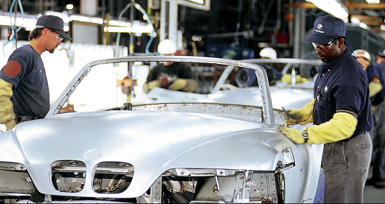
New fuel economy and greenhouse gas regulations are leading to the demand for new materials as well as new manufacturing and design methods to lightweight vehicles.
Where is auto production currently concentrated, and where will the industry expand in the future?
Advanced manufacturing will continue to be reliant upon human interaction for the application and management of technology.
Incentives have moved from the fringes of a project to being a part of the competitiveness equation in bringing manufacturers back to the U.S.
To attract and retain core manufacturing businesses in the twenty-first century, communities will have to offer significant workforce development support, combined with a business climate package that makes their companies competitive with producers that enjoy lower labor costs and more favorable taxation throughout the rest of the world.
Direct investment in North America is allowing European automotive companies to distinguish themselves from their competitors.
MidAmerica has been designated a “certified industrial park” by the Oklahoma Department of Commerce. Since it’s owned and operated by a public trust, red tape and fees have been eliminated and construction can begin almost immediately.
Today’s innovative companies require highly skilled workers — a need that cannot be overstated. Kentucky is among those states that have focused their efforts on supplying the workforce that current and future companies need.
It’s no wonder that the companies located in Mississippi’s aerospace corridor continue to grow. In fact, 2013 and 2014 have yielded significant expansion for Raytheon, Rolls-Royce, General Atomics, and Aurora Flight Sciences.
When the nation’s growing gap in skilled workers came to the forefront, Iowa’s leaders quickly mobilized and through public/private partnerships implemented initiatives to focus on science, technology, engineering, and math (STEM) education. Co-chaired by Iowa’s Lt. Gov. Kim Reynolds and Vermeer CEO Mary Andringa, Iowa’s STEM efforts have garnered national attention among educational and policy leaders in Washington, D.C., as one of the best state models.
The corridor of suppliers to the automotive industry that has developed in Mexico Bajio’s Region is important to the many car and truck makers that have chosen to locate their manufacturing facilities there.
If short-term lessons from major auto manufacturers and a diverse range of suppliers, like those in eastern North Carolina, are any indication of the future, the U.S. automotive industry and the U.S. economy have a genuine basis for confidence.
Receive quarterly issues of Area Development Magazine at no charge for qualified executives and consultants to industry.
Corporate Exec Survey Results
Leading Metro Locations
Top States for Business
Annual Econdev Awards