Critical Site Selection Factor #1: Availability of Skilled Labor an Acute Need
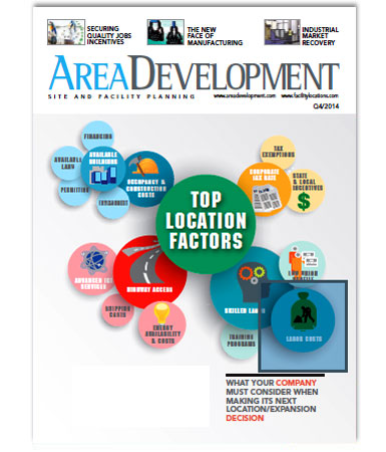
With a growing U.S. economy and an “onshoring” trend fanning demand, the availability of skilled labor has become the #1 factor in site decisions.
Highway accessibility ranks as the #2 most important factor to corporate executives, certainly reflecting the crucial role of transportation costs and logistical efficiencies in a U.S. and global market with less and less margin for error in the supply chain.
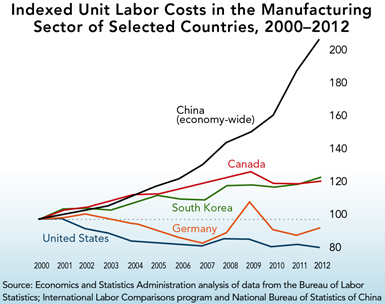
Although still of great importance, labor costs have taken a back seat to other factors. The importance of the outright cost of labor eased in the latest Area Development survey, to the #3 factor, compared with its ranking as the #1 factor in the prior year’s survey of corporate executives.
The higher importance reflects not only the continued proportional significance of occupancy and construction costs in companies’ overall cost equation, but also the fact that such costs are continuing to ratchet up as the U.S. and global economies proceed with recovery at varying paces, increasing demand and nudging up prices.
The rise of “big data” in nearly every industry vertical has promoted continued importance of a robust information and communications technology (ICT) infrastructure as a site selection factor.
Now that we are in a clear growth mode, companies seeking industrial, distribution, R&D facilities, and office space increasingly are pressed to find existing buildings that will accommodate their needs.
The importance of state and local incentives smashed up through the ranks of site selection factors to #8 in Area Development’s most recent Corporate Survey from #13 a year earlier. And, with big money at stake, states are more careful to make sure they are getting what they pay for.
A state’s corporate tax rate is usually a bedrock indicator of its business-friendliness and a simple but substantial number that has a huge long-haul impact on the financial performance of a new plant or other facility.
The cost and availability of energy has been dropping in importance as a site selection factor, ranking #10 in the 2013 Area Development Corporate Survey, down from its #6 position a year earlier. The drop seems to reflect a persistent weakness in natural gas prices as well as a steady rise in alternative-energy capabilities across the country.
Having a low union profile ranked as slightly more important in Area Development’s latest Corporate Survey, up one position to #9. But in a similarly incremental sense, U.S. unions overall actually may have gained some ground over the last year.
The key to urban vs. suburban or balancing millennial interests and boomer practicality is deciding which location and workplace strategy will accommodate growth.
U.S. manufacturers are investing in advanced equipment, automation, and robotics in order to drive down the cost of production and compete in the global economy. The net result has the potential to transform our industrial base.
As a growing number of states augment their business incentives with Quality Jobs programs, manufacturing, technology and other high value-add companies are well positioned to potentially reap significant and often enhanced tax and non-tax benefits.
When the industrial real estate recovery began, the trends that likely would drive its transformation and progress became a favorite discussion topic among industry practitioners. Just a few years later, our sector continues on a solid, positive trajectory. Now feels like a good time to look at whether those early prognostications have played out.
A comprehensive location strategy looks beyond the financial and real estate aspects of a community and carefully identifies characteristics that are not found in data sets, culminating in a project agreement that places emphasis on “community fit” and “service after sale” in addition to incentive programming.
Major economic, social, and regulatory factors are having big impacts on the life sciences and medical device industries, representing an opportunity for innovative companies to become new leaders and gain market share.
On the third anniversary of National Manufacturing Day — October 3, 2014 — the Labor Department reported that unemployment fell to 5.9 percent in September — the lowest level in six years! Analysts also predicted hiring would remain solid, as business investment and consumer spending are increasing, and the annual pace of economic growth is expected to remain above 3 percent.
Does going green mean your workforce becomes more productive? Sometimes — but not all green workplaces are created equal. Unearthing the hard evidence that a company’s sustainability programs are — or are not — enhancing productivity requires meaningful metrics that quantify both sustainability tactics and productivity impacts.
Area Development recently spoke with Larry Clinton, the president and CEO of the Internet Security Alliance, who noted that cyber security needs to be woven into corporate processes. When done successfully, it can help build competitive advantage.
In many parts of the country, manufacturing is more of a fond memory than a reality. Not so in Mississippi, which is very much a state that makes things.
Existing buildings 20 years or older, constructed at a time when energy consumption and environmental impact were barely considered, make up 72 percent of commercial square footage in the United States. There are many cost-effective opportunities for achieving environmental benefits and reducing energy consumption by promoting more sustainable operations among these assets.
Receive quarterly issues of Area Development Magazine at no charge for qualified executives and consultants to industry.
Corporate Exec Survey Results
Leading Metro Locations
Top States for Business
Annual Econdev Awards