Critical Site Selection Factor #3: Labor Costs vs. Quality Dilemma
Although still of great importance, labor costs have taken a back seat to other factors.
Q4 2014
The importance of the outright cost of labor eased in the latest Area Development survey, to the #3 factor, compared with its ranking as the #1 factor in the prior year’s survey. Nonetheless, “labor costs” scored 90.8 percent in importance, the same absolute value as the year earlier, but lower in the rankings because survey respondents became more concerned about other things.
But labor costs remain a huge factor in many location decisions, and nothing illustrates this truth better than the monumental drama early in 2014 that determined where Boeing would build its 777X aircraft. The aerospace giant got proposals to host the massive program from 22 states and played off its own growing, lower-cost South Carolina operations against its relatively expensive unionized labor base in the Seattle area.
There’s greater recognition that the quality of labor is increasingly important, and because with the economic recovery the availability of good people is getting tighter, companies are willing to pay more and are willing to be not quite as cost-sensitive Larry Gigerich, Managing Director, Ginovus.
While many states propose millions of dollars in tax breaks and other incentives to lure airplane-manufacturing jobs, Boeing’s decision came down to its two existing operations — and their relative long-term labor costs. It strong-armed the International Association of Machinists and Aerospace Workers into voting (51 percent to 49 percent) to approve a package worth tens of millions of dollars in wage, benefit, and retirement concessions to land the 777X for Washington. In doing so, Boeing called the bluff of union leaders and politicians who argued that Boeing wouldn’t leave its Seattle-area skill base and existing infrastructure behind over something as baldly bottom-line-oriented as labor costs.
Decreasing Emphasis on Rock-Bottom Costs
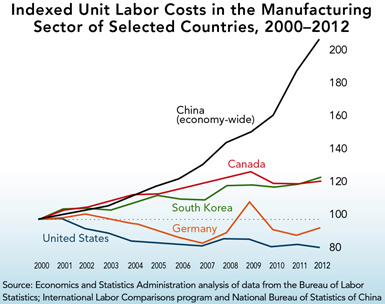
Overall, there are reasons that labor costs are easing in their relative importance as a site selection factor. For one thing, the continued movement of low-skill jobs out of the United States, still bound for places like China and Mexico, essentially puts less emphasis on the appeal of rock-bottom labor costs as a factor in site location decisions among domestic locations. At the same time, the fact that labor costs in many low-wage countries are rising relative to U.S. levels eases some of the pressure on companies to secure the cheapest possible labor in America.
“There’s also greater recognition that the quality of labor is increasingly important, and because with the economic recovery the availability of good people is getting tighter, companies are willing to pay more and are willing to be not quite as cost-sensitive,” says Larry Gigerich, managing director of Ginovus.
Yet like Boeing, many companies still look intently at labor cost differentials. Presumably that is what Reliance Worldwide, for example, did in deciding to open a new plant in Cullman, Alabama, to launch U.S. production of an innovative plumbing-connection system. In September, the Atlanta-based company announced that it would invest $50 million to create 130 jobs over five years to manufacture its SharkBite system in the town where it already has a plant that makes other plumbing components. Previously, SharkBite was made only in Australia.
And while the company and Alabama officials cited the state’s offer of employee screening and training as a lure, no doubt Reliance also was attracted by Alabama’s low labor costs — notably, the consultants ranked Alabama #1 for low labor costs in Area Development’s Top States For Doing Business survey. This advantage serves as an anchor for the state, which has been happy to supplement with other attributes.
-
Dale D. Buss, Staff Editor, Area Development
Dale Buss is a veteran of economic and business reporting for publications including Forbes, the Wall Street Journal, and Chief Executive magazine. He lives in Michigan.



Recent Project Announcements
Baxter Aerospace Expands Washington City, Utah, Production Operations
10/14/2026
Mercury Systems Expands Phoenix, Arizona, Manufacturing Operations
10/13/2026
EMD Electronics Plans Sheboygan Falls, Wisconsin, Research-Development Operations
10/12/2026
Solstice Advanced Materials Expands Buffalo, New York, Research-Development Operations
10/12/2026
Walashek Industrial & Marine Expands Norfolk, Virginia, Operations
10/12/2026
Taiwan‑Based Gudeng Precision Industrial Establishes Glendale, Arizona, Manufacturing Operations
10/12/2026
CP Industries Plans Expands Allegheny County, Pennsylvania, Manufacturing Operations
10/12/2026
Obatala Sciences Establishes Charleston County, South Carolina, Operations
10/12/2026
Hyundai Transys Expands West Point, Georgia, Production Operations
10/12/2026
Arvato Expands Louisville, Kentucky, Distribution-Fulfillment Operations
10/12/2026
Nucor Corporation Expands Crawfordsville, Indiana, Manufacturing Operations
10/09/2026
Huntington National Bank Renovates Tupelo, Mississippi, Operations
10/08/2026
CurTec USA Expands Westminster, South Carolina, Operations
10/08/2026
Viakable Expands La Salle, Illinois, Production Operations
10/08/2026
Most Read
-
Top States for Doing Business in 2026: Where Competitive Advantage Becomes Project Certainty
Q3 2026
-
Why Great Sites Get Eliminated: The Critical Role of Information Presentation in Site Selection
Q3 2026
-
What Site Selectors Discuss After the Site Visit Ends
Q3 2026
-
Steel Is Back—and Infrastructure Is Deciding Where New Mills Locate
Q3 2026
-
2025’s Top States for Business: How the Winners Are Outpacing the Rest
Q3 2025
-
Beyond the Launch Pad: Why Huntsville and Colorado Springs Are Winning Commercial Space Investment
Q3 2026
-
Why Relationships Still Win Projects in Site Selection
Q3 2026