
At the start of 2025, the mood around industrial investment was unmistakably confident. Capital was available. Incentives were abundant. Projects were being announced across nearly every sector of the economy. On paper, companies appeared to have more location options than ever .
By the end of the year, that sense of abundance had largely evaporated.
What Area Development’s reporting revealed over the course of 2025 was not a slowdown in ambition, but a collision with reality . Again and again, across sectors and geographies, site selection stopped behaving like an optimization exercise and began to resemble something closer to constraint management . The question was no longer which location offered the best mix of cost, incentives, and access. It became which location could actually deliver — on time, at scale, and without late-stage surprises.
The Illusion of OptionalityThe defining paradox of 2025 was this: more sites were marketed as “ready” , more communities claimed speed, and more incentives were placed on the table — yet more deals stalled, stretched, or quietly re-scoped than in years past.
Our coverage consistently showed that the traditional signals of readiness often masked unresolved issues. Permitting timelines that looked manageable on slide decks unraveled once federal, state, and local processes overlapped. Environmental reviews extended well beyond original schedules. Infrastructure commitments assumed coordination that had not yet occurred.
In 2025, site selection stopped behaving like an optimization exercise and began operating under a different set of rules.
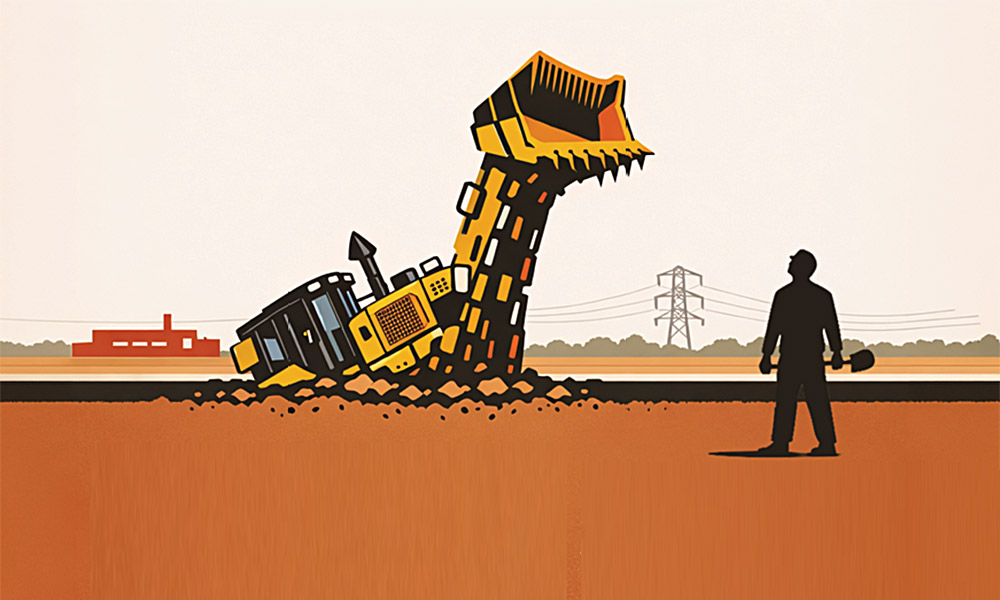
“Shovel-ready” became less a factual descriptor than a testable hypothesis — one that frequently failed under due diligence.
The result was a growing gap between announced momentum and executable reality. Companies that entered site selection expecting optionality instead found themselves narrowing choices rapidly, sometimes down to a single viable path forward.
Speed Became the Differentiator — and the ScarcityThroughout the year, one variable consistently rose to the top of corporate decision-making: speed. Not speed to announcement, but speed to operation .
In manufacturing, logistics, life sciences, and advanced materials alike, timelines were no longer abstract planning tools. They were tied directly to customer commitments, supply-chain resilience, and competitive position. A six-month delay could ripple through procurement, hiring, and capital deployment.
Yet our reporting showed how few regions could actually move at the pace companies required. Local permitting departments were understaffed. Interagency coordination broke down under pressure. Infrastructure upgrades that had been promised as parallel processes became sequential ones .
Speed, it turned out, was not something incentives could buy retroactively. It had to be built into the system long before a project arrived.
Infrastructure Moved From Supporting Role to GatekeeperIf one theme cut across nearly every major story in 2025, it was the growing centrality of infrastructure — particularly power and water .
Electric capacity assumptions proved fragile . Interconnection timelines lengthened . Utility upgrade schedules slipped beyond project horizons. In some cases, sites that appeared ideal in early screening were eliminated late in the process when capacity realities emerged.
Shovel-ready became less a descriptor and more a hypothesis — one that often failed under due diligence.
Water and wastewater constraints followed a similar pattern. As industrial processes became more resource-intensive — and as communities grew more cautious about long-term impacts — access to water quietly became a gating factor in regions that had long taken it for granted.
These were not abstract risks. They were tangible points of failure that forced companies to rethink projects midstream. Infrastructure was no longer a box to be checked; it was the box that determined whether anything else mattered.
Workforce Readiness Became a Precision ProblemLabor shortages were not new in 2025. What changed was how they manifested.
Across our reporting, workforce challenges were less about raw headcount and more about specificity . Defense manufacturers needed cleared workers. Advanced manufacturers needed technicians capable of operating automated systems. Data-driven facilities required specialized operators that could not be trained overnight.
The year revealed a growing unwillingness among companies to compromise on workforce quality in the name of speed. In multiple cases, businesses opted to slow expansion rather than risk operational instability caused by underqualified labor.
This shift carried an important implication: workforce development could no longer be reactive . Regions that treated training as a response to announced projects found themselves behind. Those that invested early — aligning education, employers, and infrastructure — were better positioned to absorb demand when it arrived.
Incentives Still Mattered — But Only After Reality Was AddressedNone of this made incentives irrelevant. But 2025 clarified their role.
Incentives could not close a power gap . They could not compress permitting timelines that were structurally constrained. They could not create cleared or highly specialized workers on demand.
Instead, incentives functioned increasingly as a tiebreaker — meaningful only once a location had already demonstrated the ability to execute. In that sense, incentives became less about attraction and more about reinforcement.
Speed could no longer be promised retroactively. It had to exist before a project ever arrived.
The most competitive regions were not those offering the largest packages, but those offering the fewest unknowns .
The Shift From Optimization to ExecutionStepping back, 2025 marked a quiet but consequential shift in how site selection operated.
For years, the discipline was framed as a comparative exercise — weighing costs, incentives, logistics, and labor to arrive at an optimal outcome. That framework assumed flexibility and choice.
What emerged in 2025 was something different. The most consequential decisions were shaped not by marginal advantages, but by hard constraints . Power availability, permitting capacity, workforce specificity, and infrastructure readiness narrowed the field before optimization could even begin.
Site selection became less about finding the best location and more about avoiding the wrong one.
What 2025 Taught Decision-MakersIf there is a single lesson from 2025, it is this: competitive advantage now lies in execution certainty .
For corporate leaders, that means deeper diligence earlier in the process, and a willingness to challenge assumptions that once went unquestioned. For regions and communities, it means investing in systems — not slogans that can deliver when opportunity arrives.
As 2026 approaches, the sites that will win investment are unlikely to be those with the loudest pitches or the boldest claims. They will be the ones with aligned infrastructure, coordinated permitting , and workforce strategies already in motion.
In a year defined by constraints, readiness became the only true differentiator.