Navigating the intricacies of the skilled trades industry has never been straightforward, but today we’re standing at a crossroads defined by two unprecedented barriers.
On one hand, a growing wave of retirees is leaving a gaping hole in the workforce. As millions of seasoned workers leave their positions, employers are racing to fill an enormous number of open roles. In the construction industry alone, the National Center for Construction Education and Research (NCCER) reports that 41 percent of the current workforce is expected to retire by 2031. Without adequate staffing, projects can get derailed, costs can rise, quality can plummet, and timelines can stretch — threatening the stability of the industry.
On the other hand, this already overextended workforce is taking on more responsibility than ever to meet the demands fueled by infrastructure investments and rapid technological innovation. As large-scale projects create a surge in demand for skilled tradespeople and new inventions constantly require time-intensive reskilling, tradespeople are losing the ability to focus on their craft.
To overcome these strains, it’s clear that the skilled trades industry needs two things: more workers and more time. Through digitization and advanced AI-powered technology, it’s possible to start giving the industry both.
The Stats Are In: The Skilled Trades Are Ready for Change
The National Fire Protection Association’s most recent survey highlights how critical digital transformation has become in solving the industry’s most pressing challenges. Ninety-five percent of respondents agree that AI already has a place in at least some day-to-day job functions, underscoring its growing role in helping the workforce adapt. Thirty-one percent see AI as vital for streamlining routine tasks amid ongoing labor shortages, freeing up time for training as technology reshapes job requirements.
AI is giving the trades time to build, time to grow, and time to lead.
Even more telling, 39 percent believe AI can help attract younger, tech-savvy professionals by reframing the trades as knowledge-intensive, highly technical, and future-oriented careers rather than outdated or physically grueling ones. This shift in perception, combined with the job security the industry provides, has the potential to strengthen the workforce pipeline at a time when it’s needed most.
Modern-day problems require modern-day solutions, and using AI and other digital tools is what the industry needs right now to combat current hardships. In fact, 64 percent of respondents say they have already seen tangible improvements in team workflows and collaboration since adopting these tools.
AI in the Skilled Trades: What It Looks Like Today
Though some professionals — 25 percent of respondents, according to the survey — remain skeptical of AI’s purpose in the skilled trades, many have seen clear benefits from adopting advanced technologies. The rapid integration of AI in other industries, especially those where entry-level positions are being eliminated, can make people wary, but the skilled trades pose a unique buffer.
95
Unlike other careers, the skilled trades require a human touch that robots can’t offer — machines can’t turn screws, pull cables, weld pipes, or perform the physical work itself. The industry will always need people for the heavy lifting, quick thinking, and detail-oriented craftsmanship, but AI can make it easier to focus on high-value tasks and embrace a growth mindset — increasingly important as professionals combat labor shortages and knowledge gaps.
Today, AI is emerging as a valuable support system, allowing tradespeople to spend less time buried in paperwork and more time on tasks that matter. According to another survey, AI is saving trade workers an average of 3.2 hours per week — more than 160 hours per year. By automating administrative responsibilities such as generating work orders, tracking inventory, and ensuring code compliance, AI helps fill critical labor gaps. With more flexible schedules, professionals gain time for mentoring and upskilling.
The skilled trades will always need people — AI just makes their work smarter and safer.
Beyond efficiency, AI is also reshaping perceptions of the skilled trades. For younger workers, especially Gen Z, the integration of advanced technologies signals that the trades are not anchored in the past but are a lucrative, highly skilled sector.
AI is already streamlining many essential processes — automatically calculating material needs and costs from blueprints, optimizing project schedules, managing budgets, and drafting policies. Through these processes, AI gives skilled tradespeople exactly what they need to thrive: more time and more focused workloads, preserving the irreplaceable human skill, creativity, and problem-solving that define the trades.
What’s Next for AI in the Skilled Trades
While current use cases focus on streamlining manual, time-consuming tasks, there’s an exciting future of AI-driven capabilities on the horizon — especially in safety and workforce development. Many of these technologies are still in development or deployed on a small scale, but it’s only a matter of time before manual automation evolves into full industry transformation.
41
One of the most promising frontiers is AI’s potential to make jobs significantly safer. Tradespeople often work in environments where hazards are constant — construction sites, manufacturing floors, utility plants — and AI is beginning to serve as an extra layer of protection. Computer vision systems can flag missing PPE, detect unsafe tool usage, or identify workers venturing too close to high-risk zones. AI-driven predictive maintenance tools can monitor equipment and anticipate failures before they become dangerous malfunctions, and AI-assisted code compliance reviews ensure that building systems meet the latest safety standards.
Modern-day problems demand modern-day solutions, and digital tools are the new toolbox.
AI’s evolving role also points to a future where real-time data and dynamic safety systems become the norm — evacuation signs that adjust based on smoke and heat spread or crowd-management algorithms that reroute people to avoid hazards. Other experimental tools, such as flashover-prediction models and rapid fire-spread simulations, show how the same technologies could protect tradespeople across industries.
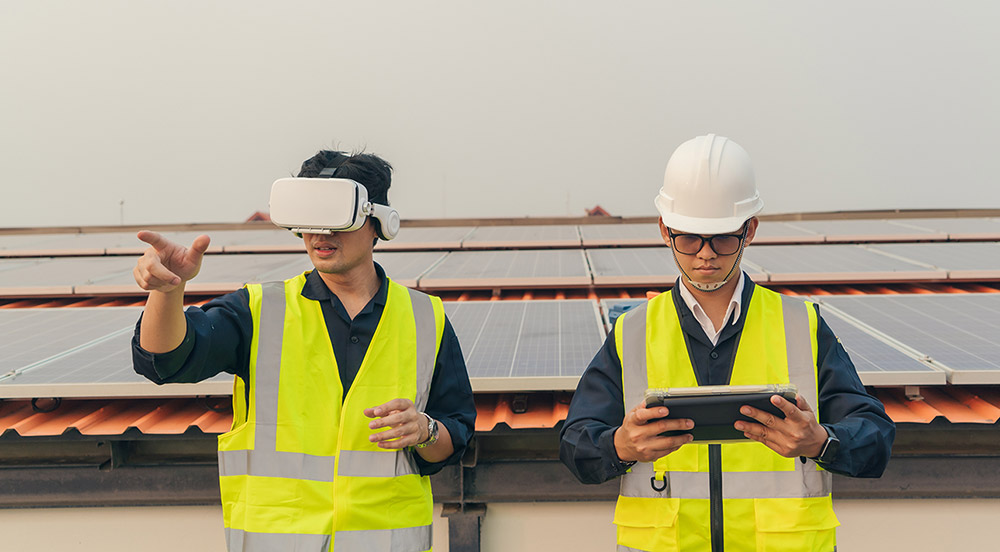
At the same time, AI will not only help the industry respond to emergencies; it will build resilience in the workforce itself. Through AI-powered training platforms, apprentices can practice high-risk tasks in zero-risk virtual environments. Digital work-order systems and automated planning tools can also reduce the mental burden and error risk that often lead to accidents in the field.
Looking Ahead
AI is becoming less about replacing what skilled tradespeople do and more about keeping them safer, sharper, and better prepared to focus on the physical craft no machine can replicate. With labor and knowledge gaps to overcome, AI is streamlining tedious tasks and helping tradespeople efficiently upskill, creating a more forward-thinking, future-ready industry.
AI is giving the skilled trades exactly what they need right now: time to build, time to grow, and time to lead.