
Innovative Programs that are Developing Skilled Workforces for Today’s Jobs
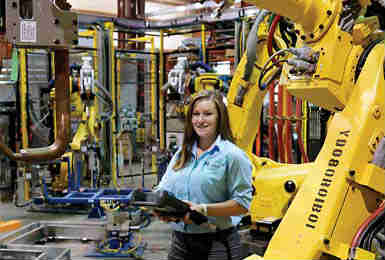
Although unemployment numbers are high in many areas of the nation, finding workers with the right skills is a problem; here are some innovative solutions.

The election results point to continued fiscal and tax uncertainty and no clear direction for economic development policy on federal, state, and local government levels.
Buildings talk — but do they talk to your CFO? If you listen carefully and through the right system, your facilities could tell you how to reduce operational failure risk, increase energy efficiency, and anticipate capital expenditures.
With the unpredictability of global weather patterns (as evidenced by Hurricane Sandy, which battered the U.S. Mid-Atlantic coast causing billions of dollars of damage) it's more important than ever for businesses to assess the potential impacts of power outages and have contingency plans in place.
An efficient, cost-effective supply chain can be achieved by considering logistics early in the location decision process and continuously sharing information.
Skyrocketing Costs and shifting legislation have pushed an area’s healthcare affordability and quality into the mix of primary site selection considerations.
Area Development’s 26th annual survey of corporate executives (published Winter 2012) found that highway accessibility topped the list of individual site selection factors, with 93.8 percent of those surveyed ranking this factor as “very important” or “important.” Here is an analysis of its importance…
Respondents to Area Development’s 26th Annual Corporate Survey (Published Winter 2012) ranked energy availability and costs seventh among the factors, with 84. 8 percent considering this factor as “very important” or “important.” And, the greater a project’s consumption of energy, the more important the availability and total cost of energy becomes in the final selection decision.
Saving even $1 per hour on employee wages can translate into hundreds of thousands of dollars in savings each year for some companies. Given those statistics, it is no surprise that labor costs consistently rank as one of the top factors in site selection decisions.
In Area Development’s 26th Annual Corporate Survey, proximity to major markets was considered “very important” or “important” by 83 percent of the survey respondents. The category jumped 8 places in the rankings — the survey’s greatest jump in importance - from the previous year’s Corporate Survey results.
Low-union and right-to-work (RTW) status may not rank at the top of the list when it comes to site selection criteria, but those factors certainly carry considerable weight in the overall decision-making process for many manufacturers. Choosing a state with a low-union profile or locating in a RTW state only ranked 10th and 12th respectively among a list of 26 different site selection factors, according to Area Development’s 26th Annual Corporate Survey.
One of the biggest up-front costs for expansion or relocation is occupancy and construction. This factor was ranked fifth in importance by the respondents to Area Development’s 26th Annual Corporate Survey, with 85.9 percent of the respondents considering it high in importance. Fortunately, it is one of the most easily controlled costs.
It goes without saying that available labor, especially skilled labor, is considered to be a key driver in site selection decisions. Workers are often the lifeblood for a company’s operations.
Tax rates, incentives, and exemptions have always been important to corporate site selectors. These factors were rated fourth, fifth, and eighth, respectively, among the site selection criteria by the respondents to Area Development’s 26th Annual Corporate Survey (published Winter 2012), more than 80 percent of whom rated them as “very important” or “important.”
Some economists say it is necessary for the nation to “fall off” this cliff in order to stop the economic “hemorrhaging,” other economists believe the nation will slide back into recession if corporate taxes are increased and federal spending is cut.
Getting projects done on time and on budget has always been a priority for private and public owners; however, today’s difficult economic times have made these two challenges more important than ever.
The editor of Area Development recently spoke with RACER Trust’s Redevelopment Manager Bruce Rasher about his organization’s goal of cleaning up and marketing former GM properties to companies that will invest in the communities where these facilities are located and create good-paying jobs.
As the importance of business intelligence rises for corporate real estate and IT departments alike, so does the need for common data standards.
The U.S. Department of Labor is betting $2 billion that an injection of funds into community colleges around the country will pay off by helping fill the skills gap in the manufacturing, information technology and healthcare sectors.
Pharmaceutical firms, large and small, have long favored locating their research operations on suburban campuses. Now this trend is changing.
Consumers have trimmed their debt loads and large corporations are creating treasure chests of cash to invest when market uncertainties are resolved; businesses should take steps now to position themselves for a revival of activity.
A survey of executives reveals the trends in efforts being made by companies to improve on-the-job performance of employees - and the effectiveness of these efforts.
Receive quarterly issues of Area Development Magazine at no charge for qualified executives and consultants to industry.