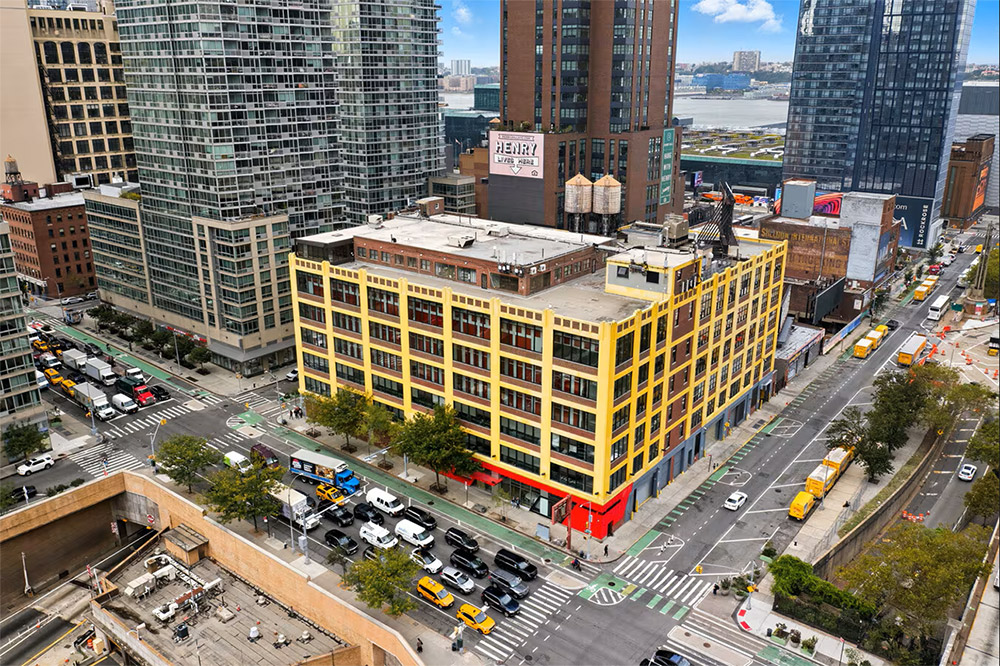
A century-old industrial building on Manhattan’s West Side is quietly redefining what “last mile” means in the urban core. Once home to Ford Motor Company and later DHL, the multi-story warehouse on 10th Avenue is coming back to market for the first time in decades — and it’s built for a kind of movement that cities suddenly need again.
Inside, a spiraling ramp system allows box trucks and delivery vans to drive up and down five floors — a rarity in New York and a feature that makes the building instantly relevant in an era of e-commerce congestion. “There really isn’t another industrial building in Manhattan that allows this kind of vertical access,” said Leslie Lanne, Vice Chair at JLL, who specializes in institutional Landlord and Tenant representation in the Northeast Region. “The design solves a problem we’re just starting to face — how to move vehicles off the street while keeping them close to the customer.”
That problem is growing across major cities as e-commerce accelerates and space remains scarce. Manhattan’s total industrial footprint is about 130 million square feet, but less than ten percent qualifies as modern Class A product. Only five million square feet of new logistics space has been delivered across New York City in the last eight years. Much of the rest is aging stock — midcentury warehouses without loading docks, staging space, or capacity for EV fleets.
The design solves a problem we’re just starting to face — how to move vehicles off the street while keeping them close to the customer.
But timing matters. Nationwide, logistics demand has softened since its pandemic peak, leaving speculative projects from Chicago to Seattle hunting for tenants. Chicago’s 1.2 million-square-foot multistory warehouse on West Division Street, once hailed as a prototype for urban logistics, still sits largely vacant. Analysts at NAIOP note that many multilevel projects face operational hurdles — from tight ramp grades to difficult vehicle queuing — that complicate their promise.
Lanne said New York is different. “This market is structurally undersupplied,” she said. “If we want to get delivery vehicles out of bike lanes and off sidewalks, we need more buildings that can load and stage fleets internally.”
Potential tenants range from parcel carriers to food distributors, art storage firms, and event logistics providers. The building’s freight elevators, large enough to carry cars, offer flexibility few urban sites can match.
For corporate real estate executives watching urban logistics evolve, the 10th Avenue project captures the paradox of modern industrial space: what was once obsolete may now be indispensable. A design from Manhattan’s automotive past could help solve the delivery gridlock of its future.