State of the Logistics Industry 2010: Modal Perspectives
Restocking of depleted inventories has resulted in a rebound in shipments for the first half of 2010, but year-end statistics have yet to be compiled.
November 2010
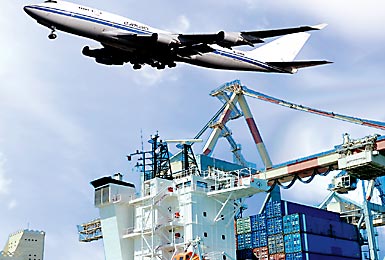
Since this event nearly 45 years ago, containerized imports and the shifting trade lanes over the past two decades have had a profound impact on industrial real estate and distribution center site selection decisions.
Containerized cargo handled at the U.S. ports increased from 15.6 million TEUs (20-foot equivalent units) in 1990 to nearly 42.9 million TEUs in 2008. This accounts for an average annual growth rate of about 5.8 percent. It should also be emphasized that between 2007 and 2008, containerized cargo fell by 5 percent, reflecting the slowing of the world economy. This decline continued into 2009, but shipments have rebounded during 2010 as depleted inventories have been restocked and stakeholders have adjusted to the new economic environment.
According to Hackett Associates' Global Port Tracker, which tracks 12 major North American container ports, strong growth in 2010 second quarter volumes over the previous quarter has been experienced and a yearly 18 percent increase over 2009 imported volumes is forecast.
West Coast Dominance
Historically, West Coast ports have handled about 47 percent of all imports into the United States, followed by the North Atlantic ports, which have handled 24 percent of the container imports, and South Atlantic ports (from Norfolk to Miami), which have handled 21 percent of total containerized imported tonnage.
The San Pedro Bay ports of Los Angeles and Long Beach handle about 35 percent of imported containerized cargo into the United States. This dominance of the containerized trade by the West Coast ports, and in particular the Ports of Los Angeles and Long Beach - particularly in the late 1990s through 2002 - was driven by importers' view of theses ports as the major linkage in the imported cargo supply chain.
Before the mid- to late-1990s, steamship lines determined the port routings, and importers were essentially "port blind" as they selected an ocean carrier. The carrier decided at which port the cargo would be discharged and how the cargo would be delivered to the customer. However, as the concentration of large importers (e.g., Wal-Mart, Target, Cost Plus, etc.) increased in the late 1990s, these importers invested in large distribution centers in the Los Angeles/Long Beach area to serve as points in the importers' logistics supply chains.
As these importers gained bargaining power in terms of contract negotiations with the ocean carriers, they were able to "demand" a San Pedro Bay port routing from the carriers. Hence, with the development of the distribution centers and cross-dock operations in the San Pedro Bay region, the concentration of imported Asian containers at the ports of Los Angeles and Long Beach increased.
In addition, railroads providing intermodal services at San Pedro ports further increased investment in rail trackage and intermodal yards to facilitate the flow of containers from the Los Angeles area to the key consumption centers in the Midwest and East, including Chicago, Memphis, St. Louis, New York, Atlanta, Columbus, etc.
Project Announcements
United Kingdom-Based Risk Ledger Plans Rockville, Maryland, Operations
04/03/2026
Umbra Plans Reston, Virginia, Engineering-Production Operations
04/03/2026
Associated Wholesale Grocers Expands Pearl River, Louisiana, Distribution Operations
04/02/2026
Brazil-Based TSEA Energy Plans Eden, North Carolina, Manufacturing Operations
04/02/2026
AMAROK Plans Columbia, South Carolina, Headquarters Operations
04/02/2026
Belgium-Based UCB Plans Gwinnett County, Georgia, Manufacturing Operations
04/01/2026
Most Read
-
Top States for Doing Business in 2024: A Continued Legacy of Excellence
Q3 2024
-
Economic Developer Role Shifting from Deal-Making to Systems Stewardship
Q1 2026
-
What Companies Need from Modern Manufacturing Sites
Q1 2026
-
Capitalizing on the OBBBA Before the 2026 Cliff
Q1 2026
-
Last Word: Don’t Lose by Winning
Q1 2026
-
Advanced Manufacturing Isn’t a Buzzword—It’s a Different Location Strategy
Q1 2026
-
The Geography of Packaging: Why Location Strategy Matters More Than Ever
Q1 2026