
Job Creation Through Reshoring
Companies are considering reshoring operations for better supply chain management and are creating jobs in the process.
Q1 2021
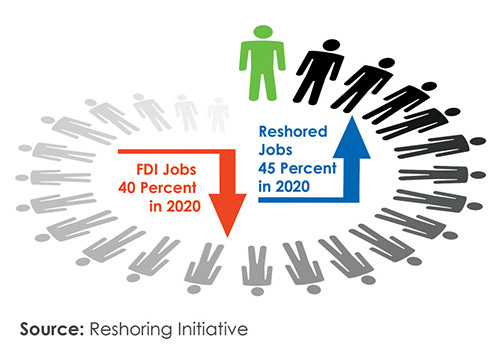
In 2020, reshoring created more U.S. jobs than foreign direct investment (FDI) for the first time in seven years, according to data collected by the Reshoring Initiative. In 2020, U.S. companies reshored nearly 69,000 manufacturing positions, while greenfield investment in the same industries created fewer than 42,000 jobs, according to the Initiative. Reshored jobs were up nearly 45 percent last year, with FDI jobs down 40 percent. The report is based on job announcements and annualized data from the first half of 2020.
Reshoring Initiative founder and President Harry Moser said the Covid-19 pandemic accelerated a trend that had already begun, with the pandemic a motivating factor in 60 percent of cases since March 2020. Medical equipment reshoring cases in the first six months of 2020 were double the full-year 2019 figure. Longer-term, the most active industries in reshoring have been transportation equipment, machinery, electronic products, and appliances.
Moser says China has lost the most reshored U.S. jobs (40 percent of cases) in the past decade. Mexico (23 percent) and Canada (10 percent) followed. Texas and the Midwest have attracted the most reshored jobs since 2010.
In 2020, reshoring created more U.S. jobs than foreign direct investment (FDI) for the first time in seven years. Myriad Reasons for Reshoring
A May/June 2020 Thomas For Industry survey of 750 North American manufacturing firms found 69 percent were “likely” or “extremely likely” to reshore overseas operations.
Why do companies decide to reshore? According to the Reshoring Initiative, increasing wages in hosting countries are one of the reasons most frequently given. Other factors include (non-labor) cost reduction; improved product quality and consistency; protection of intellectual property; shorter supply chains; a more skilled workforce; improved innovation; better responsiveness to customer needs; and total cost of ownership.
One high-profile example of corporate reshoring is Stanley Black & Decker, which moved production of its Craftsman wrenches, ratchets, sockets, and more back to the United States from China. The company built a 425,000-square-foot facility in Fort Worth for that purpose.
Smaller manufacturers are also part of the trend. Hardinge, a Berwyn, Pa.-based maker of CNC turning, milling, and grinding machines, has been doing some of its manufacturing in Taiwan since the early 2000s, according to Global Marketing Director Allan Snider. Late last year, Hardinge decided to bring its manufacturing back to Elmira, N.Y. — where it has manufactured since the 1930s — for several reasons, including better supply chain management.
The COVID-19 pandemic accelerated a reshoring trend that had already begun. Any advice for other manufacturers considering reshoring? “I can’t speak for other companies, but if reshoring allows them to better serve their customers, it is an option they should explore,” Snider told Area Development.
To reshore more jobs, Moser says he would like to see the U.S., Canada, and Mexico collaborate more on trade matters: “The United States trade agreement with Mexico and Canada (USMCA) is a good start; it may bring back 50,000 manufacturing jobs, which is not a lot. We would like to see the U.S., Mexico, and Canada get together and agree to bring back two million manufacturing jobs from Asia.”
The U.S. has a critical need for more qualified, trained workers to increase the country’s capacity to reshore, and needs to continue increasing productivity to be more price-competitive with comparatively low wages overseas, Moser adds.
-
Dan Emerson, Staff Editor, Area Development
Based in Minneapolis, Dan Emerson has been a freelance writer for business, trade, and consumer publications since 1994.
-
Advanced Manufacturing
Building the Nation's First AI-Ready Workforce

Data Centers
AEP Ohio Proposes Controversial Data Center Rate Hike Amid Power Demand Surge
-
Advanced Manufacturing
From Steel to Silicon: Chicago’s South Works Site to Host Largest U.S. Quantum Computing Hub
-
Skilled Labor / STEM
Creative Recruiting Might Help Close the Manufacturing Skills Gap
-

Recent Project Announcements
CHS Plans Evansville, Wisconsin, Soybean Processing Operations
09/21/2026
Infiltrator Water Technologies Plans Davenport, Iowa, Operations
09/21/2026
Australia-Based Sicona Battery Technologies Plans New Orleans, Louisiana, Headquarters Operations
09/19/2026
ArtiCast Jackson Plans Madison County, Tennessee, Operations
09/19/2026
Holly Poultry Establishes Hanover, Maryland, Production Operations
09/19/2026
TurbineOne Establishes Old Town, Maine, Innovation Operations
09/18/2026
Tampa Brass & Aluminum Expands Tampa, Florida, Headquarters Operations
09/18/2026
Toyotetsu Mid America Expands Owensboro, Kentucky, Operations
09/17/2026
Mayo Clinic Laboratories Plans Southaven, Mississippi, Operations
09/16/2026
V&S Schuler Tubular Products Expands Muskogee, Oklahoma, Manufacturing Operations
09/15/2026
Germany-Based Stöbich Fire Protection Systems Expands Dorchester County, South Carolina, Manufacturing Operations
09/14/2026
Black Bayou Energy Hub Expands-Plans Lafayette-Cameron Parish, Louisiana, Natural Gas Operations
09/14/2026
General Atomics Expands Shannon, Mississippi, Manufacturing Operations
09/14/2026
AirPro Expands Rhinelander, Wisconsin, Operations
09/13/2026
Most Read
-
The Shifting Landscape of Location Strategy
Q2 2026
-
Avoid These Red Flags, Deal Killers, and Blunders in Site Selection
Q2 2026
-
What Site Selectors Discuss After the Site Visit Ends
Q3 2026
-
Site Readiness Is Broken: What Manufacturers Should Demand From Their Locations
Q3 2025
-
Power Is the New Gatekeeper in Manufacturing Site Selection
Q2 2026
-
Why Relationships Still Win Projects in Site Selection
Q3 2026
-
21st Annual Shovel Awards: The American Industrial Economy Remade in Real Time
Q2 2026