
Government Funding Sweetens Site Redevelopment
With grants and incentives available from the federal to the local levels, brownfields are attracting businesses seeking well-positioned sites.
2011 Directory
Brownfields are existing properties whose redevelopment is compromised by hazardous substances, contaminants, or other toxic materials. Identifying the type and extent of contamination can be tricky and expensive, making most contaminated properties unattractive for redevelopment and expansion. Potential buyers especially worry about the possibility of civil penalties and costly cleanup efforts under the Comprehensive Environmental Response, Compensation, and Liability Act of 1980 (CERCLA).
Nonetheless, remediating and reinvesting in these properties protects the environment, reduces community blight, and takes development pressure off green space and working lands.
"Brownfield programs take properties that once had a viable use and restore their productivity, create jobs, and increase the local tax base," says Tony Hozeny, communications director for the Wisconsin Department of Commerce. "Brownfields also tend to have established infrastructure, including roads, sewer, and power, as well as proximity to restaurants and other businesses."
Businesses should not underestimate the social value of developing brownfields, especially when other site selection factors are about equal for other considered properties.
"Brownfield redevelopment allows for economic recovery and re-energizes communities with new jobs, places to live and work, and entertainment centers," says Joseph Reidy, attorney and partner at Schottenstein Zox & Dunn, a Columbus, Ohio, law firm that specializes in brownfield redevelopment. "It's a great way to show commitment to a community."
For most companies, deciding on greenfield versus brownfield sites ultimately comes down to risk tolerance.
"From a corporate perspective, site selection is all about risk avoidance," says Buzz Canup, a site selection consultant and president of Canup & Associates. "Companies always want to minimize risk, whether it is related to market logistics, labor cost, or location. Brownfield sites are viewed as higher risk because they are less predictable. Some brownfields owned by investors are only cleaned up to a certain point. Others are still in some phase of identification and discovery. Any brownfield site that a company considers should be fully vetted. In my experience, there is typically some overriding factor that compels a client to choose a brownfield site."
Existing infrastructure often sways the decision. "For example, large, Tier 4 data centers don't require a large work force, so local labor not a huge issue," Canup says. "However, these centers do consume large amounts of electricity. A brownfield site that once hosted an operation that required a lot of electricity would be high interest to a new data center if there was still infrastructure in place that met their specific energy needs."
Because they are considered higher risk properties, brownfields can typically be purchased at below-market rates, sometimes marked down more than 50 percent. "Some recent projects have involved sites that were either donated by the prior owner or sold for $1," Reidy says.
Now millions of extra dollars are available from Housing and Urban Development (HUD) and the Environmental Protection Agency (EPA) for brownfield redevelopment through the American Recovery and Reinvestment Act (ARRA). "Many states use tax credits as their principal incentives, so developers must front the money and hope to have successful project," Reidy says. "In Ohio, however, $3 million is available for a brownfield redevelopment project. Up to $1 million of that money can be used to buy the property. The rest is used for demolition and environmental remediation. The developer can then use other state programs to receive as much as $8 million to cover additional development costs, including constructing facilities and installing new equipment."
The largest potential downside for a brownfield project may be the time it takes to complete the remediation and demolition. However, this is frequently offset by the presence of all needed infrastructure.
EPA Leads the Way
The EPA Brownfields Program was established in 1995 to encourage the cleanup and re-use of an estimated 450,000 abandoned and contaminated U.S. waste sites. The EPA has awarded 1,702 assessment grants totaling over $401 million, 262 revolving loan fund grants totaling over $256 million, and 655 cleanup grants totaling $129 million to date.
With another $100 million destined for brownfield redevelopment through the ARRA, state and local governments are competing for cleanup grants, revolving loans, and job training. As of March 2010, the EPA program had leveraged more than $14 billion in cleanup and redevelopment funding.
Not only are properties being cleaned up, jobs are being created, from the business and legal services that identify and manage the complex environmental risks and liabilities, to the construction labor and ancillary industrial, commercial, and residential interests that arise.
Additionally, the Brownfields Economic Development Initiative (BEDI), HUD's competitive grant program, promotes economic and community development. BEDI helps cities target abandoned, idled, and underused industrial and commercial facilities for redevelopment. Properties are typically located in economic development zones, boosting near-term economic opportunities for low- and moderate-income people there, which HUD weighs considerably when approving BEDI funding. HUD does not consider applications for projects that are limited to site acquisition or remediation (dubbed land banking) where there are no plans for immediate redevelopment.
States: All In
State levels and structure of financial support for brownfield development vary. In Wisconsin, developers first undertake remediation, submit proof of work completion, and receive state grant money to defray clean-up costs.
"The state of Wisconsin established its brownfield program because it was getting increasingly difficult for companies to finance environmental cleanup through traditional means," Hozeny says. "Sites weren't being developed because there was an uncertainty about how much it would ultimately cost. Now the state steps up to provide the funding for remediation, often through the establishment of TIF [Tax Increment Financing] districts, which then makes it easier for these projects to get financing for construction through conventional methods."
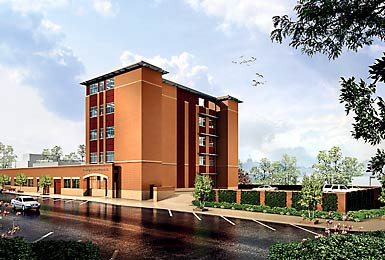
In 2009, Dermatology Associates of Wisconsin purchased a brownfield site in downtown Manitowoc to build a five-story administrative headquarters and create 124 jobs. The state of Wisconsin contributed $310,000 for environmental clean-up costs to the $6.7 million project.
"We considered both brownfield and greenfield locations," says Tricia Wagner, Dermatology Associates vice president. "We wanted to be in the city and help revitalize downtown Manitowoc. The brownfield grant made this option more affordable. Developing this property was great public relations for us. We are also eligible for Wisconsin Economic Development tax credits totaling about $540,000 for the new jobs we will create over the next three to five years." In Ohio, the state Department of Development Clean Ohio program gives about $50 million a year to brownfield development projects. "This program has provided a predictable source of funding to developers that is more readily accessible, and with larger grants, than anything provided by EPA or HUD," Reidy says. "Depending on the location of the property, grants are available for assessment, as well as remediation/demolition."
Counties and municipalities also contribute funds for brownfield projects. For example, in Cuyahoga County, Ohio, which encompasses Cleveland, the county provides grants and forgivable loans of up to $1 million, which can be used to provide the matching funds Clean Ohio requires.
In Columbus, the city now provides grants of up to $200,000 for assessment and/or remediation of brownfields or reimbursement of LEED certification costs. Time Warner Cable recently relocated its regional headquarters to a former landfill in Columbus that was remediated with a $3 million Clean Ohio Revitalization Fund grant, bringing more than 450 jobs to the city. Two new buildings there have been leased to the Ohio State University Medical Center, all part of the $60 million office park.
"One of the deciding factors for Time Warner was the fact this brownfield site was adjacent to a busy freeway with easy access," Reidy says. "With several million cars passing by every day, Time Warner also recognized the tremendous visibility the site provided and put up prominent signage on the property, essentially free advertising."
Managing Risk
Risk management tools, such as environmental remediation funding and state government sign-offs that protect developers from future litigation, can make brownfield sites cost-competitive and attractive to relocating or expanding companies. For instance, Ohio EPA Voluntary Action Program cleanup standards, coupled with the Covenant Not to Sue (Ohio EPA's promise that no further assessment or remediation is required at a property that has completed the program), provide potential brownfield site end-users with the transaction comfort to secure financing and successfully complete the relocation. "Projects have less risk and therefore become more affordable when they receive a Covenant Not to Sue from the state of Ohio," Reidy says.
Environmental insurance also protects companies from the possibility of additional investigations or remediations in the future. Depending on project size, a 10-year policy ranges from $50,000 to $300,000 for $20 million to $25 million in coverage. Some states sweeten the deal by offering a discount on environmental insurance products purchased for brownfield sites (10 percent in Ohio).
"With all the incentives we have in Ohio, as well as other publicly funded incentives available for new development, brownfields can be developed for costs on par with, if not less than, the cost to develop greenfield sites," Reidy says. "Brownfield sites can typically be acquired for less than market value and then remediated using public funds, thereby significantly reducing the cost of land for a project."
-
Mark Crawford, Staff Editor, Area Development
Mark Crawford is a full-time freelance writer based in Corrales, New Mexico, who specializes in business, technology, and history.



Recent Project Announcements
Australia-Based Sicona Battery Technologies Plans New Orleans, Louisiana, Headquarters Operations
09/19/2026
ArtiCast Jackson Plans Madison County, Tennessee, Operations
09/19/2026
Holly Poultry Establishes Hanover, Maryland, Production Operations
09/19/2026
TurbineOne Establishes Old Town, Maine, Innovation Operations
09/18/2026
Tampa Brass & Aluminum Expands Tampa, Florida, Headquarters Operations
09/18/2026
Toyotetsu Mid America Expands Owensboro, Kentucky, Operations
09/17/2026
Mayo Clinic Laboratories Plans Southaven, Mississippi, Operations
09/16/2026
V&S Schuler Tubular Products Expands Muskogee, Oklahoma, Manufacturing Operations
09/15/2026
Germany-Based Stöbich Fire Protection Systems Expands Dorchester County, South Carolina, Manufacturing Operations
09/14/2026
Black Bayou Energy Hub Expands-Plans Lafayette-Cameron Parish, Louisiana, Natural Gas Operations
09/14/2026
General Atomics Expands Shannon, Mississippi, Manufacturing Operations
09/14/2026
AirPro Expands Rhinelander, Wisconsin, Operations
09/13/2026
Moog Expands West Valley, Utah, Production Operations
09/13/2026
KIHOMAC Expands Davis County, Utah, Operations
09/13/2026
Most Read
-
The Shifting Landscape of Location Strategy
Q2 2026
-
Avoid These Red Flags, Deal Killers, and Blunders in Site Selection
Q2 2026
-
What Site Selectors Discuss After the Site Visit Ends
Q3 2026
-
Site Readiness Is Broken: What Manufacturers Should Demand From Their Locations
Q3 2025
-
Power Is the New Gatekeeper in Manufacturing Site Selection
Q2 2026
-
Why Relationships Still Win Projects in Site Selection
Q3 2026
-
21st Annual Shovel Awards: The American Industrial Economy Remade in Real Time
Q2 2026