
The conditions that are influencing location decisions are experiencing accelerated change. Corporate real estate and site selection professionals are operating in an increasingly complex landscape that requires location evaluations that take a range of surging forces into account. Labor availability, housing affordability, population growth, infrastructure capacity and automation are among the dynamic factors contributing to the shifting landscape and are affecting relocation, expansion and capital investment decisions.
This piece draws on ongoing EY advisory work with communities and organizations across the U.S. to highlight some of the most significant forces for corporate location strategy — and what site selectors should be discerning.
1. The labor pool is contractingPopulation growth in the U.S. is slowing. Projections through 2050 suggest the country is approaching peak population — a threshold that assumes continued net immigration. That assumption is now in question: Brookings estimates that 2025 marked the first calendar year with negative net immigration. If that trend persists, population contraction could begin closer to the 2030s than the 2050s.
For site selectors, this matters because labor force participation rates are also declining. The combination — a smaller pool of working-age adults and fewer of them active in the workforce — means that talent competition will intensify regardless of what markets do. Regions that appear labor-rich today may not hold that advantage for long.
The regional picture is particularly stark. In North Carolina, for example, roughly three-quarters of counties are projected to experience more deaths than births — meaning the only path to local labor growth is attraction from elsewhere. That dynamic turns talent competition into a zero-sum contest between regions, with meaningful implications for wage escalation, retention risk and the importance of affordability and a high quality of life.
The labor pool is shrinking while competition for talent intensifies.
What to watch: Analyze workforce projections — not just current labor availability — when evaluating locations. Ask whether a region has active talent attraction programs, employer relocation incentives or workforce retention strategies. Regions that have already internalized this challenge and built programmatic responses are more durable bets.
2. Housing affordability is becoming a universal constraint
For decades, secondary and tertiary markets built their competitive case on affordability. “We’re not New York or California” was a genuine selling point. But over the past few years, housing is out of reach for many residents in even “affordable” markets. Housing price-to-income ratios have deteriorated across virtually every U.S. metro — not just in coastal gateway cities — and the structural causes (constrained supply, zoning barriers, cost of construction) will not be resolved by interest rate movements alone.
This has direct operational consequences. Companies that have long used cost-of-living as a relocation selling point for talent will find that argument less persuasive in markets that were once clear value plays. Workforce housing constraints can also suppress the effectiveness of economic development incentives — a jurisdiction may offer attractive terms, but if employees cannot afford to live there, the investment underperforms.
Promising responses from regions include public-private partnerships on mixed-income development, office-to-residential conversion programs (notably in Denver and Portland) and deliberate coordination between industrial expansion and workforce housing pipelines. These are long-cycle investments — the payoff may be a decade out — but they signal whether a regional leadership ecosystem is thinking ahead.
Housing affordability is becoming a constraint in markets once considered inexpensive.
What to watch: In due diligence, go beyond current housing costs to assess trajectory and regional response. Is local government aligned with developers on permitting and density? Are economic development organizations actively partnering on housing supply? A location where these parties are working together is materially different from one where they are not.
3. Infrastructure limitations are the new deal-breakers
Data centers have become the most prominent example of a broader tension: large-scale capital investment running into hard infrastructure limits. Power, water, utility rates and grid capacity are now active constraints in site selection conversations in ways they rarely were a decade ago. Some communities across the U.S. have begun limiting or placing moratoriums on data center development not because they don’t want the investment, but because there is concern that they cannot support it without compromising existing users.
This dynamic extends beyond data centers. Advanced manufacturing can also have significant utility requirements. The combination of aging grid infrastructure, increasing demand from electrification and constrained capital for upgrades means that power availability and reliability deserve serious consideration — not just as a current-state snapshot, but as a long-horizon capacity question.
2050
Transportation is following a similar arc. Charlotte’s recent voter approval of a one-cent county sales tax to fund approximately U.S.$20 billion in road, light rail and micro-transit infrastructure illustrates both the opportunity and the complexity. The investment passed, but narrowly and reflects real tension between growth ambitions and resident concerns about cost and quality of life. Economic development partners, in coordination with public and private sector leadership, played a material role in securing that outcome — a reminder that the capability of local civic infrastructure is as important as the physical infrastructure it supports.
What to watch: Request utility capacity studies and grid investment roadmaps as part of site diligence. Evaluate not just current connectivity but planned transit and transportation investment. And assess the track record of regional leadership in translating infrastructure plans into funded, executed programs.
4. Automation is changing the economics of job-based incentives
One of the more underappreciated shifts in economic development is the decoupling of capital investment from job creation. Construction spending in manufacturing has increased dramatically since 2021 — driven by semiconductors, EV plants and reshoring initiatives — while manufacturing employment has remained broadly flat or declined. This is not a temporary anomaly. It reflects the structural impact of automation, which has allowed companies to do more with fewer workers.
Infrastructure limitations are emerging as the new deal-breakers.
A major e-commerce company’s warehouse network illustrates the trend vividly: from near-zero robots in 2014 to approximately one million in 2025, with a stated goal of automating roughly 75% of its warehouse operations. Employment per distribution center is now at a 16-year low. Projects that might have announced 2,000 jobs a few years ago are now designed around fewer jobs due to the increased adoption of robotics.
For corporate real estate teams, this has two implications. First, job-count projections in pro forma analyses and incentive negotiations deserve more scrutiny. Automation trajectory should be modeled, not assumed away. Second, the incentive structures many states and counties offer are still heavily calibrated around job creation thresholds. As those thresholds become harder to meet, the terms and structures of incentive packages are due for renegotiation in some markets — and progressive jurisdictions are already moving toward capital investment-weighted frameworks where appropriate.
What to watch: Engage directly with economic development partners on the flexibility of their incentive programs. States and regions that are actively revising their models to accommodate capital-intensive, lower-headcount investment profiles are better aligned with where corporate footprints are heading.
5. AI proliferation points to an uncertain future
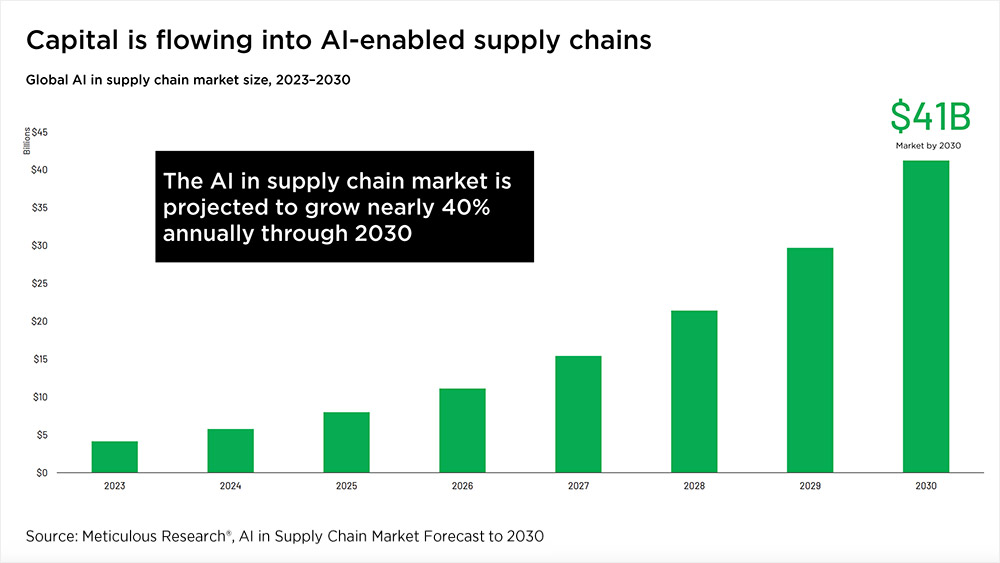
AI labor impact scenarios span from mass worker displacement to minimal employment disruption. AI is generally regarded as an unprecedented enabler of productivity, but the extent to which human labor factors into that productivity is yet to be determined. What is knowable is that the uncertainty itself has planning implications. Long-cycle location commitments — build-to-suit manufacturing facilities, long-term leases, anchor infrastructure investments — are being made against a backdrop where the future composition of the workforce and the nature of productive activity could shift materially within the asset’s useful life.
75%
Some regions are taking a proactive approach and establishing strategies and initiatives to prepare a more resilient and adaptable workforce for an AI-driven market. Cultivating flexible labor markets and workers that have in-demand, transferrable skills that are not dependent on a single industry or occupation seems to be a viable approach. There is an essential need for EDOs, workforce development organizations, higher education institutions and other partners to coordinate efforts and strategically align to employer demand in an ever-shifting labor market. Site strategy increasingly requires scenario planning so that the return on investment holds across a range of possible futures.
Automation is decoupling capital investment from job creation.
What to watch: Evaluate regional adaptability as a location attribute. Is the EDO using data-informed approaches to assess competitiveness? Are workforce development partners actively preparing students and workers to thrive in an AI-driven environment? Are local institutions demonstrating the capacity to evolve? These are leading indicators of a region’s ability to hold its value as conditions change.
Regional economic development ecosystems are a key consideration
A thread running through all five of these forces is that the quality of regional economic development cohesion and infrastructure has become a first-order location factor, not a background condition. In prior cycles, site selectors could rely primarily on static attributes — real estate costs, incentive packages, proximate labor counts and highway access — and treat the local EDO as a facilitator. In a landscape with persistent labor constraints, housing stress, infrastructure limits, automation-driven job transformation and AI uncertainty, the capability of local institutions to contribute to a community’s economic conditions and livability can be a competitive advantage or a constraint to economic growth.
The regions likely to outperform over the next decade are those where economic development organizations, local governments, workforce organizations and educational institutions are operating as an integrated system — sharing data, aligning priorities and capable of adapting to changing conditions. Assessing that organizational ecosystem, alongside the more traditional quantitative metrics, is increasingly how leading site selection teams are differentiating good markets from great ones.