The aerospace and defense sector is entering a new phase, one driven less by the development of new weapons systems than by the modernization of the infrastructure required to build them.
For much of the past half century, the United States invested heavily in research, development, and military capability, and the results are difficult to ignore. The nation maintains a significant technological advantage across much of the aerospace and defense landscape, supported by the world's largest defense budget and a robust network of prime contractors, subcontractors, research institutions, and federal laboratories.
What receives less attention is the physical infrastructure supporting that ecosystem. The aerospace sector has some of the highest fixed-capital requirements of any industry — tight specifications and rigorous testing demand a constant stream of equipment purchases, upgrades, and maintenance — yet the industry has historically struggled to invest in facilities at the same rate it invested in technology. Annual funding appropriations from Congress limit the government’s ability to guarantee long-term production, while public companies operate under financial models that closely scrutinize fixed-capital expenditures. The result: many aerospace firms have spent decades extending the life of facilities that were never designed for today’s production requirements.
It has been a common observation in aerospace circles that some of the finest military hardware in the world was being designed and constructed in some of the oldest facilities imaginable. The story is amusing, but it illustrates a broader reality: you can only repair, reconfigure, and repurpose aging facilities for so long before the infrastructure itself becomes a production constraint.
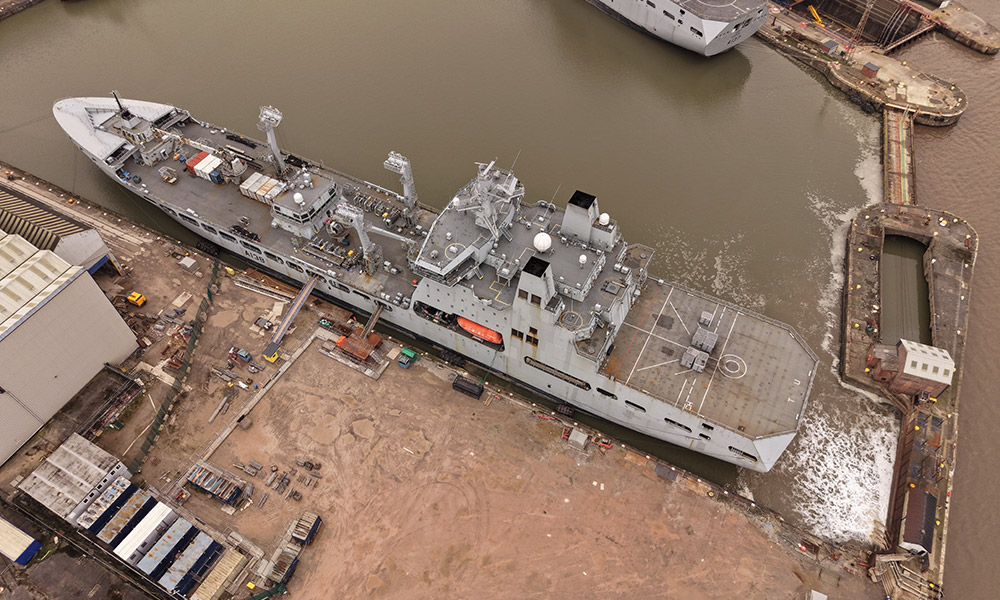
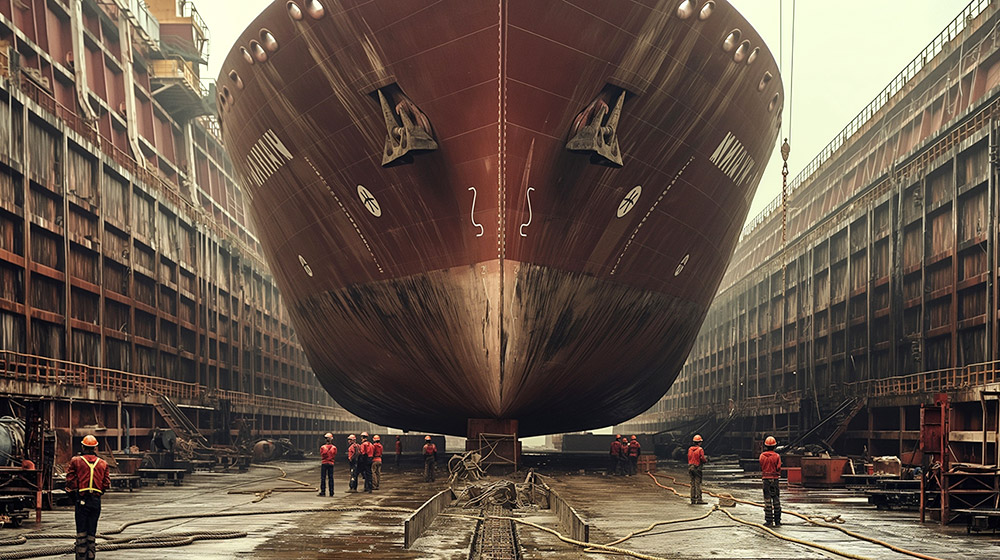
That constraint is no longer theoretical. A recent U.S. Navy assessment found the submarine industrial base producing roughly one new attack submarine per year, against a requirement closer to three, as the Navy works to replace Ohio-class missile boats and Virginia-class attack submarines that are themselves decades old. The shortfall isn’t about engineering talent or demand — it’s about facilities and production capacity that haven’t kept pace with the mission.
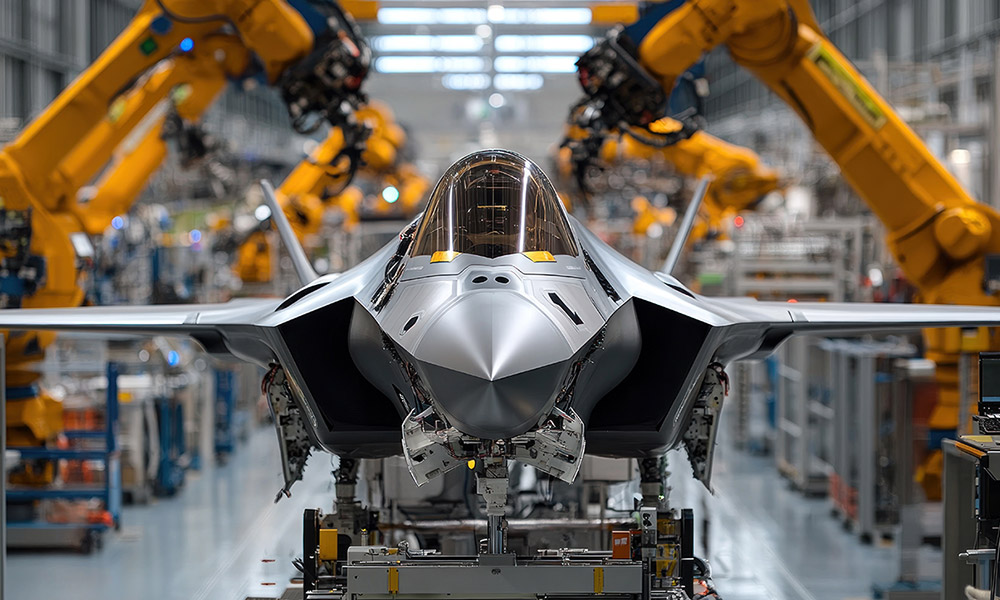
That reality is becoming increasingly important as defense contractors face growing pressure to expand production, accelerate delivery schedules, and compete against a new generation of aerospace and defense firms. The success of companies like SpaceX helped demonstrate that aerospace manufacturing doesn’t necessarily have to be conducted inside infrastructure inherited from the Second World War or the Cold War, and a growing population of defense startups is now entering markets that historically belonged almost exclusively to large incumbent contractors — often backed by private capital, building production systems from scratch rather than adapting facilities designed for weapons systems generations removed from today’s requirements.
You can only repair, reconfigure and repurpose aging facilities for so long.
That raises an interesting question. If you are responsible for a major weapons system program, who is more likely to receive the next production award: the contractor operating from an 80-year-old facility that has been repeatedly modified to accommodate new technology, or the competitor producing in a modern factory specifically designed around current manufacturing requirements?
Increasingly, the answer is forcing both heritage contractors and emerging firms to reevaluate where and how they manufacture — and it’s reshaping how production work gets funded and awarded. Much of today’s facility investment flows through what are informally known as production facilitization contracts, which push capital down through prime contractors or directly to suppliers via federal grant-like programs. In a growing number of cases, production contracts that once required a two- to three-year competitive procurement are now awarded sole-source to incumbent producers, with pricing based on prior output — letting contractors use production rate to lower per-unit cost and free up capital for the facility investment that has lagged for decades.
The result is a modernization cycle creating opportunities for communities across the country to attract aerospace and defense investment — particularly attractive projects, since they create what economists call core or base employment, importing revenue into a region while exporting product elsewhere, with multiplier effects across a broad range of supporting industries (more on that below).
The challenge for communities is understanding what aerospace and defense firms actually need. Despite all the discussion surrounding incentives, technology, and geopolitics, site selection in aerospace remains driven by a surprisingly familiar set of criteria: labor, speed to market, infrastructure, and cost competitiveness. And among those variables, labor remains king.
Labor Availability, Labor Cost, and the New Geography of Aerospace
The primary consideration in virtually all aerospace site selection projects is labor availability and labor cost. The two criteria, however, are inversely related.
As the quality of a region’s labor demographics improves, it attracts additional investment and population growth. Over time, that increased demand drives housing costs and wage rates higher, and communities that successfully attract aerospace investment can become victims of their own success.
1
While many defense contracts are awarded on a combination of technical capability, past performance, and cost, the government generally prefers the lowest-cost solution that satisfies technical requirements and presents acceptable execution risk — meaning a contractor that enters a program with a structural labor-cost disadvantage begins in a difficult position.
Modern site selection often begins with what is commonly referred to as a Black Hat analysis: determining what it costs a competitor to perform the work. Historically, this relied on public records, labor surveys, and a significant amount of educated guesswork. Today, advanced analytics and AI tools allow companies to develop a far more detailed understanding of workforce demographics, wage structures, commuting patterns, and labor-market conditions — and that competitor profile becomes a baseline.
The company combines that baseline with internal forecasts of hiring requirements, labor categories, production rates, attrition assumptions, and anticipated contract awards to build a detailed picture of workforce demand over the next five to 10 years. That workforce model becomes the foundation for any site-selection effort, and the results are often surprising.
Historically, aerospace projects tended to gravitate toward a relatively small collection of well-known markets with established labor reputations. Those locations remain attractive from a workforce-quality perspective, but they frequently struggle to compete on cost.
Modern analytical tools are opening the competitive landscape. When labor-market data is evaluated nationally, companies routinely identify five to ten previously overlooked labor sheds capable of supporting aerospace operations at a materially lower cost structure. Communities that may never have appeared on a traditional finalist list are suddenly finding themselves under serious consideration.
That analysis typically runs at the four-digit level of the Standard Occupational Classification system rather than the six-digit level used to match an exact job title. The broader view paints a more useful picture of a region’s underlying workforce capacity, even though many of those workers will need adjacent-skills training to be production-ready. Companies generally look for labor sheds covering five to ten times the required headcount across most relevant categories, paired with a cost-of-living index modestly below the national average — a combination that tends to hold up against a Black Hat competitor analysis.
3
The lesson for economic developers is an important one. A region does not need to be the most famous aerospace market in the country to compete successfully — it needs to demonstrate that it can provide a sustainable workforce advantage. That means workforce development can no longer be treated as a supporting activity; it is a primary economic-development function.
Communities must produce skilled workers faster than industry demand consumes them, and build sufficient housing to prevent wage escalation from eroding competitiveness. Housing policy and workforce policy have become inseparable — developing a noncompetitive cost of living is one of the most effective ways to encourage core employment to migrate to another market.
The strongest aerospace regions treat workforce development not as a short-term recruiting exercise, but as a long-term pipeline extending from local educational institutions to the factory floor. Workforce development addresses today’s shortages; workforce pipelining addresses tomorrow’s growth, and the distinction matters.
The most successful programs begin before a facility opens its doors. Advanced workforce analytics now allow companies to compare projected hiring requirements against current and future labor-shed demographics with remarkable accuracy, creating an opportunity for workforce initiatives to begin 12 to 18 months before occupancy — addressing labor deficiencies before production starts. Those programs generally perform best when they address four levels of development: dedication and aptitude, generalized educational training, proprietary process training, and on-the-job development. The exact mix varies by company, but the objective remains the same: ensuring the labor force is available when production begins.
For aerospace manufacturers, that remains the single most important variable in the site-selection equation.
Speed to Market and Infrastructure
If labor remains the primary site-selection variable, speed to market has become the second.
Many aerospace and defense manufacturers are being asked to increase production rates for both existing and emerging programs. Their current facilities are already rate constrained by age, layout, infrastructure limitations, or available labor. The logical solution is often a new facility.
Without a healthy base-employment sector, communities often become dependent upon the fortunes of someone else's economy.
The challenge is that defense contractors frequently do not have the luxury of waiting several years for a site to navigate environmental reviews, zoning changes, entitlement processes, utility upgrades, and construction approvals — so communities that can accelerate that process possess a meaningful competitive advantage.
Aerospace projects generally favor locations where uncertainty has already been removed from the development process: environmental reviews completed, wetland mitigation requirements identified, infrastructure capacity known, planning and zoning clearly defined, building permits moving on predictable schedules. The objective is not necessarily to make the process less rigorous — it’s to make it more predictable, because uncertainty is expensive. A contractor may be willing to invest significant capital in a new facility, but it becomes much harder to commit to a market when basic development questions can’t be answered with confidence.
The strongest communities increasingly approach site readiness as a product: the site is entitled, utility capacity is understood, the transportation network is in place, and environmental risks have been addressed, so the contractor can focus on manufacturing rather than development risk. A good model is a community capable of moving a site from agricultural zoning to approved industrial development in weeks rather than months, while maintaining a predictable permitting and inspection process throughout construction.
As aerospace manufacturers evaluate locations, they’re often comparing communities with similar labor characteristics and comparable incentive offerings — speed becomes the differentiator.
Behind labor and speed sits a third requirement that is becoming increasingly important: infrastructure.
Power availability has rapidly emerged as one of the most significant considerations in industrial development, as the explosive growth of data centers and advanced computing facilities absorbs capacity throughout much of the United States. Aerospace facilities are not among the largest consumers of power, but they require reliable power: as a general rule, a modern aerospace operation may need approximately two megawatts of service per 100,000 square feet of facility space, so a million-square-foot operation can require 20 megawatts of capacity backed by highly reliable service.
Many aerospace operations require redundant systems supported by multiple substations or independent power sources, since production and testing interruptions are both expensive — reliability is often as important as capacity, and the objective is not merely obtaining power, but obtaining dependable power.
This requirement is creating new opportunities for communities willing to think creatively about infrastructure. One emerging solution is the development of microgrids and dedicated generation assets within industrial parks: rather than relying exclusively on the traditional grid, facilities can create redundancy through local generation paired with conventional utility service, and increasingly, third-party providers are willing to finance and operate these systems through long-term power purchase agreements. The technologies vary — natural-gas generation, renewable energy systems, battery storage, and other emerging solutions are all entering the conversation — but the common denominator is reliability. Labor may get a community into the conversation. Site readiness may move it into the finalist round. Infrastructure increasingly determines whether a project can move forward at all.
Incentives, Competitiveness, and the Value of Core Employment
Business incentives are often described as the icing on the cake in the site-selection process. That may be true in some industries, but in aerospace and defense, incentives are often part of the cake mix — because aerospace manufacturing is an intensely competitive business, and a 5 to 10 percent cost advantage can influence the outcome of a contract competition worth hundreds of millions or even billions of dollars over its life cycle.
The defense industrial base is being rebuilt.
In a sector where margins are generally modest and contract awards are fiercely contested, seemingly small cost advantages matter.
Fortunately, the aerospace and defense industry operates within a framework that aligns the interests of contractors, communities, and the federal government. Under the Federal Acquisition Regulation (FAR), many forms of state and local incentives ultimately flow through the contractor’s cost structure and benefit the government customer — so communities aren’t simply assisting a private company, they’re helping lower the cost of delivering capability to the warfighter. That makes aerospace incentives fundamentally different from many traditional economic-development discussions.
The strongest incentive programs aren’t designed to replace sound business fundamentals; they’re designed to eliminate competitive disadvantages. If a community has become a victim of its own success and housing costs have pushed wage rates beyond competitive levels, incentives can offset those structural challenges while longer-term workforce and housing solutions take shape. If workforce pipelines need expansion, incentives can support training partnerships. If infrastructure improvements are required, incentives can accelerate deployment. Viewed properly, incentives become a tool for improving competitiveness rather than simply lowering taxes.
The reason communities are willing to make those investments is equally straightforward: aerospace and defense manufacturing creates the core or base jobs that economic developers covet most. These jobs import revenue into a region through payroll and contract spending while exporting product to customers elsewhere, producing a steady inflow of new dollars that supports activity throughout the local economy — moving through housing, retail, construction, professional services, restaurants, and healthcare. Economists can debate the precise multiplier, but the principle holds: strong manufacturing employment creates economic activity well beyond the walls of the facility itself.
Without a healthy base-employment sector, communities often become dependent upon the fortunes of someone else’s economy. With it, they gain the ability to generate sustainable growth from within.
That reality explains why virtually every community seeks manufacturing investment and why manufacturers devote so much effort to selecting locations that provide a durable competitive advantage.
No single factor will decide the winners. Labor remains the foundation, speed to market reduces risk, infrastructure enables growth, and incentives help close the gap between a good location and a winning one. The communities that understand those relationships — and act on them before the project arrives — will be the ones best positioned to capture the next generation of aerospace and defense investment.
The defense industrial base is being rebuilt. The question for communities is whether they intend to be part of that future, or watch it happen somewhere else.