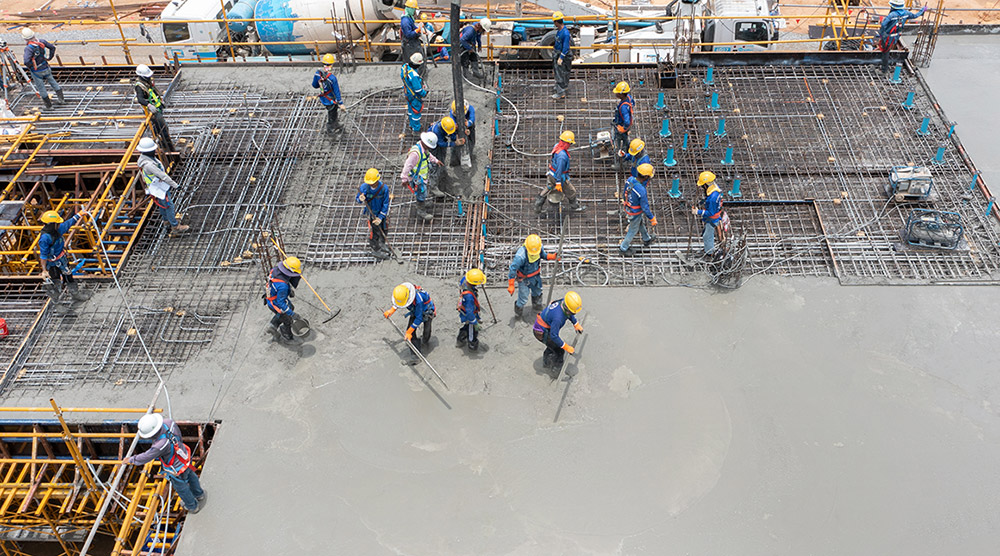

For decades, workforce development followed a familiar pattern. Manufacturers trained workers to operate facilities. Utilities developed electricians and technicians to maintain infrastructure. Construction companies invested in apprenticeship programs and craft training to build projects. Workforce development was largely organized around the needs of individual industries and employers.
Today, that model is evolving. The rapid expansion of artificial intelligence, advanced manufacturing, energy infrastructure and large-scale capital investment has fundamentally changed the workforce equation. The challenge is no longer simply finding workers to operate facilities after they are built. Increasingly, the challenge is finding enough skilled workers to build those facilities in the first place.
That reality helps explain why companies such as Meta and Google have recently announced significant investments in skilled trades development. While much of the attention has focused on the size of the investments or the number of workers expected to be trained, the larger story is what these initiatives reveal about the future of economic development in the United States.
The future may be digital, but it still has to be built.
A growing number of project owners now view workforce availability as a strategic business issue rather than simply a labor market issue. The timing is not coincidental. The United States is experiencing one of the largest waves of industrial investment in modern history. Data centers, semiconductor facilities, battery plants, advanced manufacturing operations, power generation projects, transmission infrastructure, healthcare facilities, logistics hubs and transportation improvements are all being developed simultaneously.
Each project competes for many of the same skilled trades professionals: electricians, welders, pipefitters, HVAC technicians, equipment operators, fiber technicians and construction managers. The result is a labor market unlike anything many industries have experienced before.
Historically, workforce development efforts often focused on preparing workers for jobs inside a facility once construction was complete. Economic development strategies centered on ensuring an adequate operating workforce for future employers. Today, however, workforce development increasingly begins years earlier, during project planning and construction. A semiconductor facility cannot open if it cannot be built. A data center cannot support AI workloads if the power infrastructure is delayed. A manufacturing facility cannot begin production if labor shortages extend construction schedules by months or years. In many cases, workforce capacity has become a leading indicator of project certainty.
Workforce development is becoming a form of risk management.
That shift helps explain why some of the world's largest owner companies are moving beyond traditional workforce development approaches and investing directly in skilled trades initiatives. Meta and Google are not alone. Companies across multiple industries are becoming more active participants in workforce development. Retail leaders such as Lowe's and Home Depot have expanded support for skilled trades education and career awareness programs. Industry advocates such as Mike Rowe have spent years elevating the visibility and importance of skilled trades careers. Manufacturers, utilities, technology companies, contractors, educational institutions and workforce organizations are increasingly aligning around a shared objective: expanding the skilled labor pipeline.
What makes the current moment different is the level of owner engagement. For years, contractors, trade associations, community colleges and workforce agencies carried much of the responsibility for developing skilled labor. Today, project owners are increasingly investing their own resources, influence and capital into workforce solutions because they recognize the direct connection between labor availability and business growth. Workforce development is becoming a form of risk management.
A semiconductor facility cannot open if it cannot be built.
Companies understand that access to power, permitting, water, transportation and real estate remains critical. Increasingly, however, access to skilled labor belongs on that same list of strategic considerations. For economic developers and site selectors, this trend carries important implications. Regions that can demonstrate strong workforce ecosystems, scalable training capacity, industry partnerships and sustainable skilled labor pipelines will enjoy a competitive advantage in attracting future investment. The ability to build projects may become just as important as the ability to operate them.
The emergence of owner-led workforce initiatives also signals a broader shift in how companies evaluate location decisions. Labor availability is no longer simply a hiring metric. It is increasingly a project delivery metric, a growth metric and a competitiveness metric. In many respects, this represents a natural evolution. The construction industry has spent decades warning about demographic challenges, retirements and declining awareness of skilled trades careers. What is changing today is that owners are experiencing those constraints firsthand through longer schedules, rising costs and increasing competition for talent.
As a result, workforce development is moving from the margins of corporate strategy to the center of it. The AI economy, manufacturing renaissance, energy transition and infrastructure expansion may be driven by technology and capital investment, but none of them can succeed without the skilled workforce required to bring projects to life. America's largest companies are beginning to invest accordingly. The future may be digital, but it still has to be built.