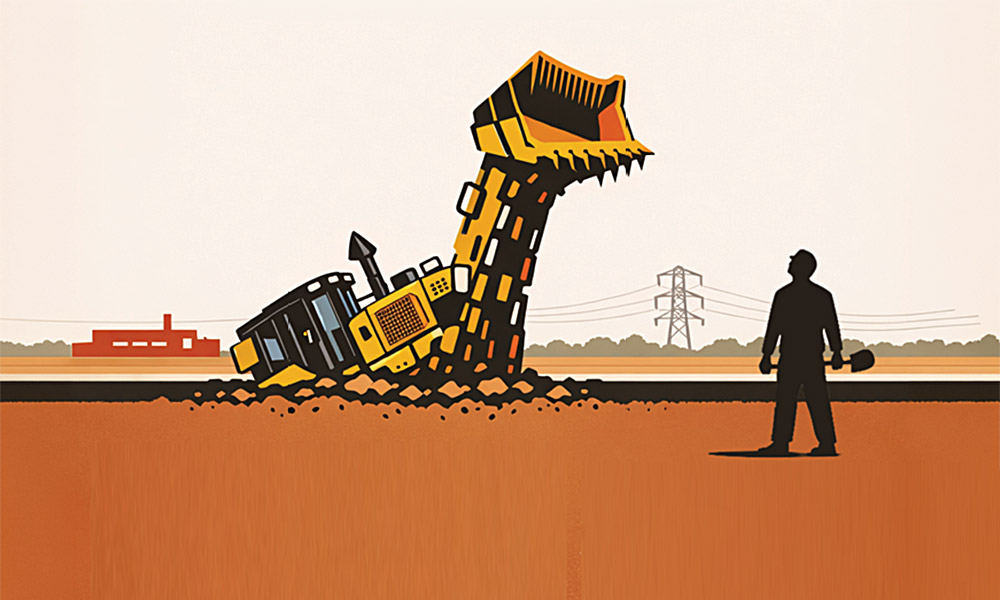
The world of site selection has always been a high-stakes game of timing, logistics, and negotiation. But the conditions shaping project decisions today are more complex, more compressed, and more punishing of mistakes than at any point in recent memory. The margin for error has shrunk to almost nothing, and the old playbook is increasingly obsolete.
To find out what's really killing deals in 2026, Area Development went straight to the people in the room when projects go sideways. What we heard was a consistent story about speed, uncertainty, and the growing mismatch between how the private sector moves and how the public sector responds.
Permitting and Rezoning Delays: The Public Sector’s Achilles Heel
One of the clearest refrains from practitioners this year is that project delays are no longer primarily the client’s fault. The bottleneck has shifted.
“Where we’re seeing the delays happen is actually on the state and local side rather than the client side,” says Alicia Janesko-Hutchings, a site selection and incentives specialist with Cresa’s Dallas office who works across manufacturing, warehouse, distribution, office, and life science sectors. “The permitting process often slows down the process. Sometimes NIMBYism at the local level is also delaying the project. There needs to be more prep work done on that side of things.”
Janesko-Hutchings notes that the incentive process itself has become a source of friction. “The incentive process isn’t really aligning with the way projects are making decisions so quickly nowadays. There’s definitely a disconnect there — the inability to respond quickly in terms of an incentive proposal, whether it’s approvals or application process. Those need to start aligning a little bit better, because the world of economic development has changed significantly and just continues to speed up.”
Patrick McMullen, CEO of Phillips Infrastructure Corp. — a family-owned heavy civil contractor approaching its 75th year in business — sees this from the contractor side daily. “The biggest delay in getting going, once the site is selected and someone wants to go, would be incomplete design and permitting,” he says. His COO, Gerry Arvidson, points to early contractor involvement and open communication with agencies as partial solutions, and stresses understanding wetland and waters-of-the-U.S. impacts early. “Having the contractor selected and the team early for early contractor involvement can help drive that,” Arvidson says. Having storm water control plans well thought out before the process begins is critical — because doing it wrong costs time that can’t be recovered.
Stale Budget Data: The Construction Cost Trap
If permitting is the most common public-sector deal killer, construction cost miscalculation is its private-sector counterpart — and it’s almost entirely avoidable.
“A lot of times clients come in with preconceived notions around what a project could cost or should cost,” says Chris Urchell, Senior Manager of Real Estate Advisory at Baker Tilly. “They’re using old benchmark data around a previous facility, and they don’t really have a good understanding of how much construction cost has risen in the last couple of years or even months.”
The consequences play out in a painful sequence. A company gets informal estimates during feasibility, bakes those numbers into a board-level capital authorization, then discovers — deep into design — that detailed construction costs are 30, 40, or 50 percent higher. “They’ve already talked to the banks. They’ve already gone to the board for approval and it’s information that’s outdated.” The project has to go backwards: back to the bank, back to the board, sometimes back to the drawing board on facility design.
The incentive process isn't really aligning with the way projects are making decisions so quickly nowadays.
McMullen at Phillips Infrastructure puts hard numbers on the inflation driving this dynamic. Skilled labor costs across their business are up roughly 30 percent over five years. Equipment acquisition costs have essentially doubled over five to seven years due to price increases from manufacturers like Caterpillar, Komatsu, and John Deere. Commodity inputs have followed. “All inputs are up — labor, commodities, equipment,” McMullen says. The fix is straightforward: connect companies to construction and engineering firms early, before numbers get locked into commitments that the market can no longer support.
Power Availability: The Hard Filter
Ask almost anyone in site selection what they’re watching most closely, and the conversation arrives at power. What practitioners are describing in 2026 goes beyond a preference for available capacity. Power has become a binary filter.
“Even a location that is optimal from a logistics perspective, from a labor perspective — if the power cannot be supplied in sufficient quantity for a particular operation, then that facility or that location is filtered out,” says J.C. Renshaw, Head of Supply Chain Consulting for North America at Savills.
Renshaw points out that the challenge extends beyond raw electricity availability to the full ecosystem of switching equipment, transformers, and ancillary infrastructure. In a world where facilities are increasingly embedding automation and AI in their systems, these requirements are only growing. “Our clients have to make sure that their facilities are outfitted not just for today but for tomorrow,” he says.
Courtland Robinson, Director of Business Development at Brasfield & Gorrie — a national, privately held contractor with more than 60 years of experience across industrial, commercial, healthcare, and data center markets — frames the issue in terms of scale. “Many of the campuses being cited across the country are going into fairly rural areas, and those rural areas don’t inherently have the infrastructure to support everything that campus is going to need at full build-out — from simple things like road and sewer to fire and police, to bigger regional infrastructure considerations.”
For Janesko-Hutchings at Cresa, utility partners have made real progress on transparency about delivery timelines. “I love seeing that,” she says. “But it still is delaying projects if it’s not meeting the client’s timeline.”
Financing Uncertainty: When the Math Doesn’t Work
Even when a site checks every box, deals can collapse when financing doesn’t come together. David MacNamara, an economic development attorney with Womble Bond Dickinson, identifies financing conditions as one of the most significant — and underappreciated — sources of project stalls.
50%
“Financing is a big piece of it — companies being able to support the business case for the project, either the economics penciling out, or actually just borrowing at a number they’re comfortable with,” MacNamara says. “Often lenders are very interested in teeing those up. But ultimately, when you get down to the hard numbers, those numbers don’t end up penciling out the way clients are willing to sign on the dotted line.”
The result is a pattern he encounters frequently: companies saying they’ll wait six months and watch how market conditions evolve. For companies collateralizing project loans with treasury stock, share price movements have a direct impact on borrowing capacity and cost of capital. At its root, MacNamara acknowledges, it comes back to the same theme running through nearly every stalled deal: uncertainty.
The Tariff and Immigration Overhang
It would be impossible to survey deal-killers in 2026 without addressing the macro environment. One foreign direct investment specialist focused on international manufacturing projects describes the current situation as a two-part challenge: uncertainty and rising costs. “The uncertainty of what the tariffs are, the rising costs due to tariffs — and then immigration. The questions on who can come and who cannot come cause a lot of projects to slow down or reduce their scope.” For companies whose equipment is not made domestically and has to be imported, tariff-driven cost increases are direct and concrete. Janesko-Hutchings agrees that ongoing legal battles continue to cloud the landscape, even as some clarity has emerged.
The Speed Imperative — and What It Demands
Woven through all of these deal-killers is a common thread: speed. Robinson of Brasfield & Gorrie describes the current environment as an “exponential age” — faster innovation cycles, shorter times to market, surging demand across multiple sectors. “Decisions have to be made faster. Yet there is an incredible amount of uncertainty in almost every facet of making capital project planning decisions.”
Even a location that is optimal from a logistics perspective, from a labor perspective — if the power cannot be supplied in sufficient quantity ... that location is filtered out.
McMullen at Phillips Infrastructure describes companies launching projects before designs are complete and before all permits are in place. His firm built the initial site work for a major Ford manufacturing facility in West Tennessee under those conditions — what was bid was “not at all” what was ultimately built, as aggressive scheduling drove significant changes in the field. The project succeeded because Ford was a sophisticated owner who understood the environment. Most aren’t.
His advice to site selectors is pointed: bring the civil contractor into the process early. “They should put us in the car with them when they’re selecting their site. Tell us what their objectives are, what their timelines are, what the cost-schedule tradeoff means to them.” The civil contractor, he argues, is the tip of the spear on fast-track projects. If the civil side falters, everything downstream delays.
Ohio’s Model: What Alignment Looks Like
One example of what it looks like when the public sector keeps pace with the private sector comes from Ohio. J.P. Nauseef, President and CEO of JobsOhio, describes a model built explicitly around speed, access, and collaboration.
“Speed to put a deal together, access to a site that is ideal, ability to find talent, a focus on customer service, a working relationship with the administration and the legislature, and a network of economic development professionals working together are all ways JobsOhio competes and creates a competitive advantage for Ohio,” Nauseef says.
The results are concrete. Just last month, Sherwin-Williams celebrated the grand opening of its new headquarters in Cleveland, transforming the city’s skyline after out-of-state competitors made a serious run at pulling the company away. Earlier this year, Anduril Industries began drone production at its Ohio facility less than a year and a half after announcing the project — a timeline the company had made clear was non-negotiable. And when Intel surfaced as an opportunity, Ohio wasn’t even in the original consideration set. “We pulled together options from across the state, submitted a proposal in just three days, and were ultimately chosen from 40 other options,” Nauseef says — after a councilwoman’s call to a network partner set the whole thing in motion.
They should put us in the car with them when they're selecting their site.
“JobsOhio is unique in that our model is private, allowing flexibility when addressing a company’s needs and challenges,” Nauseef adds. “When our partners at the state and local level are confronted with challenges, we’ll respond rapidly with solutions to navigate our clients’ needs.”
The Ohio story is instructive not just as a success case, but as a template. The deal-killers practitioners describe — slow permitting, misaligned incentive timelines, inadequate infrastructure, delayed decision-making — are all symptoms of a system that hasn’t adapted to the speed at which private capital now moves. The states and communities that close that gap are the ones that win the projects.
The Short Checklist
The experts interviewed for this article offer a consistent set of recommendations:
Get current construction cost estimates — not ballpark figures from previous projects or benchmarks from five years ago. Real numbers, from active contractors, matched to your actual facility requirements.
Treat power as a primary filter, not a secondary consideration. Understand not just what is available today, but what can be delivered on your timeline and at the scale your operations will require as they grow.
Bring the civil contractor into site selection, not just site construction. Their early read on geotechnical conditions, permitting complexity, and schedule achievability can save months and millions.
The deal-killers are well known. The difference, in 2026, is that there’s very little time to recover from them.