The space industry and the defense industry have always had a close relationship, but for many years they were treated as different markets. Human spaceflight, science missions and commercial satellites were generally placed in one category, while military aircraft, weapons systems and other defense platforms were placed in another.
That separation is becoming harder to maintain.
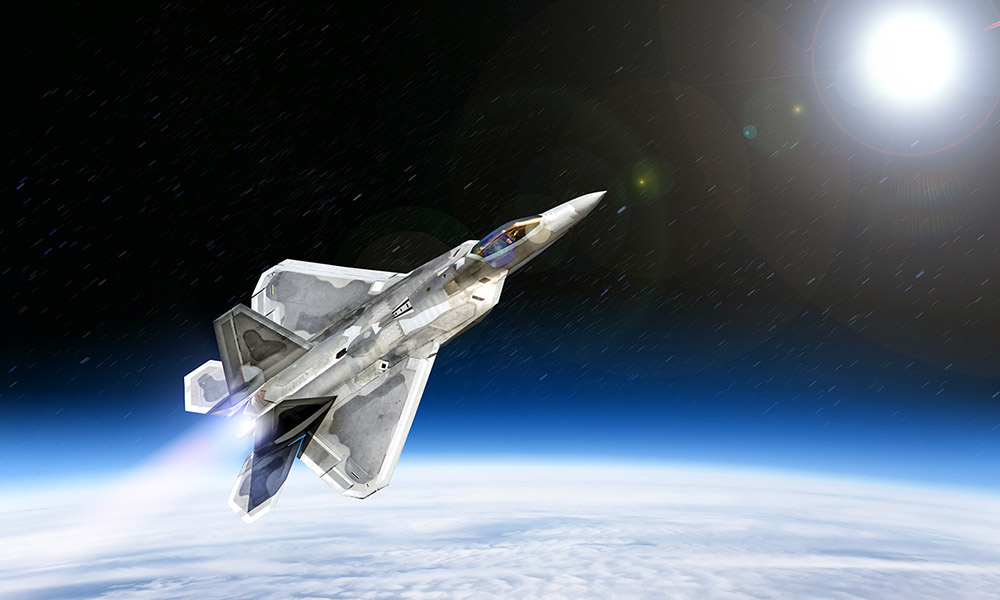
The two industries are continuing to merge through shared technologies, engineering talent, suppliers and missions. Companies are combining launch capability with spacecraft production and operations. Defense companies are using space engineering experience to solve difficult problems in aircraft and missile programs. At the same time, communications, navigation, surveillance and missile-warning systems in orbit are becoming more important to national security. For companies and communities, space and defense should increasingly be viewed as parts of the same industrial ecosystem.
The relationship between the two industries goes back to the beginning of modern rocketry. Early pioneers including Robert Goddard, Konstantin Tsiolkovsky and Hermann Oberth were interested in rockets as a way to carry scientific instruments and eventually reach the moon. World War II moved rocketry into an industrial and military phase through Germany's development of the V-2 missile.
After the war, space exploration and defense aerospace developed their own institutions, budgets and supplier networks. The industries appeared to move in different directions, but many of the underlying technologies remained similar. Today, those similarities are becoming more visible and more important.
One example is the growing combination of launch vehicles, spacecraft and space-based services.
SpaceX has demonstrated a business model in which launch capability supports a much larger satellite and communications operation. The launch vehicle provides access to space, but the larger revenue opportunity comes from the communications services delivered through the satellites placed in orbit.
In that way, the launch vehicle is not necessarily the final product. It is the means of delivering the systems that support the larger business.
Other companies are also bringing launch, spacecraft manufacturing, satellite operations and data services into the same organization. As this continues, the traditional lines between launch providers, satellite manufacturers, communications companies and defense contractors become less distinct.
The overlap is also occurring within engineering organizations.
In 2001, Lockheed Martin won the Joint Strike Fighter program, now known as the F-35. During the design of the aircraft, its large amount of computing and processing capability created a significant increase in electrical demand. That demand, along with other advanced systems, contributed to the aircraft becoming overweight.
Aircraft have always been sensitive to weight, but the space industry has historically been even more sensitive. The cost of placing each pound into orbit was so high that spacecraft designers spent a great deal of effort reducing weight wherever possible.
The two industries are continuing to merge through shared technologies, engineering talent, suppliers and missions.
Lockheed Martin brought engineers from its space operations into the F-35 weight-reduction effort. The spacecraft designers recommended the use of space battery technology along with other design approaches intended to save weight. Within a matter of months, the program was moving back toward its weight targets.
The collaboration was not considered an obvious solution at first.
The aircraft engineers believed they had to design to a tougher standard because a fighter jet must endure thousands of high-impact landings and operate in a wide range of environmental conditions. The space engineers pointed out that their systems also had to operate in extreme environments, including dramatic temperature changes, launch forces and radiation.
There was another important difference. When an aircraft has a failure, it can often be recovered and examined. A spacecraft may never return, meaning engineers may not have the opportunity to physically inspect a failed component. Both groups eventually recognized that they were dealing with different versions of the same basic challenge. Each engineering team had experience that could help the other.
Hypersonic systems provide another example of the overlap between space and defense.
Hypersonic speed in missiles is not new. What is changing is the ability of these systems to maneuver, alter their flight path and potentially change targets while traveling at extreme speeds. That creates difficult problems involving temperature, shock, materials, aerodynamics and guidance.
These are not new problems for the space industry. Spacecraft routinely travel at speeds greater than hypersonic weapons, particularly during orbital flight and atmospheric re-entry. Space engineers have spent decades working with thermal protection, high-temperature materials, flight dynamics and control systems.
Space engineers and traditional defense engineers have combined this experience to support a new generation of hypersonic systems. Technologies developed for spaceflight and re-entry can now be applied to military vehicles operating within the atmosphere.
The relationship between the industries has also become closer because space itself is now a contested military domain.
In 2007, China destroyed one of its own satellites in orbit as a demonstration of its antisatellite capability. The event showed the vulnerability of large, expensive satellites and the importance of space-based systems to military operations.
Since then, the United States has placed more emphasis on resilience. One approach is to deploy larger numbers of smaller satellites instead of relying only on a limited number of highly capable spacecraft. A disaggregated constellation can make communications, surveillance and other capabilities more difficult to eliminate through a single attack.
This change is bringing commercial space companies, traditional defense contractors and newer technology companies into the same procurement and supplier environment. Satellite manufacturing, launch services, secure communications, sensors, cybersecurity and data processing are increasingly connected parts of the defense industrial base.
The launch vehicle is not necessarily the final product. It is the means of delivering the systems that support the larger business.
This convergence has important implications for economic development and corporate location strategy.
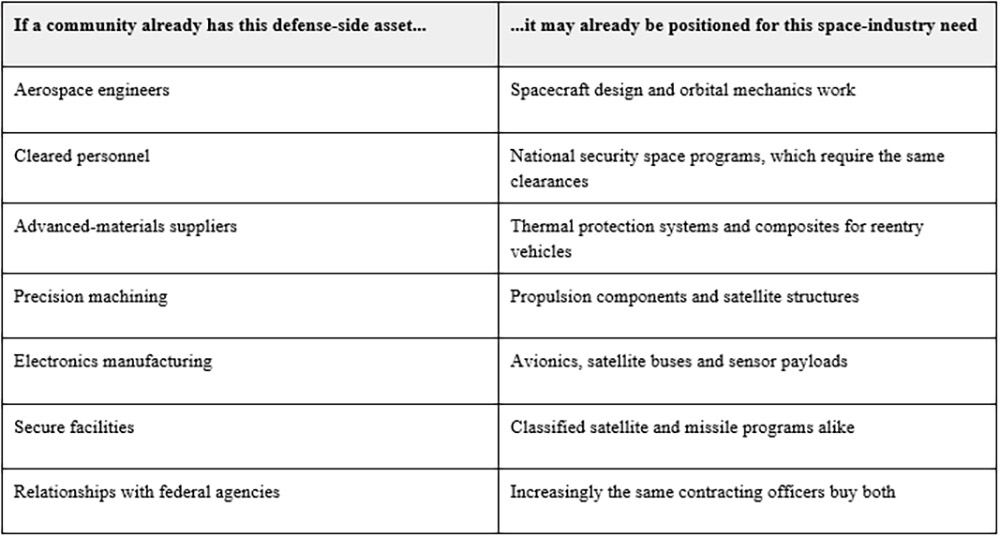
A community with an existing defense industry may already have many of the assets required by space companies. Those assets can include aerospace engineers, cleared personnel, advanced-materials suppliers, precision machining, electronics manufacturing, secure facilities and relationships with federal agencies.
The reverse is also true. A region with launch activity, satellite production, research universities or a commercial space cluster may already have capabilities that are attractive to defense companies.
Communities should not automatically treat space and defense as unrelated recruitment categories. They should look at the technologies, workforce skills, infrastructure and supplier capabilities that can support both industries.
A company producing parts for military aircraft may already have the precision manufacturing experience needed by a spacecraft company. A university working on propulsion or thermal materials may be relevant to both launch vehicles and missile systems. A workforce familiar with federal contracting and secure facilities can be useful across both markets.
Federal defense budgets remain much larger than commercial space budgets, but the amount of space-related work inside the defense budget is increasing. At the same time, technologies developed by commercial space companies are moving more quickly into military applications.
The space and defense industries will continue to have different customers, contracting processes and operating environments. They are not becoming completely interchangeable.
Their overlap, however, has become too large for companies and communities to ignore.
For regions that already have an established space or defense industry, the other market may represent a natural opportunity for growth.