There is an old line in hard tech that the second mouse gets the cheese. The company that builds the first commercial plant for a new technology absorbs the cost overruns, the startup problems, and the skepticism of every lender it meets. The company that builds the fifth plant gets a proven design, a trained supply chain, and a bank that has seen the numbers before.
Someone still has to go first, and the past three years have shown what happens when first-of-a-kind (FOAK) projects run out of runway. Battery recycler Li-Cycle paused construction on its Rochester, New York, hub in 2023 and entered bankruptcy in 2025 without drawing a dollar of a $475 million federal loan. Northvolt, once Europe's flagship battery maker, went under after its Swedish gigafactory struggled to reach meaningful output.
Much of the coverage of this problem is written for investors. But the financing gap is also a location problem. The site a company chooses changes how much its first plant costs, how long it takes to build, and how comfortable a lender is underwriting it. For corporate real estate teams and the communities competing for these projects, that makes site selection part of the financing strategy, whether anyone calls it that or not.
$475M
Too big for venture, too risky for banks
The first commercial plant is a different consideration. The price tag jumps to hundreds of millions or billions of dollars, and most of that money goes into concrete, steel, process equipment, and utility infrastructure. Venture investors are poorly suited to fund physical assets at that scale. The dilution is punishing, and hard assets don't produce the kind of returns venture funds are designed to chase.
Conventional project finance should step in here, but it can't, at least not yet. Project lenders underwrite predictable cash flows from proven technology. They want operating history, performance data, and a track record of similar plants. A FOAK facility, by definition, has none of those.
That is the valley of death: the technology is proven enough that venture investors have done their job, but not proven enough that lenders will do theirs. Projects that can't find a way across don't fail dramatically. They stall, burn equity while they wait, and eventually run out of time.
A loan award is not money in the bank, and an incentive that pays out after operations begin does nothing to get a project across the valley.
The first plant always costs more
The best data on FOAK cost overruns is more than 40 years old. In 1981, the RAND Corporation published a study of 44 pioneer process plants built by 34 oil, chemical, and mineral companies. It remains the most commonly cited method for estimating first-plant costs.
The headline findings are sobering. According to a 2009 summary of the study in California Management Review by Bent Flyvbjerg, Massimo Garbuio and Dan Lovallo, final construction costs averaged more than double the initial estimates. A year after startup, roughly half the plants were producing below 75 percent of design capacity, and a quarter were below 50 percent.
The finding that should matter most to site selectors is buried deeper in the report. RAND found that most of the variation in cost-estimating error came down to three factors: how far the technology departed from prior plants, how well the project's site and related characteristics were defined, and how complex the plant was.
Once a company commits to a technology, it can't do much about technology novelty or plant complexity. The site is the variable it controls. A poorly defined site, with uncertain utility capacity, unresolved environmental conditions, or an unclear permitting path, compounds the technology risk that lenders are already nervous about.
Schedule risk makes this worse. Every month a FOAK project slips, it burns equity without producing revenue, and investor patience erodes. Lenders know this, which is why, in my experience, the independent engineer reviewing a FOAK project looks as hard at site conditions as at the process technology.
500+
How projects get across
No single source of capital bridges the valley. FOAK projects that reach construction typically assemble a layered stack: sponsor equity, strategic investors who are often also future customers, government loans or grants, transferable tax credits, debt secured against long-term offtake contracts, equipment vendor financing, and state and local incentives.
Each layer comes with conditions, and the conditions tend to depend on each other. Lenders want an independent engineer's sign-off, bankable offtake agreements, construction contracts with performance guarantees, and contingency and reserve accounts funded up front. Most of all, they want sponsor equity committed before their money goes in.
Li-Cycle shows how that chain breaks. The company received a $375 million conditional commitment from the Department of Energy (DOE) in February 2023. It closed as a $475 million loan in November 2024. To draw on it, Li-Cycle had to put in its own equity and fund roughly $173 million in project reserves. It couldn't raise the money. Meanwhile, the state and county incentives were tied to workforce benchmarks that could only be met once the plant was operating. Every piece of the stack was waiting on the one piece nobody could provide. Glencore acquired the assets in bankruptcy in 2025.
The federal layer of the stack has also shifted. DOE's Loan Programs Office has been renamed the Office of Energy Dominance Financing and its authority rewritten under the One Big Beautiful Bill Act. In January 2026, DOE said it was restructuring, revising, or eliminating more than $83 billion in loans and conditional commitments from the prior portfolio. Priorities now center on nuclear, critical minerals, grid reliability, and dispatchable generation, anchored by a $17.5 billion conditional commitment in June 2026 for long-lead components for up to 10 Westinghouse AP1000 reactors.
The tax credit picture is similarly mixed. The 45X advanced manufacturing credit survives, but wind components lose eligibility after 2027, critical minerals phase down starting in 2031, and new foreign-entity restrictions took effect in 2026. The 48C investment credit is closed to new projects. Treasury, the IRS and DOE allocated the program's full $10 billion in two rounds in 2024 and early 2025, and the One Big Beautiful Bill Act bars reissuing credits revoked from projects that miss their certification milestones, eliminating the possibility of a third round. The 45V clean hydrogen credit now requires construction to begin before 2028.
Federal support for FOAK projects is still real. But eligibility now tracks policy priorities more closely than it did in 2024, and policy risk has become its own line item in underwriting.
Location as a risk-reduction tool
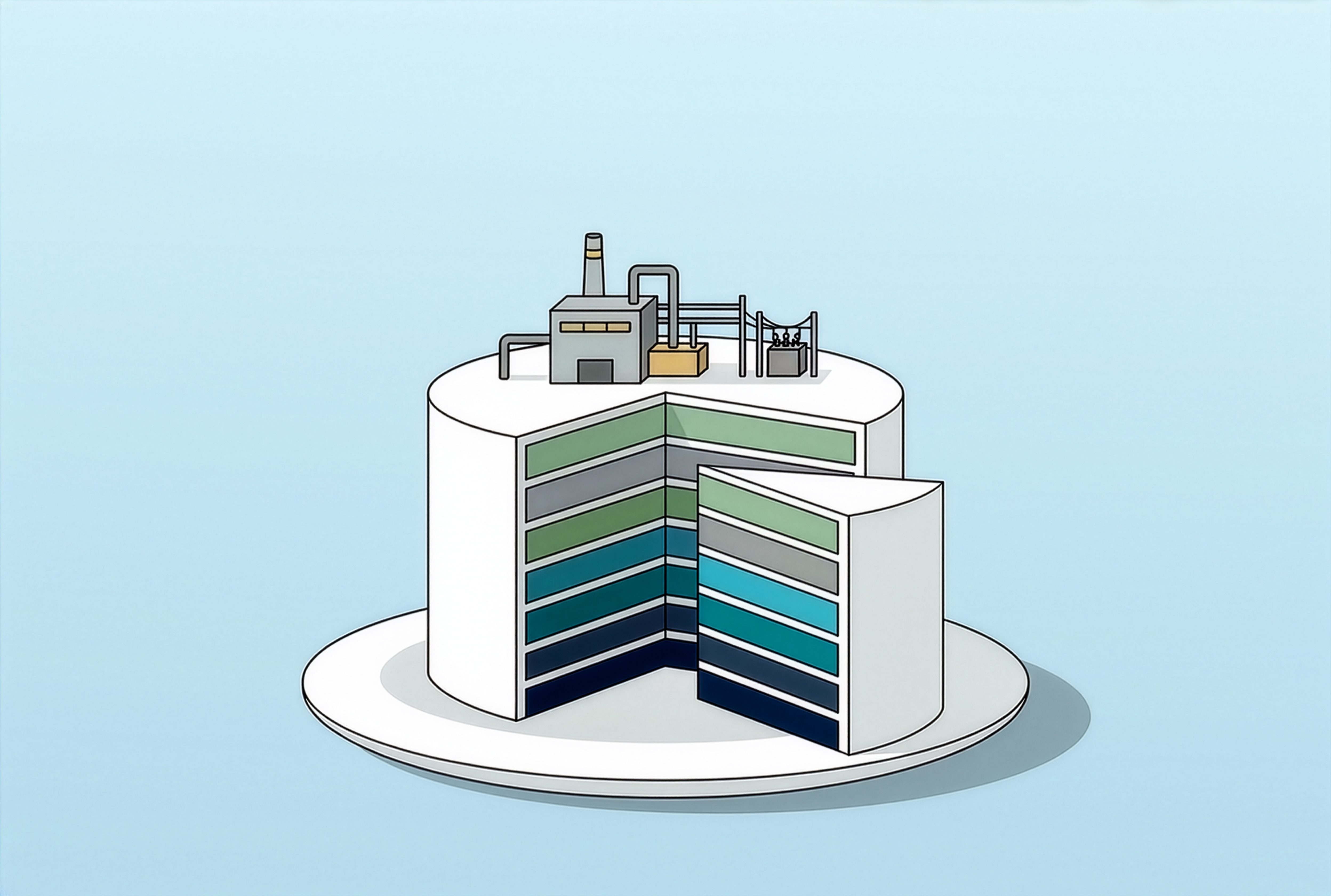
If the FOAK problem is too much risk concentrated in one project, the site can take some of that risk off the table. It does so in four ways.
It reduces schedule risk. A pre-permitted, shovel-ready site with confirmed utility capacity shortens the window between financial close and first production, which is the window where FOAK projects bleed cash.
It reduces cost risk. Brownfield sites with existing rail, water, wastewater, and power infrastructure cut the capital a company has to raise. Publicly funded shared infrastructure does the same.
It reduces execution risk. Proximity to an experienced industrial workforce, a national laboratory or university partner, and an established supplier base makes the difficult startup phase more manageable.
And it reduces capital risk, which is where communities have the most room to be creative.
Form Energy's first factory is an instructive example. The iron-air battery company reviewed more than 500 candidate locations across 16 states before choosing a 55-acre former steel mill site in Weirton, West Virginia, with direct access to rail, highway, and the Ohio River. The state's Economic Development Authority committed $75 million to acquire the land and build the facility, and the state retains ownership of the land and buildings as collateral for its broader incentive package.
That structure matters more than the dollar figure. It moves land and building costs off the company's balance sheet at exactly the moment capital is scarcest. Form pays the state a market-based lease rate, and the incentives remain tied to job creation. But if the company falls short, the state doesn't have to chase a clawback against a company that may not have the cash to pay it. It already holds the asset.
So far, the project is on track. Form Factory 1 began trial production in September 2024 and employed more than 400 people as of February 2026. It is building the batteries for a 30-gigawatt-hour system Xcel Energy will use to serve a new Google data center in Minnesota, and Form is targeting at least 500 megawatts of annual capacity by 2028.
Commonwealth Fusion Systems (CFS) is building a similar stack for ARC, its planned fusion power plant in Chesterfield County, Virginia. The roughly 94-acre site is owned by Dominion Energy, and CFS holds an option to lease it rather than buying the land outright. Google and Eni have signed power purchase agreements covering more than half of the plant's planned output. A $1 billion equity raise in July 2026 brought the company's total to roughly $4 billion.
The state protected itself by holding a real asset, not by relying on a clawback against a company that might not have the cash to pay it.
The lease conserves capital. The offtake agreements give future lenders something to underwrite. The utility partnership addresses infrastructure risk. But CFS also shows where schedule risk now lives: the company filed its interconnection application with PJM Interconnection, the regional grid operator, in April 2026, a process expected to take four to six years. For many FOAK projects, the longest lead time is no longer the technology. It is the grid queue.
What changes for companies and communities
For corporate real estate teams working on FOAK projects, the practical shift is timing. The site should enter the financing conversation early, not after the capital stack is assembled. That means screening candidate sites against the questions a lender's independent engineer will eventually ask: when utility capacity will be available in writing, what the permitting path looks like and how long it takes, what is known about subsurface and environmental conditions, and what infrastructure the company will have to build itself. A site that can't answer those questions cleanly adds cost to the capital, not just to construction.
For economic development organizations, the shift is in how incentives are structured. Traditional packages pay out against jobs created and capital invested, usually after operations begin. That is backward for FOAK projects, which need help most before they produce anything. Incentives that front-load support, tie it to construction and technical milestones, or take the form of publicly owned land and buildings do far more to get a project across the valley. They can also protect the community better than a clawback against a company that may not survive.
Communities also need to do their own diligence. A FOAK plant that fails leaves behind a partially built or idle facility, stranded infrastructure investment, and a workforce that was promised jobs. Understanding the project's capital stack, which conditions it depends on, and what happens to the site if the company doesn't make it is part of responsible deal-making. Sometimes the right answer is to walk away.
$75M
Northvolt offers a partial counterpoint. The company failed, but its infrastructure didn't. Lyten completed its acquisition of Northvolt's Swedish assets in February 2026, including 16 gigawatt-hours of existing battery manufacturing capacity and more than 160 hectares (about 395 acres) of land, and a data center developer plans to buy a portion of the site. A FOAK facility built on a well-chosen, well-served site has a second life. One built on a marginal site usually doesn't.
The valley doesn't disappear. It gets narrower.
No site can make a new technology work. But the right site can shorten the schedule, lower the capital requirement, give lenders fewer unknowns to price, and give the community a real asset if things go wrong. For FOAK projects, those advantages can be the difference between a plant that reaches financial close and one that stalls in the valley.
The companies and communities that understand this are already treating the location decision and the financing decision as the same conversation. The rest are still running a traditional site search for a project that will never be traditional.
The first mouse still takes the risk. The job of the site is to make sure it survives long enough to build the second plant.