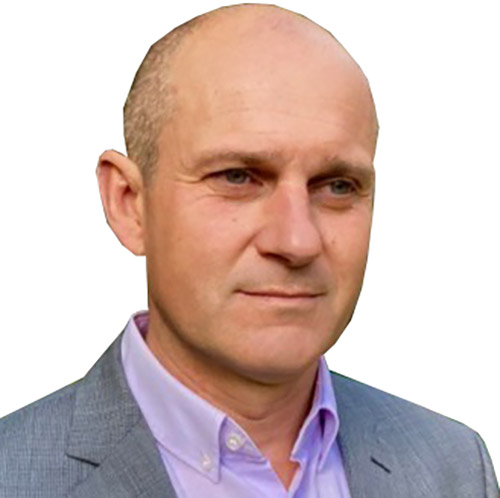
Philippe Mantelet, Head of Global Engineering, Sites and Facilities at UCB — the Belgium-based, family-owned biopharmaceutical company — has spent more than 20 years helping the company transform its manufacturing footprint worldwide. Now he's overseeing one of the biggest projects of his career: a $2 billion large-scale biologics manufacturing facility in Gwinnett County, Georgia, that will anchor UCB's U.S. supply chain for decades to come. Mantelet spoke with Area Development about what won the site, what keeps him up at night, and why failure isn't even in the risk register.
Area Development: You head Global Engineering, Sites and Facilities for UCB. Set the scene for us: What's driving UCB's push into U.S. manufacturing specifically?
Philippe Mantelet: We are facing a decade of growth — the products that we are proposing to our patients are really successful, so we need to upgrade our manufacturing capabilities. The U.S. patients are really important for us. We want to secure the supply of our products within the U.S. — to ensure that every patient in the U.S. will benefit from the most reliable and performant product delivered by our facilities. This is our strategic ambition, and this is why we decided to come and settle in the U.S.
AD: What put Georgia and Gwinnett County over the top?
Mantelet: First, we have a history in Georgia. We have been here with our headquarters and commercial activities for more than 30 years now. So we have a specific relationship. Georgia and Rowen, a master-planned in Gwinnett, offered really a specific certainty — this end-to-end, large-scale collaboration. They are able to support state-of-the-art technology and large-scale biology manufacturing. But also they are sharing with us a journey. UCB is a family-owned company with a vision for decades, almost a century — and beyond the technical capabilities they were offering, there is also this commonality in the vision we want to develop for the long term.
AD: Sustainability also came into it, I understand.
Mantelet: UCB has a huge ambition in preserving resources. We want to be carbon neutral for our local operations by 2030, which is tomorrow in our field of industry. But we also want to preserve water. We are in an activity where we are consuming a lot of water, and we want to develop and implement innovative processes and devices to be able to recycle this water and leave the water for the community — not using all the water available in the county for our own purpose.
AD: Were there other serious contenders, and what fell short?
Mantelet: There were, of course, some other sites. We visited a lot of sites, and I would say we were really impressed by the quality — most of them were meeting our criteria. Really, none of them failed. It's just, as I was mentioning, Georgia, and Gwinnett County made the difference with this end-to-end consistency regarding our history and also our project. It was a journey for us European guys coming to the U.S. — visiting different states, different counties, different pieces of land — and then finally landing in Gwinnett.
AD: Speed to market — how much of a factor was site readiness?
Mantelet: We decided to come to the U.S. — it was part of our strategic plan, and we were waiting to have confirmation of the success of our products — once we decided to go, we wanted to go fast. So of course we have been looking for sites that were ready, that were connected with utilities, power, but also with the sewers and the wastewater. It was really an important criteria for us, just to save time — also being sure that we would be able to have the right permits to build
AD: What do you see as the biggest risks to your timeline?
Mantelet: On this kind of project, there are really things that we cannot control and things that are under our control. The design, construction, execution — I would say this is under our control. We are following a process, and we will deliver on time. What remains out of our control is what is external: obtaining permits on time, having access to resources, training and onboarding the talent, also having the regulatory approvals on time. This is out of our control, so it's the main risk that I see today.
AD: You mentioned talent — how deeply are you engaging with the state and local institutions on workforce?
Mantelet: Of course, it was part of the discussions we had with the state and the county. The location is just in between the two main universities in Georgia, which is really interesting for us. We will have to hire and onboard different levels of competencies — really highly technical, skilled people, but also supervisors, bioengineers, engineers, technicians. All of those people will have to be trained or experienced, and these are programs that we will need to develop with the support of the county and the state.
Contributing to the value creation of a drug that will cure or make the life of a patient easier is a mindset and it takes time. Working for UCB, it's not, "I'm doing my job eight hours a day and then I'm gone." It's, how can I contribute the best I can — being trained, bringing my knowledge, bringing rigorous operations into this value creation of a product for a patient.
AD: How much did tariffs and supply chain uncertainty factor into the decision?
Mantelet: For UCB, this is really a long-term growth strategy. So of course, tariffs and all this geopolitical uncertainty has some impacts, but I would say we are not reacting to short-term policy dynamics. We are really building for the future. We don't have a lot of sites, but each time we own a site, it is for decades. Investing in the U.S. today is part of our long-term strategy to secure the supply chain for U.S. patients, to avoid disruption, and to work in the most local ecosystem we can.
AD: If you were advising a counterpart at another company going through a similar site search, what's the biggest mistake to avoid?
Mantelet: To me, it's just focusing on short-term opportunities. I will take the parallel: when you are looking for a place you want to live, — if you have a project, a long-term project, and if your ambition is clear - what is important is the place, it is the environment. So avoid getting lost in the really wide ecosystem, or just taking a short-term decision, or just focusing on maybe the level of incentives you could get from the states. It's important, it's contributing — but in the end, it's a generational project. It's for decades. So protect yourself 15 or 20 years from now, just to be sure that you take a no-regret decision, meaning that you have weighed all the pros, the cons — and maybe what seems to be difficult at the moment will just be a detail in a few years from now.
AD: Last question — how close did this project come to not happening?
Mantelet: Once it was decided, our executive management, our board of directors supported it. It's really long-term planning — it's based on our success today and, I think, in the future. We communicated seriously, we engaged a team seriously, and we will deliver seriously. Failing is not an option. It's not even in our risk register. And there is no blocking point. The decision has been taken — and we are very impatient to accelerate.