
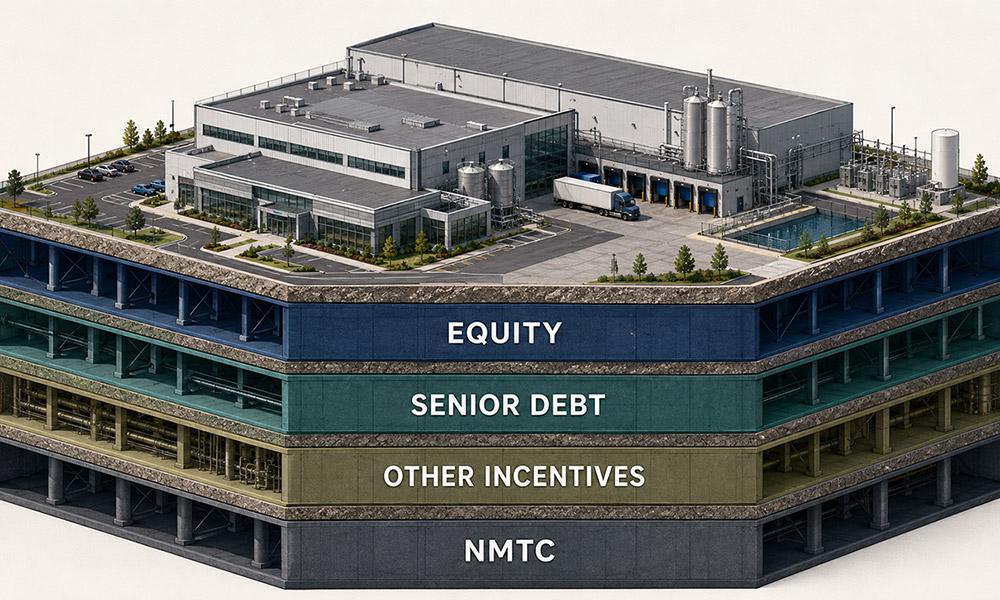
New Markets Tax Credits used to carry an asterisk. Every few years, the program's authorization lapsed, leaving the industry waited for Congress to renew it. That asterisk is gone. The One Big Beautiful Bill Act made New Markets Tax Credits, or NMTCs, a permanent part of the tax code in 2025, ending 25 years of short-term extensions. For companies weighing whether to build an NMTC deal into a project's capital stack, that changes the calculation.
Permanence alone does not make the program simpler. It does make the program more dependable, and it is already reshaping how much capital is available and who receives it.
The deal stack expanded, then contracted
In December 2025, the Treasury Department's CDFI Fund announced $10 billion in NMTC allocation authority for a combined CY 2024-25 round, the largest single round in the program's history. A total of 142 organizations received awards covering 41 states, Puerto Rico and the District of Columbia, with individual awards ranging from $20 million to $95 million and averaging $70 million per community development entity, or CDE.
That was a double round, not a new baseline. Going forward, the program is set at $5 billion in allocation authority per year, fixed in the tax code with no provision for inflation. Companies should not expect the program to grow in step with construction costs. The annual pool is smaller than the amount just awarded and will remain fixed absent further congressional action.
$10B
Program priorities have shifted
On Sept. 15, 2026, the Treasury Department released the Notice of Allocation Availability (NOAA) inviting applications for the Calendar Year (CY) 2026 allocation round of the New Markets Tax Credit Program, with $5 billion in allocation authority available.
The stated priorities under the current Trump administration differ from those of two years ago. Treasury has signaled that 2026 allocations will emphasize domestic manufacturing, affordable housing, small businesses, rural hospitals and essential community health infrastructure. The most recent round showed a 20% increase in investment in rural and nonmetro areas.
For manufacturers evaluating a facility project, this shift is favorable. Manufacturing projects have historically scored well because they can create accessible jobs, and it now falls squarely within the administration's stated priorities. Rural sites benefit as well. Projects that meet these criteria are likely to receive priority consideration from CDEs.
$5B
State NMTC programs also merit a closer look in this environment. Illinois, Nevada and Mississippi are among the states that have created their own versions that largely mirror the federal structure and can be layered on top of it. Wisconsin recently enacted legislation establishing its own program and is now actively deploying it into projects. With the federal pool fixed at $5 billion annually rather than growing, a state credit can help make a project financially viable. Companies with projects in states with active NMTC programs should ask their advisers to consider modeling both credits together rather than treating the federal program as the only source of capital.
The fundamentals remain unchanged
The criteria that made NMTCs work before remain in place. A project must generally be located in a qualifying census tract and demonstrate a positive community impact, such as a high number of quality and accessible jobs. The optimal project size remains $10 million to $50 million, with CDEs generally seeking to deploy $5 million to $20 million in allocation authority per transaction.
The underlying economics have not changed either. A $10 million allocation, sold to an investor at a market price of approximately 79 cents on the dollar, nets roughly $2.1 million in capital at closing after fees. That return remains the reason companies pursue a financing tool of this complexity.
The complexity itself has become harder to overlook, given the multiple special-purpose entities and tax-structuring considerations. For years, the industry has discussed standardizing legal and financial structures to reduce transaction costs, but without success. Permanence is intended to be the catalyst that finally justifies that investment, since CDEs and investors no longer need to question whether the program will exist the following year.
142
Whether that materializes remains to be seen. For now, companies should expect the paperwork burden to remain unchanged, though it can largely be managed with experienced professionals involved.
Implications for companies planning a project now
CDEs that received allocation from the double round in December 2025, have a limited window in which to deploy it. That capital typically is deployed within 12 to 18 months of the CDE receiving its award. Companies with a project in the $10 million to $50 million range, located in a qualifying tract and with a strong community impact case, should consider approaching a CDE with newly awarded capital now.
Separately, with the release of the CY 2026 round NMTC application, CDEs are assembling projects to include in their applications now, even though that allocation will not be awarded until later in 2027. Inclusion in a CDE's application is not a commitment to fund a deal. It is a way to establish visibility with a CDE before the capital exists. Companies whose projects will not be ready to close for another year or two should pursue this path.
In either case, the lookback period for costs already incurred is capped at 24 months, though 12 to 18 months is the more reliable window. Companies with a project that has been delayed should confirm they remain within that window before ruling out NMTC financing.
Competition for a fixed pool
One additional shift deserves direct acknowledgment. The CY 2024-25 double round created the impression that NMTC allocation is currently abundant. Going forward, it will not be.
20%
At $5 billion annually, split among CDEs competing nationally, most CDEs will have less capital to deploy than they received in the 2024-25 double round. This makes CDE selection more consequential than it has been. A CDE with unutilized allocation and a mandate aligned with a given project, such as manufacturing in a rural tract, is a stronger partner than one that is already fully committed.
This is precisely the kind of judgment an experienced adviser is equipped to provide. Working through a broker or adviser has long been the standard approach to reaching the right CDEs, and in a tighter allocation environment, that guidance matters more, not less.
The bottom line
NMTCs were never designed to be an entitlement, and permanence has not changed that. What it has changed is the risk of building a project timeline around a program that might not exist by the time it is needed. That risk is gone.
The program is smaller on an annual basis than the double round that was awarded late last year, priorities have shifted toward more manufacturing and rural projects, and the paperwork burden remains substantial.
For companies with a qualifying project and the patience to work through a rigorous financing process, that trade-off is a reasonable one. The window to engage a CDE, whether for the double round's remaining capacity or the CY 2026 round now in full swing, remains open. Companies that act now will be best positioned to capture capital when the CY 2026 allocation awards are announced.