Editor's Note:This contributed content was written by the Virginia Economic Development Partnership and was approved for publication by Area Development.
Economic developers love to use the term “ecosystem” to describe the intricacies and players in various industries. But there are times when we engage with the word in its more literal sense. The Chesapeake Bay is a major part of Virginia’s food and beverage industry, helping the Commonwealth rank third nationally in seafood industry landings in 2022. Now, with support and guidance from VEDP, Virginia researchers are working to protect the bay from a disruptive species.
Virginia and Maryland officials introduced the blue catfish in the 1970s to enhance recreational fishing opportunities along the bay and its tributaries. They have been dealing with the consequences ever since. An adult blue catfish can grow larger than 100 pounds and live for as long as 10 years in both freshwater and saltwater habitats, all the while preying on ecologically significant species in the bay, including the iconic blue crab.
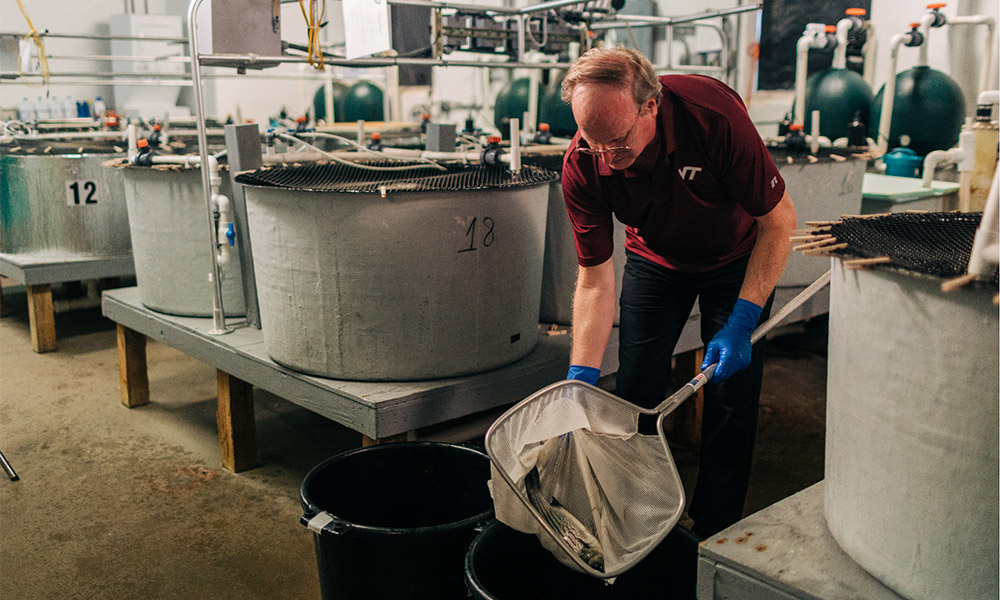
“We’re getting fish that are completely full of nothing but baby clams and oysters,” said Michael Schwarz, associate director of the Virginia Seafood Agricultural Research and Extension Center, a Virginia Tech facility in Hampton. “They’ve eaten everything else and they’re still hungry. They’ll feed wherever they find food.”
The solution is to fish it down to a sustainable level.
Blue catfish have been found in intercoastal waterways as far south as Georgia, underscoring the importance of finding a solution — and Virginia officials are looking to industry to help. Working in their favor: Blue catfish meat is delicious, holds up well to frying and is rich in nutritional benefits. VSAREC data indicates that blue catfish surpass most other lean fish in heart-healthy omega-3 fatty acids. Catfish skin also contains large amounts of collagen, which is popular in the nutritional supplement and cosmetics industries. But the uses for blue catfish go beyond supplements. Fish skin is an emerging factor in burn treatment. Kerecis, an Icelandic biotech company with U.S. headquarters in Arlington County, helped pioneer the technique using fishing industry waste.
100 lbs
With research support from groups including Virginia Tech and VSAREC, the Virginia Institute of Marine Science and others, Virginia is working to develop a sustainable blue catfish fishery to support such innovators. In 2024, the Commonwealth distributed its first awards from the Governor’s Blue Catfish Processing, Flash Freezing, and Infrastructure Grant Program to Sea Farms Inc., a family-owned aquaculture and seafood processing business in Gloucester and Mathews counties on Virginia’s Middle Peninsula. Chris Sopko, Sea Farms’ vice president of operations, said the funding would allow the company to “buy and sell larger quantities of blue catfish [and] hire additional employees.”
They’ve eaten everything else and they’re still hungry. They’ll feed wherever they find food.
The “additional employees” piece is crucial in a rural region that has traditionally drawn much of its livelihood from the water. Ideally, a robust fishery can become self-sustaining, growing to pull more catfish from the bay. VEDP’s Food and Beverage Manufacturing team is leading efforts to attract and expand seafood processing around the Chesapeake to support jobs, innovation and long-term economic resilience while revitalizing the seafood industry that has sustained the region for centuries.
“It’s a challenge and a tremendous opportunity,” Schwarz said. “The solution is to fish it down to a sustainable level. We could end up with a whole new fishery that is sustainable, reduce the environmental impact and end up with the best of both worlds in a bad situation.”