Editor's Note: This article was written for Tennessee Department of Economic and Community Development by Area Development Magazine.
Aerospace and defense companies do not expand lightly. They require a location that delivers technical talent, infrastructure certainty, research proximity and long-term policy stability. In Tennessee, those fundamentals are not aspirational — they are already in place.
Today, more than 12,300 Tennesseans are employed in aerospace and defense across 164 companies statewide. Since 2019, the sector has grown by 44 percent, supported by more than $617 million in capital investment and more than 3,200 new job commitments. In 2024 alone, Tennessee exported more than $960 million in aerospace products and parts and $35.5 million in arms and ammunition, underscoring the state’s expanding role in both commercial aviation supply chains and national defense readiness.
That growth is not concentrated in a single market. It stretches from East Tennessee’s precision manufacturing base to Middle Tennessee’s aviation services corridor and West Tennessee’s industrial infrastructure.
12,300
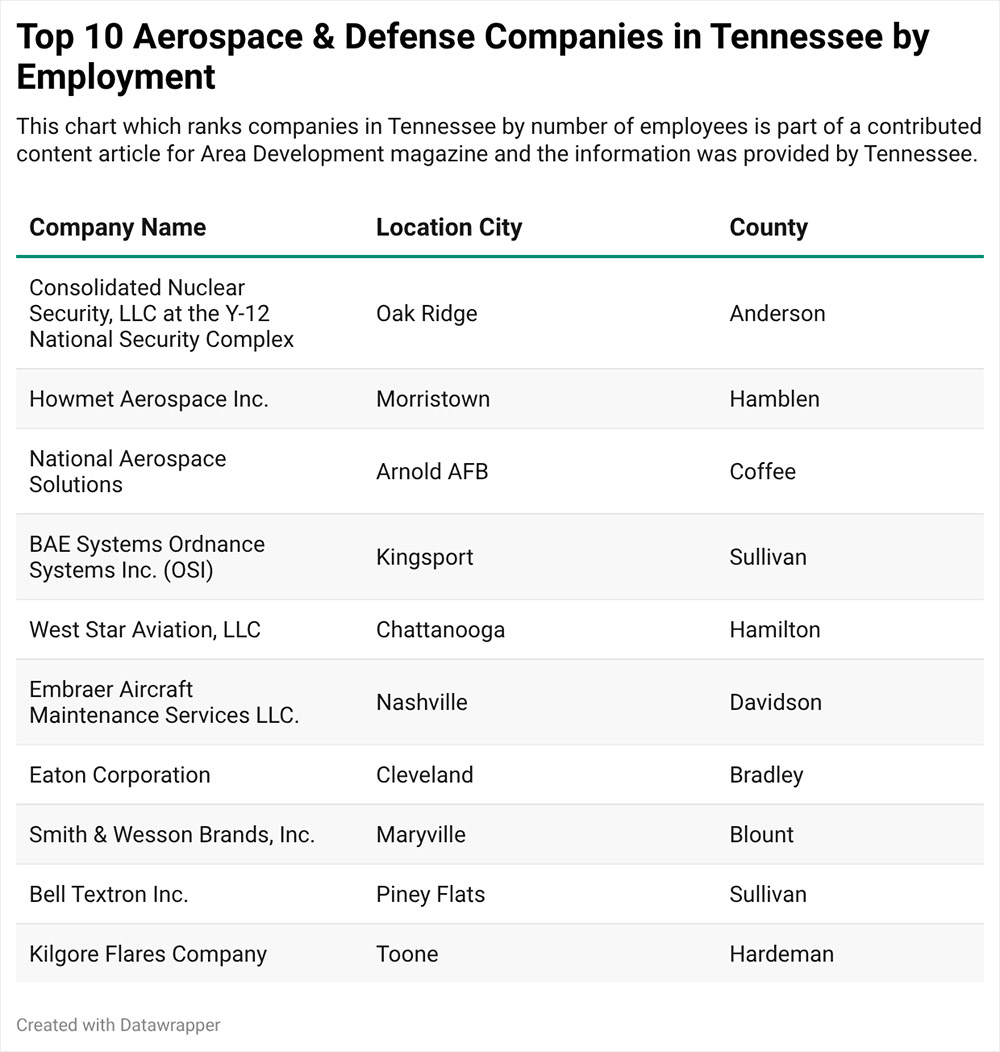
Recent expansions highlight the sector’s acceleration. At the 2025 Paris Air Show, Howmet Aerospace announced its second Morristown expansion in less than a year, adding 217 new jobs on top of 50 previously announced positions. The investment reinforces Hamblen County’s role in advanced aerospace component manufacturing and reflects confidence in Tennessee’s workforce pipeline and operating climate.
Earlier this year, Barrett Firearms Manufacturing announced a $76.4 million investment in a new 250,000-square-foot Manufacturing & Technology Campus in Murfreesboro. The project will create 183 new jobs and will serve as the company’s primary global manufacturing site, while also housing the future U.S. headquarters of its Australian parent company, NIOA Group.
Behind these announcements is a deeper structural advantage: proximity to world-class testing and research infrastructure.
Arnold Air Force Base in Coffee County anchors one of the most advanced aerospace testing environments in the world. The Arnold Engineering Development Complex (AEDC) spans approximately 40,000 acres and includes nearly 70 aerodynamic and propulsion wind tunnels, rocket and turbine engine test cells, space environmental chambers and ballistic ranges. Supporting the U.S. Department of Defense, NASA and commercial aerospace clients, AEDC employs roughly 3,000 people and provides critical testing data that shapes next-generation aircraft, missile and space systems.
44%
Less than five miles away, the University of Tennessee Space Institute (UTSI) strengthens the region’s research and graduate-level engineering capabilities. Established in partnership with the Air Force, UTSI supports advanced research in hypersonics and high-speed aerothermodynamics, aligning academic talent with federal research and private-sector demand. Tullahoma’s proximity to Huntsville, Alabama — one of the nation’s largest aerospace markets — further expands access to technical labor and collaborative opportunities.
To support continued sector growth, the Tennessee Department of Economic and Community Development is advancing the Middle Tennessee I-24 Industrial Site. The 1,800-acre contiguous property is being positioned for large-scale advanced manufacturing and aerospace investment. Road access and wastewater improvements are being funded to accelerate readiness, and electric infrastructure will be managed by Tennessee Valley Authority, providing long-term reliability.
$960M
A Tennessee College of Applied Technology (TCAT) campus is nearing completion on the site, with classes expected to begin by summer 2026. The TCAT system plays a central role in delivering tuition-free, industry-aligned technical training, ensuring employers have a responsive workforce partner embedded directly within the development footprint.
Since 2019, Tennessee has produced more than 20,300 aerospace and defense-related graduates, reinforcing a talent pipeline that complements the state’s manufacturing base. For companies evaluating expansion, that scale of workforce alignment reduces ramp-up risk and shortens time to productivity.
Geographically, Tennessee’s central location places nearly 70 percent of the U.S. population within a day’s drive. Combined with multimodal logistics networks and a stable pro-business environment, the state offers aerospace and defense firms both operational reach and long-term predictability.
In a sector defined by precision and performance, Tennessee has built an ecosystem designed to meet the same standards. For aerospace and defense companies seeking room to scale without sacrificing capability, the Volunteer State is not just participating in the industry’s growth — it is helping shape its next chapter.