
The commercial space economy is no longer a horizon event. It is here, accelerating, and reshaping where companies choose to put down roots. For site selectors, that shift carries direct implications — the infrastructure, talent, and institutional relationships that once served government-dominated aerospace are now the raw material for a new private-sector space industry projected to surpass $1 trillion within two decades.
Understanding which markets are best positioned to capture that growth requires moving past the obvious names. Florida, California, Virginia and Texas have long served as the country's launch epicenters, and their advantages are well documented. But two markets — Huntsville, Ala., and Colorado Springs, Colo. — offer something different: a convergence of deep technical expertise, evolving industrial strategy and proximity to the institutions defining what commercial space actually looks like in practice.
The Structural Shift Driving Location Decisions
The space industry's center of gravity has moved. According to the FAA, as recently as 2014, roughly 80 percent of U.S. launches were attributable to the public sector. By 2023, that share had fallen below 50 percent. The commercial sector now accounts for 78 percent of the global space economy — approximately $480 billion, according to the Space Foundation — a reversal driven by three compounding forces.
The commercial space economy is no longer a horizon event.
Deregulation opened the door. The U.S. Commercial Space Launch Act of 1984 and its subsequent amendments created the legal framework for private launch activity. When NASA retired the Space Shuttle, it effectively handed the launch services market to commercial providers. That transition is now nearly complete: today, most U.S. government launch activity is outsourced to the private sector, with the Artemis program as the primary exception.
Cost compression changed the calculus. Reusable rocket technology has made launch economics viable for commercial applications that would have been financially impossible a decade ago. Miniaturization has had a parallel effect: CubeSats and modular satellite platforms have lowered barriers to entry for new market entrants across a range of industries.
New revenue models have followed. Satellite internet now accounts for more than 60 percent of all satellites in Earth's orbit, according to Jonathan McDowell’s GCAT database, and is a primary driver of global launch activity. That is not a niche application — it is the demand signal reshaping the entire industry. Commercial low Earth orbit habitats, space tourism, in-space manufacturing and point-to-point launch are not speculative futures; they are the business models that today's site selection decisions are being made to serve.
Huntsville: From Rocket City to Commercial Space Anchor
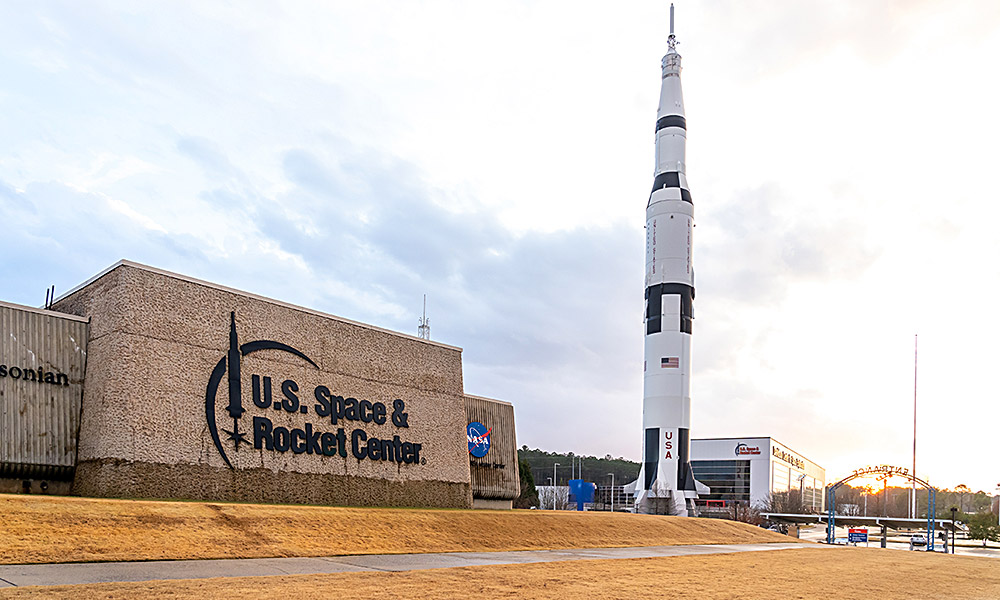
Huntsville's identity has been built around propulsion and human spaceflight for more than 60 years, anchored by NASA's Marshall Space Flight Center. Marshall's contributions to the International Space Station and its sustained focus on propulsion systems created a talent base and supply chain depth that few metros can replicate. As NASA prepares to de-orbit the ISS in 2030 in favor of purchasing services from commercial LEO destinations, Huntsville is the rare market where that transition reinforces, rather than threatens, its competitive position.
Greenfield markets offer incentives; these markets offer infrastructure, talent and institutional relationships.
The city has moved deliberately to convert its legacy in government spaceflight into a commercial advantage. Its most targeted pitch is to companies working in microgravity operations — a field that stands to expand significantly as human spaceflight in LEO continues and commercial habitat operators look for tenants. The value proposition is straightforward: microgravity enables the production of pharmaceuticals and advanced materials with fewer defects than are achievable in Earth's gravity. For companies evaluating where to build the R&D and manufacturing infrastructure to support that work, proximity to Huntsville's institutional knowledge base represents a meaningful head start.
The city has also made a strategic bet on agricultural technology for space — not an obvious pairing, but a logical one. Closed-loop food production and carbon dioxide conversion systems are mission-critical for long-duration spaceflight and will be foundational to any permanent LEO habitat, lunar base or Mars mission. By attracting ag-tech companies now, Huntsville is positioning itself to be the development ground for systems that will define the next generation of human presence in space.v
Colorado Springs: Defense Heritage as Commercial Catalyst
Colorado Springs enters the commercial space conversation from a different angle. Its cluster of military installations — Peterson Space Force Base, the Air Force Academy and the Space Information Sharing and Analysis Center — has historically made it a center for space defense. That foundation is now a commercial asset as the lines between defense applications and commercial space continue to blur.
$1T
The city's most direct investment in the transition is Catalyst Campus, an aerospace and defense incubator and accelerator funded through a combination of state grants and Department of War contracts. The model is proving out: one participating company scaled from four employees at entry to nearly 600 in the region. That kind of anchor-tenant growth effect is exactly what site selectors and economic development officials track when evaluating an emerging cluster's staying power.
Colorado Springs also controls something with expanding commercial relevance: the management and control infrastructure for the GPS constellation. As GPS applications proliferate across industries from logistics to autonomous systems to precision agriculture, the concentration of domain expertise in Colorado Springs becomes a differentiator for companies building on top of that infrastructure. Add more than 5,000 regional graduates with aerospace and defense credentials, and the talent pipeline argument becomes straightforward.
The market's next chapter will be shaped by how effectively it converts defense-sector experience in Earth observation, space traffic management and cyber defense into commercial products and services. The institutional groundwork is in place; the question is execution speed.
The space industry's center of gravity has moved.
The Site Selection Takeaway
Huntsville and Colorado Springs are not emerging markets in the traditional sense — both have decades of aerospace investment behind them. What is emerging is the commercial demand that their existing capabilities are positioned to serve. For companies making location decisions in the space economy, that distinction matters. Greenfield markets offer incentives; these markets offer infrastructure, talent and institutional relationships that cannot be built quickly.
As the commercial space market intensifies, the metros best positioned to lead are those that recognized early that the transition from government-directed to commercially-driven space was not a threat to manage but an opportunity to capture. Both cities made that bet. The next decade will show what it pays.
This article contains general information only and Deloitte is not, by means of this article, rendering accounting, business, financial, investment, legal, tax, or other professional advice or services. This article is not a substitute for such professional advice or services, nor should it be used as a basis for any decision or action that may affect your business. Before making any decision or taking any action that may affect your business, you should consult a qualified professional advisor. Deloitte shall not be responsible for any loss sustained by any person who relies on this article.
As used in this article, "Deloitte" means Deloitte Consulting LLP, a subsidiary of Deloitte LLP. Please see www.deloitte.com/us/about for a detailed description of our legal structure. Certain services may not be available to attest clients under the rules and regulations of public accounting.
Copyright © 2026 Deloitte Development LLC. All rights reserved.