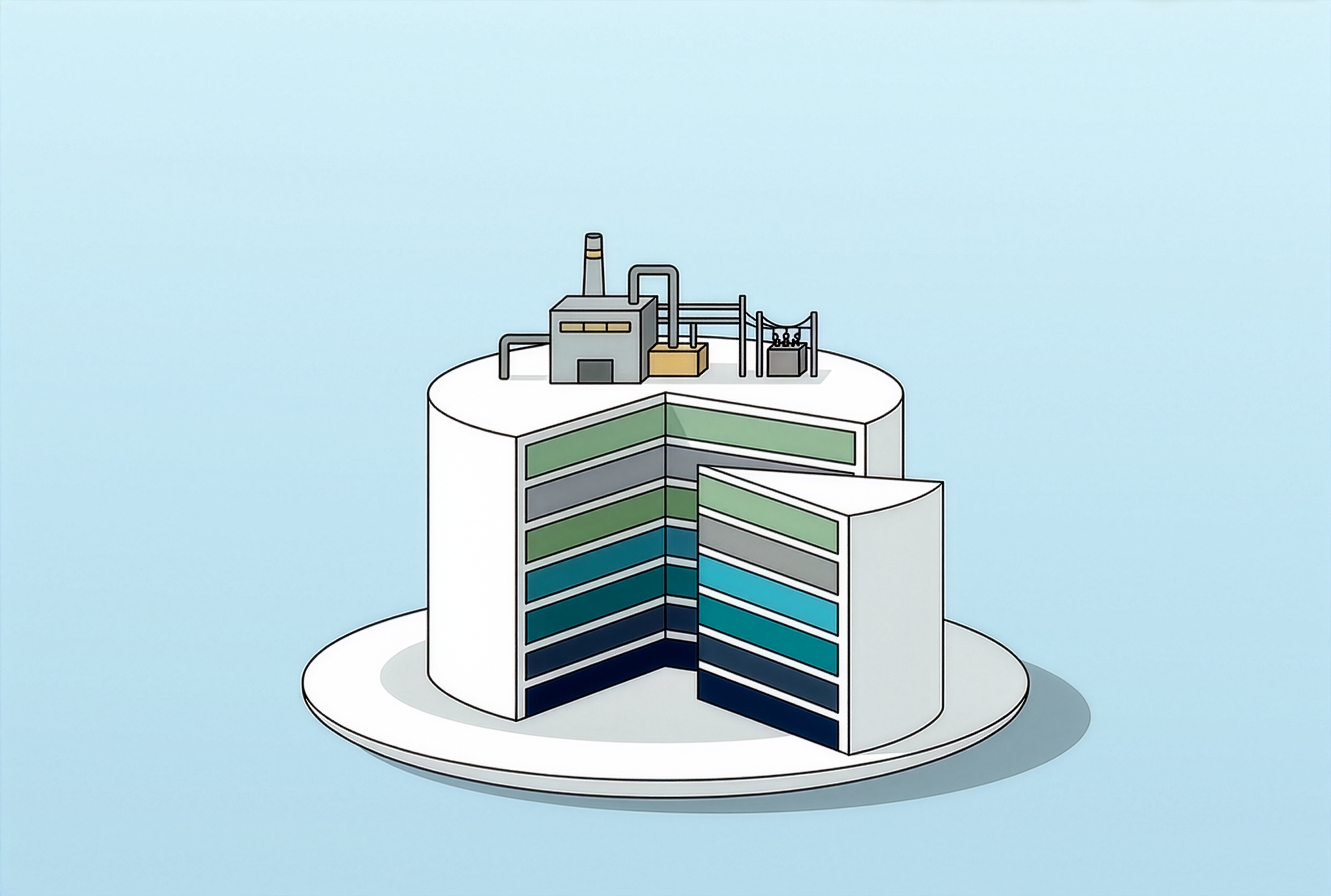
In the 1950s, the federal government wanted private utilities to build nuclear power plants. The utilities were interested. Their insurers were not. The technology was new, the worst-case scenario was catastrophic, and there was no loss history to price it against. Congress solved the problem with the Price-Anderson Act of 1957, which capped operator liability and put a federal backstop behind the private insurance market. Nearly 70 years later, the act’s authority to indemnify new reactors runs through 2065.
Most hard tech never gets a Price-Anderson. New battery chemistries, advanced materials plants, carbon capture facilities, and fusion machines face a version of the same problem the reactor builders did, without an act of Congress to solve it.
The first article in this series looked at how first-of-a-kind (FOAK) projects bridge the financing gap. This one covers the requirement underneath every one of those loans: insurance. Lenders won’t close without it, and insurers are often the last parties at the table willing to take a view on unproven technology.
The pattern that emerges is useful for anyone choosing or marketing sites. Early on, insurers worry about whether a technology works. As it matures, that concern fades and a different one takes its place: where the plant sits. Location shapes insurability from the first day of construction through the life of the facility.
No history, no price
Insurance runs on loss data. Underwriters price risk by looking at how often similar assets have failed, how badly, and why. A FOAK facility, by definition, gives them nothing to look at.
The product designed for this problem is technology performance insurance, which transfers the risk that a new plant won’t operate as designed from the owner and lenders to an insurer. According to a Resources for the Future analysis, that coverage has historically been sparse and expensive. Insurers also tend to engage only after a project is fully designed, rather than during demonstration and early deployment.
The result is a timing mismatch. The period when a FOAK project most needs to transfer risk is the period when the insurance market is least equipped to take it.
Where FOAK losses fall through the cracks
The standard coverage for a project under construction is builder’s risk insurance, which pays for physical damage to the work in progress. It has always carved out the cost of fixing defective design, workmanship, or materials, on the theory that defects are a contractor’s business risk rather than an insurable accident.
On large projects, that carve-out is increasingly written using a set of standard exclusions developed by the London Engineering Group (LEG). They come in three levels. The broadest coverage, LEG 3, pays for damage caused by a defect but still excludes the cost of improving the original design.
For conventional construction, that distinction is manageable. For a FOAK plant, it is a problem. When a FOAK process fails, fixing it often means redesigning it, and the line between repairing a defect and improving a design gets very thin. The law here is still unsettled. The first published U.S. court decision interpreting LEG 3 did not come until 2023, when a federal court in Washington, D.C., found the exclusion ambiguous and ruled for the policyholder.
The gap continues after construction. Conventional property insurance pays for physical damage, not underperformance. A new plant can run without breaking and still produce well below design capacity. As the first article in this series noted, roughly half the pioneer plants in the RAND study were producing below 75 percent of design capacity a year after startup, and a quarter were below 50 percent. That shortfall is a serious financial loss. No standard policy covers it.
30–70%
The market is starting to fill the gap
Specialty insurers have begun writing coverage aimed squarely at that gap. Munich Re’s technology performance insurance for bioenergy and circular economy projects, for example, protects revenue when a plant underperforms during startup or long-term operation. The policy responds when design, engineering, or operating problems cause lower yields, reduced uptime, off-spec product, or reduced output.
The real value is on the financing side. Broker Aon describes technology performance guarantees as a way for early-stage companies to secure debt financing. The guarantees assure lenders that debt payments will be protected. Used this way, the insurance policy functions as part of the capital stack.
Governments are starting to participate, too. In December 2025, Munich Re and KfW, Germany’s state development bank, launched a program to make geothermal drilling bankable. Munich Re insures 30 to 70 percent of a project’s loan, and KfW grants a partial debt waiver if exploration fails and triggers a claim. Between the two, project sponsors can secure up to the full loan amount.
One detail of that program deserves attention from anyone in site selection. The coverage is available only for projects in geologically promising areas. The underwriting variable is not the drilling technology. It is the ground.
When the site becomes the risk
The geothermal program is an early example of a pattern that has already played out in more mature energy technologies.
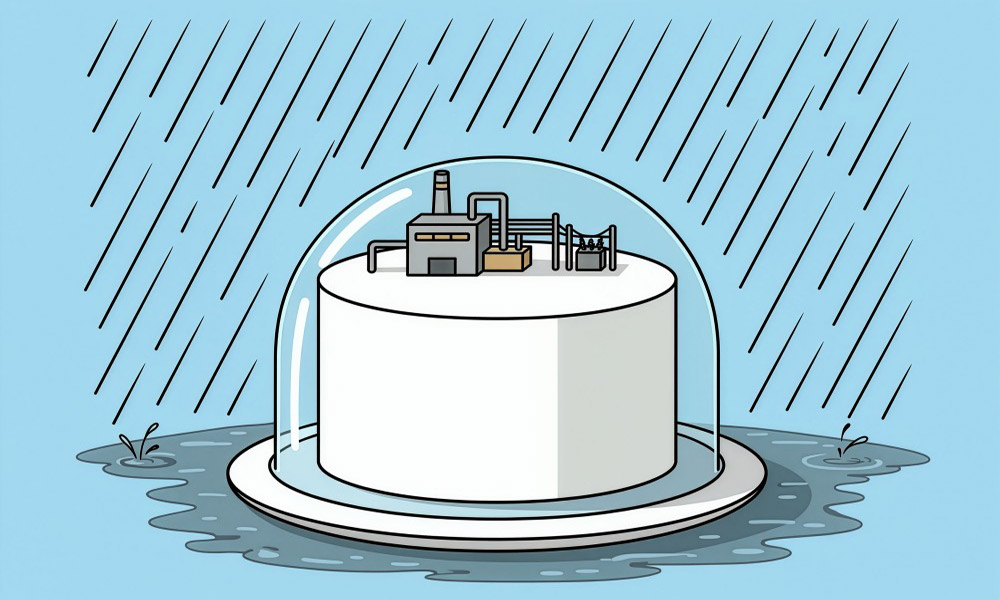
Take solar. Technology performance insurance was originally developed more than a decade ago to cover emerging solar and wind projects, when lenders were uncertain whether the equipment would perform. That uncertainty has largely been resolved. Today, according to kWh Analytics’ 2026 Solar Risk Assessment, hail accounts for 73 percent of insured solar losses by dollar amount, and across 52 percent of the contiguous U.S., standard module glass alone can’t keep hail losses below an acceptable level. Insurers have started rewarding projects built to withstand it. As kWh Analytics CEO Jason Kaminsky put it, “resilient sites deserve to be rewarded.” The technology risk faded. The location risk remained, and grew.
73%
Battery storage offers a sharper version of the same lesson. In January 2025, fire destroyed most of a 300-megawatt battery array at the Moss Landing Energy Storage Facility in California, which occupies a decommissioned 1950s-era gas-fired power plant site. The batteries that burned were installed indoors, inside the shell of a building left over from the old plant, and used a nickel manganese cobalt chemistry that tolerates heat less well than the lithium iron phosphate cells that dominate new projects. Owner Vistra wrote off roughly $400 million, the facility’s entire remaining book value. The site burned again on Sept. 18, 2026. This time the fire started in damaged batteries still inside the building, awaiting removal.
Yet insurance brokers did not treat the fire as a verdict on battery storage. Michael Bogdan, a partner at broker Lockton, said he did not expect the fire to move the market for battery storage insurance, noting that insurers recognized the facility was very different from what is being built today. In other words, the market priced the loss as a site and design problem rather than a technology problem. Brokers also note that the logistics of fire response, including how far emergency crews have to travel, factor into how storage projects are rated.
Two lessons follow for site selection. Reusing an existing building or industrial site is not automatically the lower-risk choice. And local emergency response capacity is an underwriting variable, not just a public safety question.
A site that raises premiums or narrows coverage raises the cost of capital, even if the land is cheap.
Fusion is the next test case. In February 2026, the Nuclear Regulatory Commission (NRC) proposed regulating commercial fusion under its byproduct materials framework rather than as a nuclear power reactor. Because fusion would be licensed as a materials activity, it would sit outside the reactor framework that Price-Anderson was built around. The proposal does not amend the NRC’s Price-Anderson regulations. That suggests developers should expect to rely on the private insurance market. The proposal also means that the state a fusion developer chooses may end up being its regulator. Under the Atomic Energy Act, the NRC can hand oversight of byproduct material to Agreement States, and 40 of the 41 Agreement States now have authority over the category that would include fusion material. A state’s regulatory capacity will shape how insurers view the projects inside its borders.
What site teams and communities can do
For corporate teams, the practical change is to bring the insurance conversation into site screening instead of saving it for after the site is chosen. That means evaluating natural hazard exposure, including hail, flood, wildfire, and wind, with the same rigor applied to power and water. It means looking closely at fire protection, water supply for firefighting, emergency response times, and adjacent land uses. For regulated technologies, it means understanding which agency will actually oversee the project. A site that raises premiums or narrows coverage raises the cost of capital, even if the land is cheap.
40
For economic development organizations, the opportunity is to make sites easier to underwrite. Insurance-grade site data, including hazard mapping, geotechnical reports, fire flow testing, and documented emergency response times, answers questions insurers will ask anyway. Investing in local fire and emergency response capacity for novel hazards like battery fires or hydrogen can matter as much as a cash incentive. And states pursuing fusion or other emerging technologies should recognize that regulatory readiness is part of what makes a location insurable.
States might also look at the German geothermal program as a model. Public risk-sharing that makes private insurance possible is a narrower, more targeted tool than a general incentive, and it goes directly at the problem FOAK projects can’t solve on their own.
The technology risk eventually fades. The location risk stays for the life of the plant.
Location is the risk that remains
Price-Anderson worked because Congress stepped in where the insurance market could not. Most hard tech will not get that kind of help. What these projects can get is a site that gives insurers fewer unknowns to price: well-documented hazards, strong emergency response, clear regulatory authority, and infrastructure built for the process going inside.
The technology risk eventually fades. The location risk stays for the life of the plant.
But even a well-financed, well-insured facility faces one risk no policy covers: the technology moving on. That is the subject of the final article in this series.