Aerospace has quietly been one of Ohio's most durable industrial sectors. For a century, the state has supplied research, propulsion, components and talent to nearly every major American aircraft program, with GE Aerospace's Cincinnati operations among the most prominent examples of that continuity.
What's changed in recent years is how that foundation is being put to work — and how quickly manufacturers are being asked to turn new investment into production.
A concentration of federal aerospace assets — Wright-Patterson Air Force Base and the Air Force Research Laboratory, NASA's Glenn Research Center and the Neil Armstrong Test Facility — has increasingly been paired with business incentives, available sites, workforce programs and infrastructure designed to attract large primes and next-generation manufacturers.
Joby Aviation's aircraft production facilities in Dayton and Anduril Industries' Arsenal-1 campus outside Columbus illustrate the pattern. So do a pair of announcements at this summer's Farnborough International Airshow: Beehive Industries' expansion in southwest Ohio to additively manufacture jet engines and Electra's decision to build its EL9 Ultra Short production facility in Springfield.
Taken together, the projects point to a broader shift in what aerospace and defense companies need from a location. Access to talent and suppliers still matters. Increasingly, so does the ability to move from site selection to production at program speed.
Anduril and Joby were the proof of concept. The next generation of primes will be the proof of scale.
An ecosystem 100 years in the making
Ohio's aerospace position did not start with a single project win. The state that gave the world the Wright brothers, Neil Armstrong, John Glenn and Jim Lovell spent generations building one of the deepest aerospace ecosystems in the country.
Today, more than 640 aerospace suppliers and 400-plus defense contractors make Ohio the top U.S. supplier state to both Airbus and Boeing. Military and federal activity supports an estimated 418,000 Ohio jobs and $55 billion in annual economic output, and the state's defense industry is now valued at roughly $69 billion annually.
For companies evaluating where to locate aerospace production, some of the state's most important assets are difficult to reproduce.
Wright-Patterson Air Force Base, the largest single-site employer in Ohio, is home to the Air Force Research Laboratory and the Air Force Life Cycle Management Center — putting the customer, requirements writers and much of the U.S. Air Force's science-and-technology enterprise within the state's borders.
NASA Glenn Research Center in Cleveland and the Neil Armstrong Test Facility in Sandusky provide propulsion research and some of the world's largest space-environment test infrastructure; 57 Ohio companies participate in the Artemis supply chain. Add the National Advanced Air Mobility Center of Excellence in Springfield and more than $16 billion in annual science and engineering R&D investment statewide, and aerospace companies can connect research, testing, suppliers and production within a relatively concentrated geography.
From prototype to production
The most persuasive evidence is what companies are actually building.v
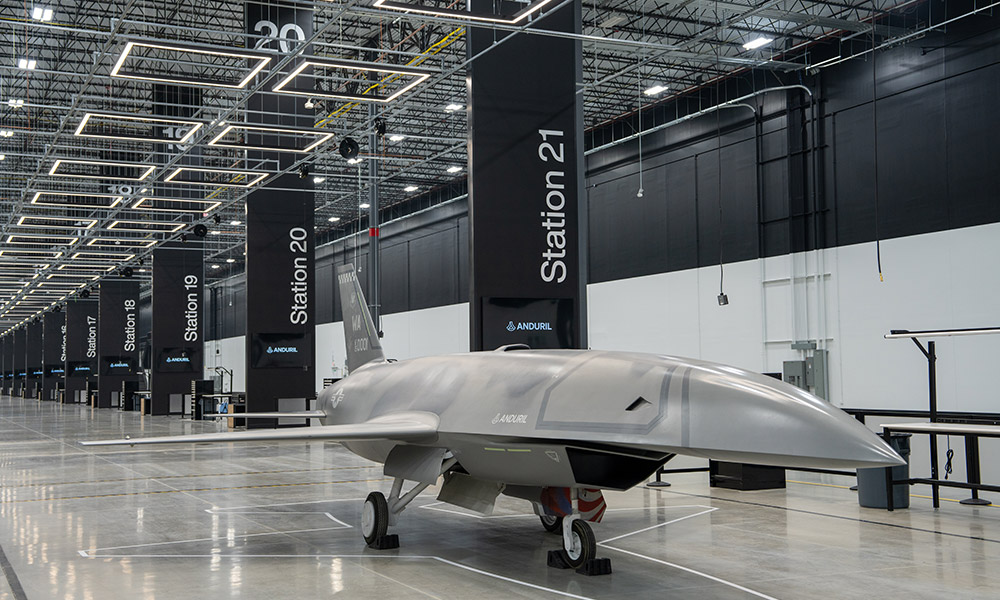
Anduril Industries selected Rickenbacker Airport, near Columbus, for Arsenal-1 — a hyperscale manufacturing campus for autonomous defense systems spanning roughly 5 million square feet at full build-out, with more than 4,000 jobs projected by 2035 and over $2 billion in annual economic output.
557
Just as important as the project's scale is its timeline. Anduril moved from site selection in January 2025 to active production of its Fury autonomous aircraft — the YFQ-44A, its candidate in the U.S. Air Force's Collaborative Combat Aircraft program — in roughly 14 months, ahead of schedule, delivering the first aircraft 557 days after the project was announced.
Joby Aviation chose Dayton — the birthplace of aviation — for what was announced as the largest aviation project in Ohio history, with up to 2,000 jobs. Joby began propeller-blade manufacturing at Dayton International Airport in late 2025, with capacity for up to 15,000 blades per year, and in January 2026 acquired a second Dayton-area facility of more than 700,000 square feet to support doubling aircraft production in 2027.
Sierra Nevada Corporation completed its four-hangar, 440,000-square-foot Aviation Innovation and Technology Center at Dayton International Airport — an investment of roughly $180 million and the state's most significant large-aircraft maintenance, repair and overhaul expansion since World War II — supporting the U.S. Air Force's $13 billion Survivable Airborne Operations Center program.
In Ohio, you can dream it, build it, test it and scale it — all in one state.
GE Aerospace, headquartered in Cincinnati, continues to anchor Ohio's position as a global center of jet-engine innovation while investing in next-generation flight, including a $300 million stake in electric-aircraft developer BETA Technologies.
The supply chain is expanding as well. Resonant Sciences opened a new military radome production facility in Greene County with 101 new jobs. AeroVironment is undertaking a $15 million, 200-job expansion near Dayton. Hartzell Propeller has developed a 150,000-square-foot innovation center in Piqua. Each is within reach of Wright-Patterson and the broader aerospace concentration surrounding Dayton.
For manufacturers weighing expansion locations, that concentration can reduce the distance between customers, engineering talent, suppliers, testing capabilities and production.
Incentives built around execution
Ohio's incentive structure is different by design, and the difference starts with who delivers it.
JobsOhio is the state's private nonprofit economic development corporation, funded by the profits of Ohio's liquor enterprise rather than annual taxpayer appropriations. Since its creation in 2011, JobsOhio has operated outside annual political and budget cycles.
For companies conducting competitive site searches, the structure is intended to provide faster decision-making, confidentiality and continuity after a project is announced.
For aerospace and defense companies specifically, the newest tool is the JobsOhio Aerospace and Defense Opportunity Program — a five-year, $250 million initiative launched in early 2026 to strengthen Ohio's military installations, defense industrial base and the communities that support them.
600+
The program provides grants and loans to companies, nonprofits and port authorities whose work supports national defense. Resonant Sciences' Greene County radome facility received the program's first award: a $2.5 million grant paired with a state job creation tax credit.
That program builds on a broader toolkit designed around different stages of a company's investment.
The state's refundable Job Creation Tax Credit ties value directly to new payroll. JobsOhio's Growth Fund and economic development grants can offset capital investment, machinery and infrastructure costs. The Ohio Site Inventory Program invests in speculative, shovel-ready sites and buildings.
The most persuasive evidence is what companies are actually building.
The same approach helped fund the $250 million Convergence Research Center rising on an enhanced-use lease at Wright-Patterson, creating installation-adjacent R&D infrastructure that can connect private-sector companies more closely with federal aerospace activity.
On the operating side, Ohio levies no state tax on corporate income.
Workforce as production infrastructure
Ohio also treats workforce as an incentive in its own right.
The state has the nation's third-largest manufacturing workforce and produces more than 38,000 STEM degree and certificate completions annually across a network that includes seven Carnegie R1 research universities.
JobsOhio's Talent Acquisition Services function like an embedded recruiting arm for expanding companies, while programs such as TechCred help upskill incumbent workers. A 10-year, $300 million experiential learning initiative is building the technician pipeline, starting with an earn-and-learn program.
That effort reflects the scale of the challenge. Ohio projects a need for 540,000 STEM- and technically skilled workers over the next decade.
For aerospace manufacturers, workforce capacity is increasingly inseparable from site readiness. A building or industrial site matters only if the engineers, technicians and production workers needed to operate it can be recruited and trained quickly enough to meet a program schedule.
Doubling down on advanced aerospace
Ohio is now institutionalizing the strategy.
Ohio also treats workforce as an incentive in its own right.
Legislation establishing the Ohio Defense and Space Commission passed both chambers of the General Assembly this year with overwhelming bipartisan support. The commission will coordinate statewide efforts and lead an expansion program specifically charged with recruiting domestic and international defense and aerospace investment.
The broader objective is to position the state not simply as a supplier to aerospace programs, but as a place where companies can move more of the development and production cycle. For a century, Ohio supplied the parts, propulsion, research and people behind American airpower while many final assembly lines went elsewhere.
That calculus is beginning to change.
The combination of federal aerospace assets, an established supply chain, available production capacity, workforce programs and a development organization structured to move quickly is giving manufacturers another option as they decide where the next generation of aerospace production will take place.
Anduril and Joby provide two early tests of the model. The larger question is how many companies follow them.