
Inbound-Outbound Logistics Cost Determines Location Decisions
The majority of respondents to Area Development's 24th Annual Corporate Survey said inbound-outbound shipping costs were important to selecting a site. Consider these factors before your next move.
June/July 10
Future implications of inbound-outbound shipping costs on distribution networks should concern corporate managers. The volatility of fuel costs, accessibility of other modes of transportation, and major legislation currently being debated have given corporate managers a new list of worries. But building a robust distribution network can alleviate future problems.
To figure out what markets you will serve can be as easy as looking at a map or as complicated as hiring a site selection consultant to conduct a service area study. The easy route involves taking the time to call and discuss issues that other distribution facilities in the area have. Ask them why they are there, about the transportation infrastructure, and if they are meeting cost and service targets set before they located to the area.
Don't worry about reaching out to other distribution facilities in the area. There are plenty of opportunities to speak with representatives from those sites. Begin a discussion on a social networking platform like LinkedIn. Attend local professional meetings hosted by the Society of Industrial and Office Realtors (SIOR), the Warehousing Education and Research Council (WERC), Commercial Real Estate Development Association (NAIOP), or the Council of Supply Chain Management Professionals (CSCMP). One reason to attend local meetings and conferences, especially in the logistics and supply chain field, is to discover best practices or issues and concerns that could affect your distribution facility. You can also measure your company against competitors, an opportunity to snoop around without really snooping.
Transportation
Keep your transportation options open. Look for sites that provide a mix of options, from air and rail to truck and ocean shipping. Customer business strategies change as fast as teenage trends. If your customer changes plans a year after you begin operations and expects you to deliver to another region in the country or to another country altogether, can you receive and send shipments using a combination of shipping methods? And don't forget about expediting orders. While FedEx and UPS can support your strategy, your total cost analysis must reflect the cost of those services. Being located near a combined heavy weight and small package air hub can make a difference.
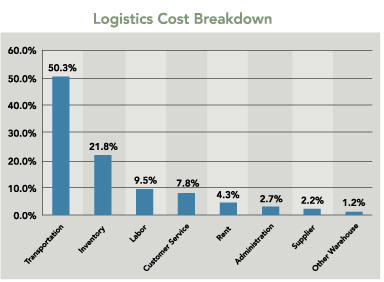
Evaluate any long-term plans that could alter the mix of products and how that will affect shipping methods and service delivery. And remember that transportation typically comprises more than 50 percent of a company's supply chain costs. Labor costs consume around 17 percent, while rent, taxes, and maintenance typically encompass less than 10 percent of supply chain costs (Figure 2).
Future Projections
Consider your company's growth potential, as well as which customers will grow with the company. Will the business grow or decline over the next five years? Will it expand or reduce overseas operations? Having several small distribution facilities will speed delivery to customers and lower fuel and trucking costs, but it will be harder to manage inventory and consolidate deliveries if something changes.
At the same time, don't succumb to the one-size-fits-all approach. If your company provides a range of products and services, locating a large cold storage facility in a central location to support many customers may make sense. The larger facility will have higher costs associated with transportation - longer routes, slower delivery, and higher fuel usage - but lower costs when considering other factors such as work force training, lower inventory levels, and ability to consolidate orders. Be sure to examine total cost when analyzing your network cost.
"Logistics Cost, Labor, and Love"
Your distribution network must be flexible enough to improvise, adapt, and overcome changes in this brave new world of constant flux. Understanding that site selection decisions are based on cost service trade-offs and how those trade-offs affect your overall network flow and total cost, will help you make smarter decisions.
There is no holy grail in site selection. However, careful consideration of the total network cost, energy availability, incentives, and infrastructure needs, along with overall network design, will enhance your search for the right site for your next distribution facility.
"Location, location, location" used to determine the quality of a commercial real estate site. Today the three L's - "logistics cost, labor, and love" - are key factors. Logistics cost and labor are major elements in the total cost of your network. The love comes from local and state communities that must embrace your company's investment in the community. Without a genuine desire for your investment, the local market may make operating your facility difficult, or more expensive if there are no incentives.
-
Tim Feemster, Managing Principal, Foremost Quality Logistics
Over 35 years of experience have provided Tim Feemster, Managing Partner, Foremost Quality Logistics, with a variety of problem solving situations in real estate, transportation, logistics, and distribution. Feemster is quoted frequently in the industry press and makes over 20 presentations a year to professional organizations. Before starting FQL Logistics, Feemster was a senior manager in three manufacturing companies, a consultant, an executive in two 3PL logistics providers, and a Practice Group leader at two real estate companies. Feemster has been responsible for transportation and warehouse operations, real estate site selection, economic development strategy consulting, strategic planning, and lean quality management. Feemster holds an M.B.A. in Marketing from the Ross School of Business, University of Michigan in Ann Arbor, and a B.A. in Mathematics from DePauw University in Greencastle, Indiana. Feemster is an active member in the Warehouse Education and Research Council (WERC.org), where he is past president, and the Council Supply Chain Management Professionals (CSCMP.org. He is also a member of the Board of Directors for the Trade Data Exchange (TDE) Corporation.

Logistics / Infrastructure
The Coming Battle Over Infrastructure Funding and Investment
-
Logistics / Infrastructure
10 Inland Ports to Watch
-
Logistics / Infrastructure
Global Supply Chain Faces a Complex Mix of Issues
-
Logistics / Infrastructure
Location Notebook: Union Pacific Intermodal Opens in Santa Teresa, New Mexico
-
Joseph Tillman, Vice President, Transportation, KS Harvesters
Joe Tillman is vice president of Transportation at KS Harvesters Inc. Prior to joining KS Harvesters, he worked with Supply Chain Visions, Wal-Mart Logistics, and Union Pacific Railroad. His keen interest in all things supply chain and his high-energy approach to life find him authoring articles for industry publications, and speaking to supply chain industry groups. He co-leads the Warehousing Education and Research Council's influential annual benchmarking study, "DC Measures." Joe is certified in transportation and logistics (CTL) by AST&L and SCOR-Professional certified by the Supply Chain Council.
Recent Project Announcements
Switzerland-Based Givaudan Plans West Harrison, Indiana, Liquids Production Operations
09/27/2026
A&W Custom Furniture Expands Okolona, Mississippi, Manufacturing Operations
09/27/2026
Britain-Based SubSea Craft Plans Port Bienville, Mississippi, Production Operations
09/27/2026
Leading Edge Manufacturing Expands Youngsville-Broussard, Louisiana, Operations
09/27/2026
Devro Expands Calhoun County, South Carolina, Operations
09/26/2026
Eden Radioisotopes Plans Lea County, New Mexico, Production Operations
09/26/2026
Canada-Based Hammond Power Solutions Plans Fort Worth, Texas, Manufacturing Operations
09/26/2026
Amazon Plans Greenwood, Indiana, Manufacturing Operations
09/26/2026
Tandem Foods Expands Allegheny County, Pennsylvania, Production Operations
09/26/2026
Raybern Foods Expands Shannon, Mississippi, Production Operations
09/25/2026
Applied Atomics Plans New Orleans, Louisiana, Headquarters-Technical Operations
09/25/2026
Italy-Based Pirelli Expands Rome, Georgia, Manufacturing Operations
09/25/2026
The Okonite Company Expands Orangeburg, South Carolina, Manufacturing Operations
09/25/2026
S23 Holdings Expands Newport News, Virginia, Repair-Manufacturing Operations
09/25/2026
Most Read
-
The Shifting Landscape of Location Strategy
Q2 2026
-
Why Great Sites Get Eliminated: The Critical Role of Information Presentation in Site Selection
Q3 2026
-
What Site Selectors Discuss After the Site Visit Ends
Q3 2026
-
Why Relationships Still Win Projects in Site Selection
Q3 2026
-
Beyond the Launch Pad: Why Huntsville and Colorado Springs Are Winning Commercial Space Investment
Q3 2026
-
Steel Is Back—and Infrastructure Is Deciding Where New Mills Locate
Q3 2026
-
2025’s Top States for Business: How the Winners Are Outpacing the Rest
Q3 2025