The aerospace and defense industry is entering a period of renewed expansion, driven by geopolitical competition, the commercial aviation recovery and increased investment in advanced manufacturing. But as manufacturers work to increase production of aircraft, missiles, satellites and other advanced systems, some of the industry's most significant challenges are no longer technological.
Power is the first bottleneck
Energy availability, infrastructure capacity and logistics constraints are increasingly determining how quickly aerospace and defense production can expand.
These issues have become strategic considerations rather than operational challenges. Manufacturers, governments and suppliers must ensure that production capacity can scale alongside demand while maintaining resilience against disruptions ranging from energy shortages to geopolitical instability.
Energy availability is among the most pressing constraints. Modern aerospace manufacturing is highly energy-intensive, relying on precision machining, heat treatment, additive manufacturing, composite curing and extensive testing facilities. These processes require reliable, uninterrupted electricity and, in many cases, high-temperature industrial heat. As manufacturers expand production of military aircraft, missiles, satellites and commercial airframes, electrical demand at production facilities continues to rise.
At the same time, many regions face aging electrical infrastructure, transmission bottlenecks and growing competition for power from industries including data centers, semiconductor fabrication and electric vehicle manufacturing. The U.S. Department of Energy estimates that an additional 100 gigawatts of new peak generating capacity will be required by 2030, with roughly half of that growth driven by data centers. That increase in demand is highly location-specific and time-sensitive, increasing competition for grid capacity in some of the same regions where aerospace manufacturers are seeking to expand or commission new production lines.
These issues have become strategic considerations rather than operational challenges.
Facilities in areas with constrained grid capacity have encountered delays when expanding operations or commissioning new production lines. The problem is compounded by extended lead times — often 50 to 60 weeks after an order is released — for critical electrical equipment such as transformers, switchgear and distribution panels.
Consequently, many aerospace firms are exploring alternative energy solutions, including on-site generation, battery storage, microgrids and long-term renewable energy procurement, to improve resilience and reduce operational risk.
Facilities take years to bring online
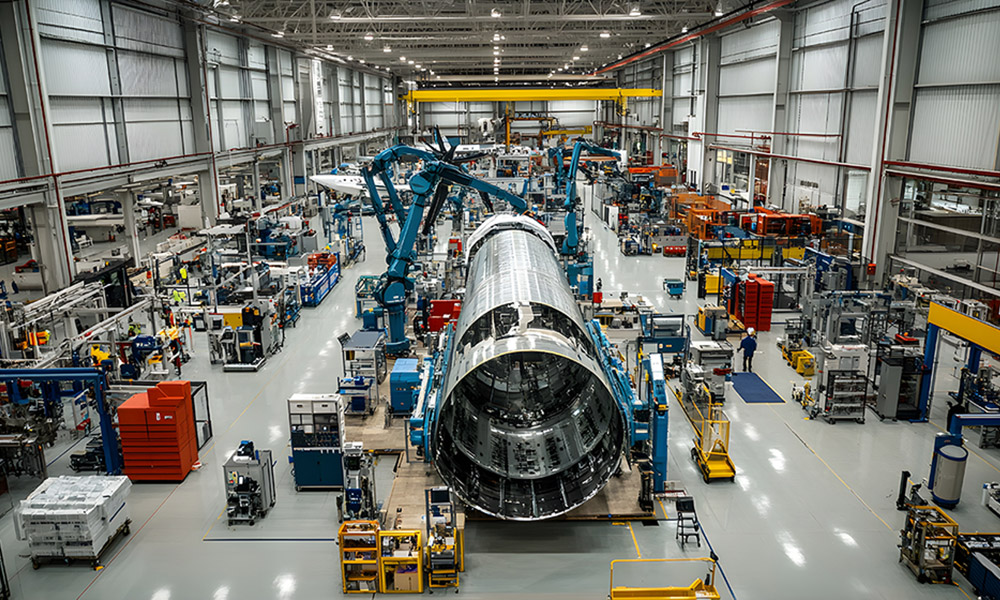
Infrastructure presents another significant constraint. Aerospace manufacturing requires specialized industrial facilities equipped with large assembly bays, secure testing environments, advanced machine tools and transportation access capable of handling oversized components. Expanding that infrastructure is both capital-intensive and time-consuming.
Defense production adds complexity because many facilities must comply with stringent security, access control, export control and quality assurance requirements. Constructing new facilities or expanding and modernizing existing ones can require extensive planning, site selection, design development, permitting, construction and equipment installation before meaningful production increases can be achieved.
A shrinking skilled workforce
Workforce infrastructure is equally important. Advanced manufacturing increasingly depends on highly skilled engineers, machinists, technicians, software developers and systems integrators. Many regions face shortages of qualified labor, while an aging workforce creates additional replacement risks.
Those pressures are already affecting production. Boeing and Airbus have reported difficulty maintaining production schedules because of shortages of skilled machinists, welders and engineers, with Boeing incurring an estimated $5 billion in losses tied to halted production. With 29% of the aerospace and defense workforce eligible to retire and industry attrition running near 15% annually, the sector faces a widening gap between rising production requirements and the skilled trades available to support them.
100 GW
Investments in apprenticeship programs, technical education and digital manufacturing technologies are therefore becoming essential components of industrial resilience.
Roads, bridges and ports under strain
Transportation infrastructure also plays a central role. Large aerospace components often require specialized rail, highway, air cargo or maritime transportation. Congestion at ports, limitations on oversized cargo routes or insufficient airport capacity can delay production schedules and increase costs.
The condition of existing transportation infrastructure can compound those problems. More than 43,000 U.S. bridges are classified as structurally deficient, and roughly one in five miles of highway is in poor condition. Heavy trucks carrying oversized aerospace components can be forced to reroute around load-restricted crossings. Although the $1.2 trillion Infrastructure Investment and Jobs Act is funding transportation improvements, those investments will take years to fully materialize, leaving manufacturers to continue planning around deferred maintenance and unpredictable freight corridors in the near term.
As supply chains become more geographically distributed, efficient transportation networks become increasingly important to maintaining predictable manufacturing timelines.
Supply chains with single points of failure
Logistics may represent the industry's most visible constraint. Aerospace supply chains span thousands of suppliers across multiple continents, with production dependent on the timely delivery of highly specialized components. A single aircraft may contain thousands of individual parts sourced from hundreds of manufacturers.
Global disruptions including the pandemic, semiconductor shortages, geopolitical conflicts and shipping delays demonstrated how vulnerable these complex supply networks can be. Even relatively small disruptions involving precision castings, specialty fasteners, electronic components or composite materials can halt production lines for months.
Defense programs face additional pressures because many critical components are sourced from a limited number of suppliers or rely on rare materials with geographically concentrated production. Titanium, rare earth elements, specialty alloys and advanced semiconductors all present potential supply risks.
Technological superiority depends not only on research and development but also on the physical systems that allow innovation to move from the laboratory to large-scale production.
Titanium illustrates how difficult those dependencies can be to unwind. Four years after Russia's 2022 invasion of Ukraine, Russian producer VSMPO-AVISMA still accounted for an estimated 25% to 30% of titanium used in Western aerospace manufacturing as of 2026, particularly in rocket structures, propellant tanks and turbopump housings. The continued exposure illustrates how diversification away from geographically concentrated or single-source materials can proceed much more slowly than an industry's initial response to a disruption might suggest.
Governments and manufacturers have responded by looking for ways to diversify traditional supply chains, increase domestic production capacity and maintain larger inventories of strategically important materials.
Energy, infrastructure and logistics are also deeply interconnected. Expanding manufacturing capacity requires sufficient electrical power, but it also depends on transportation infrastructure capable of delivering raw materials and finished products. Logistics networks, in turn, rely on reliable energy systems to power manufacturing facilities, warehouses, ports and transportation fleets. Failures or extended interruptions in any one area can affect the performance of the entire industrial ecosystem.
From efficiency to resilience
Looking ahead, resilience is likely to become as important as efficiency. For decades, global supply chains prioritized cost reduction and relied heavily on just-in-time production. While those approaches reduced operating costs, they often left manufacturers vulnerable to labor strikes, pandemics, natural disasters, semiconductor shortages, geopolitical conflicts and shipping delays.
43,000+
Today's strategic environment increasingly favors diversified suppliers, regional production capabilities, redundant logistics networks and investments in domestic industrial capacity.
Governments are also recognizing industrial resilience as an element of national security. Public investment in energy infrastructure, transportation networks, semiconductor manufacturing, workforce development and critical minerals processing is increasingly viewed as necessary to sustain long-term aerospace and defense competitiveness.
Through the CHIPS and Science Act and Defense Production Act Title III authorities, for example, the federal government has directed tens of billions of dollars toward domestic semiconductor and critical-materials capacity. The departments of Commerce and Defense also have agreed to coordinate investments in the semiconductor defense industrial base. These public-private mechanisms demonstrate how governments increasingly are treating industrial resilience, not simply battlefield capability, as a core component of national security.
Public-private partnerships are likely to play a growing role in financing these foundational capabilities.
Ultimately, technological superiority depends not only on research and development but also on the physical systems that allow innovation to move from the laboratory to large-scale production. Reliable energy supplies, modern industrial infrastructure and resilient logistics networks form the backbone of the aerospace and defense industrial base.
As global demand for advanced aerospace systems continues to grow, organizations that strengthen these foundational capabilities will be better positioned to respond to evolving security requirements, market opportunities and future disruptions.